Home › Van Gogh for Kids › Lesson plans and worksheets
For teachers
Van Gogh Lesson Plans and Printable Worksheets
Three ready-to-use art lessons about Vincent van Gogh for primary and lower secondary classes, with free printable worksheets, an answer key and links to colouring pages, a quiz and puzzles.
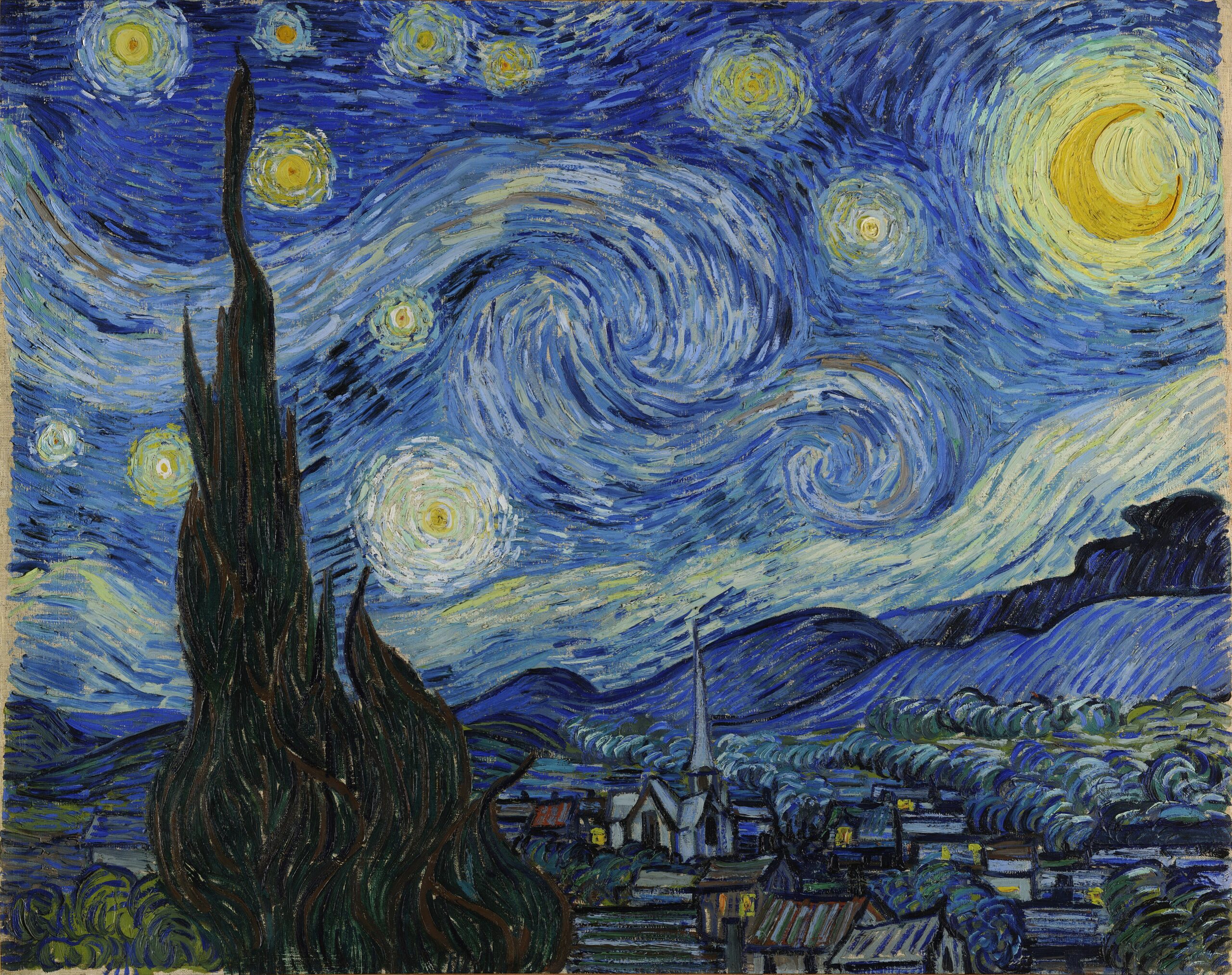
Lesson 1: Swirling skies (The Starry Night)
Age: 7–12 · Time: about 60 minutes
Learning goals: describe how brushstrokes can show movement; use short, curved strokes to create texture.
You will need: a large image of The Starry Night; oil pastels or thick poster paint in blues, yellows and white; dark blue paper; Worksheet 1.
Step 1. Show the painting for one minute in silence, then ask pupils to list everything they noticed. (5 min)
Step 2. Tell the story: Van Gogh painted it in 1889 at a hospital in Saint-Rémy, partly from his window and partly from memory. (5 min)
Step 3. Complete Worksheet 1 in pairs. (10 min)
Step 4. Demonstrate short, curving strokes and swirls. Pupils create their own night sky over their town or school, using only strokes, no blending. (30 min)
Step 5. Gallery walk: pupils explain how their sky “moves”. (10 min)
Questions to discuss: Is the sky calm or stormy? How does the painting make you feel? Why might Van Gogh have painted the stars so big?
Lesson 2: Colour that sings (complementary colours)
Age: 8–14 · Time: 45–60 minutes
Learning goals: identify complementary colours and explain how they affect each other; apply them in a still life.
You will need: a colour wheel; images of Café Terrace at Night, Irises and The Night Café; paint or coloured pencils; Worksheet 2; our colour palettes page.
Step 1. Introduce the colour wheel and the three complementary pairs. (10 min)
Step 2. Find the pairs in the three paintings; discuss how Van Gogh used red and green in The Night Café to create an uneasy mood. (10 min)
Step 3. Complete Worksheet 2. (10 min)
Step 4. Paint a simple object (a fruit, a flower or a cup) in one colour on a background of its complementary colour. (20 min)
Questions to discuss: Which pair is the most exciting? Can colours show feelings? What happens if you put two colours that are not complementary side by side?
Lesson 3: Van Gogh’s life and Sunflowers
Age: 6–11 · Time: 45–60 minutes
Learning goals: retell key events in Van Gogh’s life in order; observe and draw flowers at different stages.
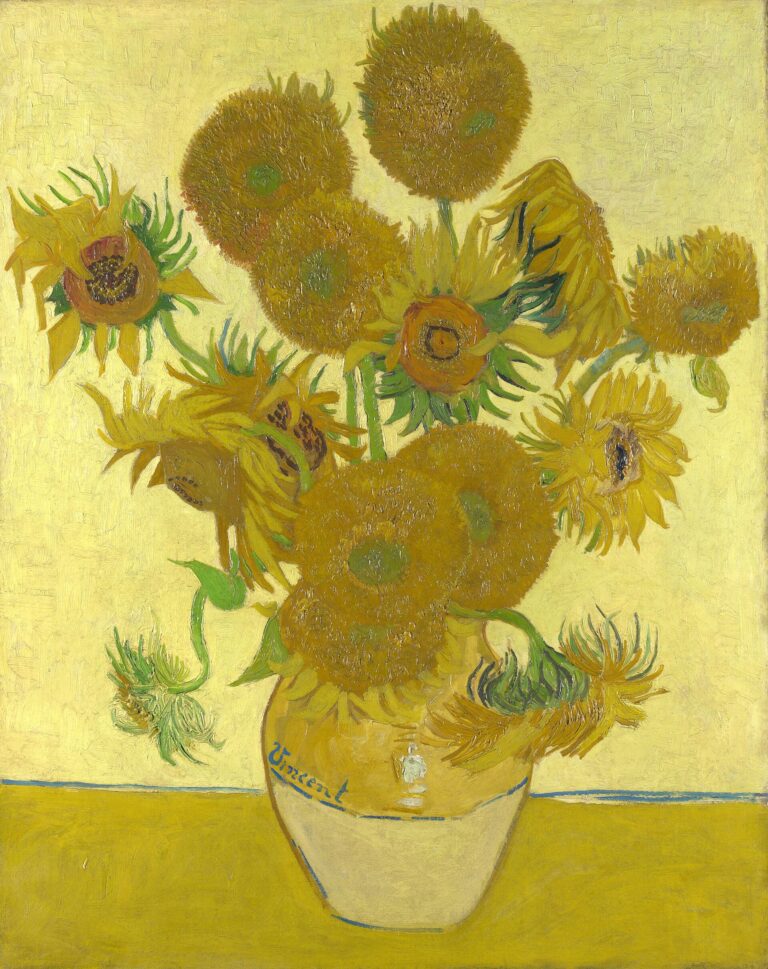
You will need: real or artificial sunflowers (or photos); Worksheets 3 and 4; the Van Gogh for kids page; our interactive timeline.
Step 1. Read the short life story on the Van Gogh for kids page together or explore the timeline. (10 min)
Step 2. Complete Worksheet 3 (life events in order) in pairs. (10 min)
Step 3. Look at Sunflowers: find a flower that is fresh, one that is drooping and one full of seeds. (5 min)
Step 4. Draw a vase of flowers on Worksheet 4, using only three or four colours. (25 min)
Questions to discuss: Why might Van Gogh have painted flowers that were dying as well as fresh ones? Why did he paint them to decorate a friend’s room?
Printable worksheets
Print each sheet with the button underneath it. They work well in black and white, but colour printing is best for Worksheets 1 and 4.
Look closely: The Starry Night

- How many stars can you count in the sky? ______
- What is the tall dark shape on the left? Circle one: a tree · a tower · a mountain
- Name three colours Van Gogh used in the sky.
- Does the sky look calm or moving? Which brushstrokes make you think so?
- Van Gogh painted this in 1889 from a hospital window. How do you think he was feeling? Why?
Complementary colours
Complementary colours sit opposite each other on the colour wheel. When they are side by side, they make each other look brighter. Van Gogh loved them!
| Colour | Its complementary colour | A Van Gogh painting that uses this pair |
|---|---|---|
| Blue | __________ | __________________________ |
| Yellow | __________ | __________________________ |
| Red | __________ | __________________________ |
Your turn: in the box, draw a simple flower in yellow on a purple background, using short strokes like Van Gogh.
Van Gogh’s life: put it in order
Number these events from 1 (first) to 8 (last).
| ___ | He paints The Starry Night at the asylum in Saint-Rémy. |
| ___ | He is born in Zundert, in the Netherlands. |
| ___ | He moves to Paris and starts using bright colours. |
| ___ | He paints The Potato Eaters in Nuenen. |
| ___ | He paints the Sunflowers in Arles. |
| ___ | He decides to become an artist, aged 27. |
| ___ | Paul Gauguin comes to stay in the Yellow House. |
| ___ | He moves to Auvers-sur-Oise and paints Wheatfield with Crows. |
Design your own Sunflowers
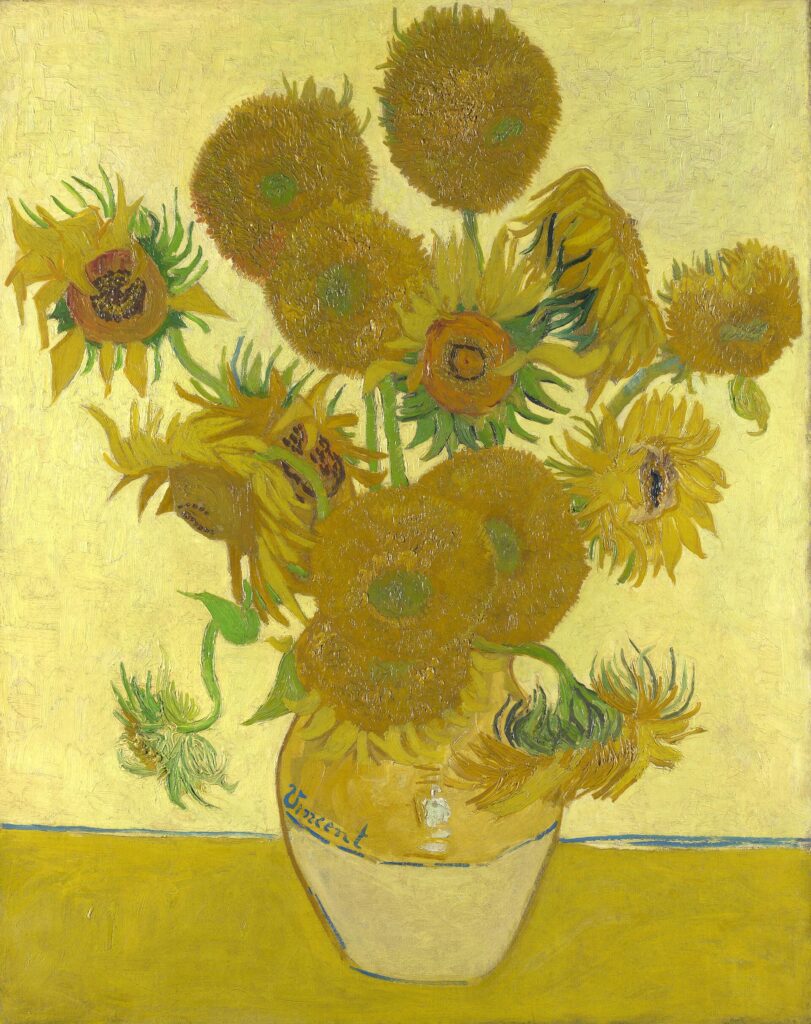
Van Gogh painted sunflowers at every stage: fresh, open, drooping and full of seeds. Draw your own vase of flowers below. Use only three or four colours, and make the background one bold colour.
Why did you choose these colours?
Answer key (for teachers)
Worksheet 1: 11 stars (plus the moon); the dark shape is a cypress tree; colours include blue, white, yellow and green; answers about mood will vary.
Worksheet 2: blue–orange (Café Terrace at Night, Starry Night Over the Rhône); yellow–purple/violet (Irises 1890, The Sower); red–green (The Night Café).
Worksheet 3: 1 born in Zundert (1853); 2 decides to become an artist (1880); 3 The Potato Eaters (1885); 4 Paris (1886); 5 Sunflowers (1888); 6 Gauguin arrives (1888); 7 The Starry Night (1889); 8 Auvers-sur-Oise (1890).
More free resources
Van Gogh colouring pages – 20 paintings, each in easy and detailed versions. Which Van Gogh painting are you? – a quick personality quiz. Jigsaw puzzles – online puzzles of famous paintings. Wallpapers – high-resolution images for the classroom screen. Van Gogh facts – answers to common questions, written for adults.
Paintings used in these lessons
 The Starry Night1889 · Museum of Modern Art
 Sunflowers1888 · National Gallery
 Café Terrace at Night1888 · Kröller-Müller Museum
 Almond Blossom1890 · Van Gogh Museum
Frequently asked questions
Are the worksheets free?
Yes. All worksheets on this page are free to print and use in classrooms and at home.
What age are these lessons for?
They are designed for ages 6 to 14 and can be simplified or extended.
Looking for more? Try the colouring pages or share the Van Gogh for kids page with your class.
Sources: the Van Gogh Museum.