Home › Van Gogh Facts › Biography
Biography · 1853–1890
Vincent van Gogh: A Biography
Vincent van Gogh painted for barely ten years, sold almost nothing and died at 37, yet he became one of the most loved artists who ever lived. This is the full story, from the parsonage in Zundert to the wheat fields of Auvers, told with his own letters and the latest research.
Childhood in Zundert (1853–1869)
Vincent Willem van Gogh was born on 30 March 1853 in Zundert, a village in the Catholic south of the Netherlands near the Belgian border. His father, Theodorus van Gogh, was the Protestant minister; his mother, Anna Cornelia Carbentus, came from a family of bookbinders in The Hague and liked to draw and paint watercolours. Exactly a year earlier she had given birth to a stillborn son, also named Vincent, whose grave Vincent passed on the way to church.
He was the eldest of six surviving children: Anna, Theo, Elisabeth (Lies), Willemien (Wil) and Cor. Theo, four years younger, would become the most important person in his life. Vincent was a serious, solitary child who loved walking in the fields and collecting insects and birds’ nests, habits that show up decades later in his paintings. He was sent to boarding schools in Zevenbergen and then Tilburg, where he had drawing lessons with the artist Constant Huysmans, but in March 1868, aged 15, he left school and went home. He never returned to formal education.
The art dealer (1869–1876)
The Van Gogh family had strong links to the art trade: three of Vincent’s uncles were dealers. In July 1869, aged 16, he joined the Hague branch of Goupil & Cie, an international firm selling paintings and reproductions, where his uncle Vincent (“Uncle Cent”) was a partner. He did well, learning about the Hague School painters and the French artists of Barbizon, especially Jean-François Millet, who would remain a hero.
In August 1872 he wrote his first surviving letter to Theo, beginning a correspondence that would last until his death. Theo also joined Goupil, in Brussels, in 1873. That year Vincent was transferred to London, where he lodged in Brixton, admired English illustrators and Dickens, and fell for his landlady’s daughter, who turned him down. His work suffered as he became more absorbed in religion. Moved to the Paris branch in 1875, he quarrelled with customers about their taste, and in April 1876 he was dismissed.
Teacher, bookseller and preacher (1876–1880)
For the next four years Van Gogh tried to find a vocation in religion. He taught at small boarding schools in Ramsgate and Isleworth in England and preached his first sermon in a Methodist church near Richmond. In 1877 he worked briefly in a bookshop in Dordrecht, then moved to Amsterdam to prepare for university entrance to study theology, staying with his uncle Jan, a naval commander, and taking lessons in Latin and Greek. After a year he gave up.
He trained briefly as an evangelist in Brussels and in late 1878 went to the Borinage, a poor coal-mining region in southern Belgium. He lived as the miners did, gave away his clothes and slept on straw, and the church authorities, who thought his zeal undignified, did not renew his appointment. In 1879–80 he went through a long crisis, cut off even from Theo. When he wrote again, in the summer of 1880, he had made up his mind: he would become an artist and serve humanity through art. Theo, by then working for Goupil in Paris, began sending him money, which he would do for the rest of Vincent’s life.
Learning to draw: Brussels, Etten and The Hague (1880–1883)
Van Gogh was 27 and almost entirely self-taught. In Brussels in the winter of 1880–81 he copied drawing manuals and anatomy books and became friends with the young painter Anthon van Rappard. In 1881 he moved back in with his parents, now in Etten, drawing peasants and landscapes. There he fell in love with his widowed cousin Kee Vos-Stricker, who rejected him firmly; the episode ended in a bitter row with his father, and at Christmas he left for The Hague.
In The Hague he took lessons from his cousin-by-marriage Anton Mauve, a leading painter of the Hague School, who introduced him to watercolour and oil. In 1882 he began living with Sien Hoornik, a pregnant former prostitute, and her young daughter. His family was appalled and Mauve broke with him, but Sien and her children became his models and his household. He drew constantly, made lithographs such as Sorrow, and in August 1882 painted his first serious oils, of the dunes and the beach at Scheveningen. By September 1883 money and family pressure had worn him down; he left Sien and spent three lonely months painting peat bogs and cottages in Drenthe in the north-east.
Nuenen and The Potato Eaters (1883–1885)
In December 1883 Van Gogh joined his parents in Nuenen, in Brabant, where his father was now minister. Relations were strained, but he was given a room for a studio and stayed nearly two years, his most productive Dutch period: almost two hundred paintings of weavers at their looms, peasants at work, cottages, the old church tower and still lifes of pots and vegetables. He wanted to be a painter of peasant life like Millet, and painted dozens of studies of heads and hands.
In 1884 a neighbour, Margot Begemann, fell in love with him; both families opposed a marriage, and the affair ended unhappily. In March 1885 his father died suddenly. That spring Van Gogh painted his first major composition, The Potato Eaters, showing a family eating by lamplight. He wanted the viewer to feel that these people had dug the earth with the same hands they put in the dish. Van Rappard criticised it harshly and their friendship ended. In November 1885, after the local priest discouraged villagers from posing for him, he left for good.
Antwerp (1885–1886)
Van Gogh spent three months in Antwerp. He visited the museums, was overwhelmed by the colour of Rubens, bought Japanese woodblock prints in the docks and briefly enrolled at the Academy, where his teachers disliked his rough drawing. He ate badly, smoked heavily and his health suffered. At the end of February 1886, without much warning, he took the train to Paris.
Paris: colour and the avant-garde (1886–1888)
Van Gogh arrived in Paris in March 1886 and moved in with Theo, first in rue Laval and then at 54 rue Lepic in Montmartre. Theo managed a branch of Goupil (now Boussod, Valadon & Cie) and knew the new painting at first hand. Vincent studied for a few months at Fernand Cormon’s studio, where he met Henri de Toulouse-Lautrec and Émile Bernard, and soon came to know Camille Pissarro, Paul Signac, Paul Gauguin and the colour merchant Père Tanguy, whose portrait he painted against a wall of Japanese prints.
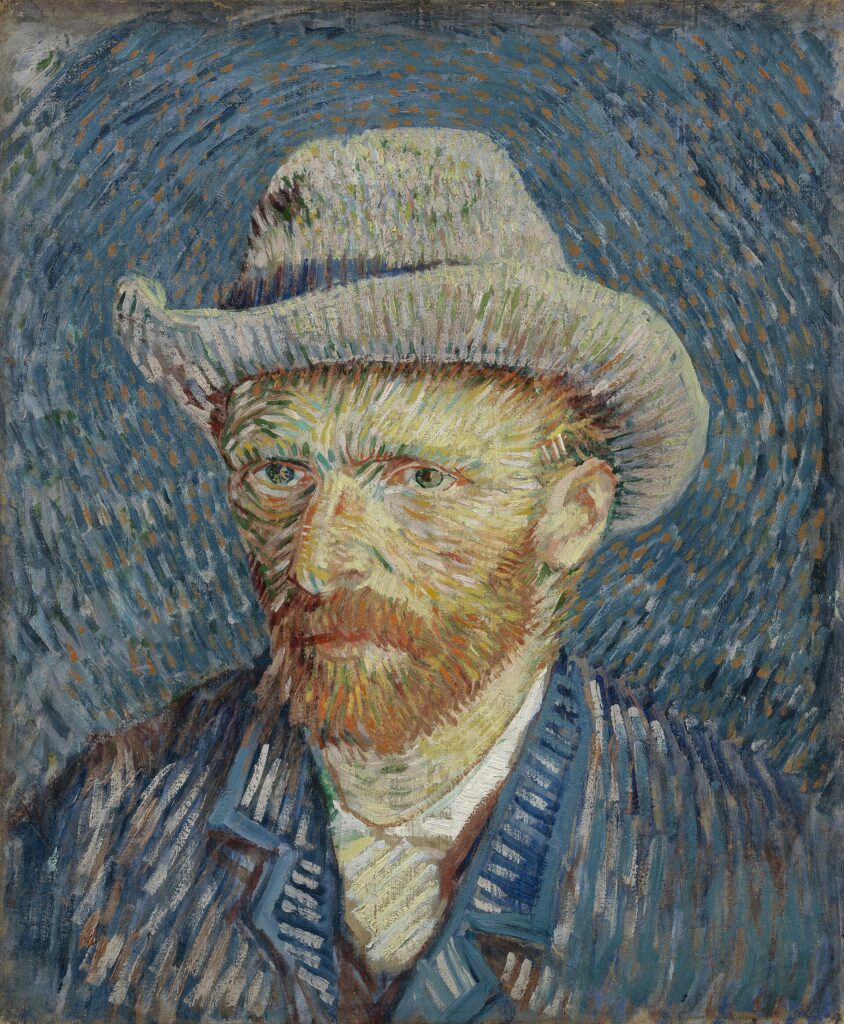
Paris transformed his art. He saw Impressionist and Neo-Impressionist paintings, worked with Signac along the Seine at Asnières, and painted flowers to study colour. His palette went from earth tones to pure, bright colour applied in short strokes. Lacking money for models, he painted himself more than twenty times. He collected hundreds of Japanese prints, copying several, and in 1887 organised small exhibitions at the Café du Tambourin and in a restaurant on the avenue de Clichy, showing work by himself and his friends. Living with Vincent was not easy, and Theo confided to their sister that it was almost unbearable at times. By early 1888, exhausted by city life, Van Gogh decided to go south in search of light and colour.
Arles: the Studio of the South (1888–1889)
Van Gogh arrived in Arles on 20 February 1888 to find snow on the ground. When the fruit trees came into blossom he painted them almost non-stop, then the Langlois Bridge, the boats at Saintes-Maries-de-la-Mer and the wheat harvest. In May he rented four rooms in the Yellow House on Place Lamartine, dreaming of a “Studio of the South” where artists could live and work together.
Over fifteen months he made about two hundred paintings, among them the Sunflowers, Café Terrace at Night, The Night Café, Starry Night over the Rhône, The Bedroom and portraits of the postman Joseph Roulin and his family. Theo paid for Paul Gauguin to join him, and Gauguin arrived on 23 October. For nine weeks they painted side by side, but they argued about art and temperament. On 23 December 1888, after a quarrel, Van Gogh had a severe mental crisis and cut off his left ear, or most of it, and took it to a woman at a nearby brothel. Gauguin left for Paris.
Van Gogh was treated by the young doctor Félix Rey and recovered within weeks, but further attacks followed. In early 1889 a group of neighbours petitioned for him to be confined, and the police closed the Yellow House. Aware that he could not live alone, he decided to enter an asylum voluntarily.
The asylum at Saint-Rémy (1889–1890)
On 8 May 1889 Van Gogh admitted himself to the asylum of Saint-Paul-de-Mausole, a former monastery outside Saint-Rémy-de-Provence, run by Dr Théophile Peyron. He was given a second room as a studio and, when well, allowed out with an attendant. His illness came in sudden attacks, in July and December 1889 and in early 1890, during which he could not work and was sometimes confused; doctors then diagnosed epilepsy, and historians still debate the cause (see Van Gogh’s mental illness).
Between attacks he painted with astonishing energy: Irises in his first week, the walled wheat field below his window, olive groves, cypresses and, in June 1889, The Starry Night. When confined indoors he copied prints after Millet and Delacroix in his own colours. Recognition began to arrive. In January 1890 the critic Albert Aurier published the first serious article on him, six of his paintings were shown with the avant-garde group Les XX in Brussels, and The Red Vineyard was sold there to the painter Anna Boch for 400 francs. When Theo and Jo’s son, named Vincent Willem after him, was born on 31 January 1890, he painted Almond Blossom as a gift for the baby’s bedroom.
Auvers-sur-Oise: the last ten weeks (1890)
Van Gogh left the asylum on 16 May 1890, spent three days with Theo, Jo and the baby in Paris and on 20 May arrived in Auvers-sur-Oise, a village north of the city where the doctor and amateur painter Paul Gachet had agreed to keep an eye on him. He rented a room at the Auberge Ravoux and worked at a furious pace, producing around seventy paintings in ten weeks, roughly one a day: thatched cottages, gardens, the church, Dr Gachet, his daughter Marguerite, and long panoramic canvases of the wheat fields, including Wheatfield with Crows.
In early July he visited Theo in Paris and found the family under strain: the baby was ill, and Theo was worried about money and his job. Back in Auvers he wrote of sadness and extreme loneliness, though also of the health and strength he found in the countryside. On the evening of 27 July 1890 he returned to the inn wounded by a gunshot to the chest. Theo hurried from Paris, and Vincent died in his room in the early hours of 29 July, aged 37. He was buried in the village cemetery the next day. Most historians accept that he shot himself; a 2011 biography argued that he may have been shot accidentally by local youths, a theory the Van Gogh Museum does not support. Read more in How did Van Gogh die?
Theo, Jo and how Van Gogh became famous
Theo never recovered from his brother’s death. His health collapsed, and he died in a clinic in Utrecht on 25 January 1891, six months after Vincent. His widow, Jo van Gogh-Bonger, was left with a baby and hundreds of paintings and drawings. Instead of selling them off, she set out to make Vincent known: she lent and sold works carefully to build his reputation, organised exhibitions, including a large retrospective at the Stedelijk Museum in Amsterdam in 1905, and edited and translated the letters, published in 1914. That year she had Theo reburied beside Vincent in Auvers.
Collectors followed. The Dutch collector Helene Kröller-Müller began buying his work in 1908 and built the collection now in the Kröller-Müller Museum. Jo’s son Vincent Willem van Gogh placed the family collection in a foundation, and the Van Gogh Museum opened in Amsterdam in 1973. Today his paintings are among the most valuable in the world: in November 2026 Blossoming Chestnut Trees sold for $190.4 million (see our auction results).
His art in numbers
In about ten years Van Gogh made roughly 860 oil paintings and more than 1,300 watercolours, drawings and sketches; see how many paintings he made. More than 800 of his letters survive, about 650 of them to Theo. They are one of the richest records any artist has left, and the main source for his life. Browse every painting in our painting explorer, or follow his life on the interactive timeline and map.
Faith and art
Religion shaped Van Gogh’s first adult decade. As a young man in London and Paris he read the Bible obsessively, copied out hymns and wanted to become a minister like his father. His failure as a preacher in the Borinage was a turning point, and he grew bitter about the official church. But the urge to comfort and to serve never left him; it moved into his art. He wrote that he wanted to paint men and women with “something of the eternal” that the halo used to symbolise, and that he tried to express it through colour. Sowers, reapers, the sun and the stars recur in his work as quiet symbols of life, death and renewal, and in Saint-Rémy he painted his own versions of Delacroix’s Pietà and Rembrandt’s Raising of Lazarus.
How his style developed
Van Gogh’s style changed faster than almost any other painter’s. In The Hague and Nuenen he worked in browns, greys and greens, inspired by Millet and the Hague School, and believed that drawing was the backbone of painting. In Paris he lightened his palette, tried Impressionist and pointillist brushwork and learned from Japanese prints to use flat areas of colour, bold outlines and unusual viewpoints. In Arles he combined all of this into the style we recognise: pure yellows and blues, complementary colours set against each other, and thick paint applied in rhythmic, directional strokes. At Saint-Rémy his brushwork became more swirling and his colour sometimes more subdued, and in Auvers he moved to wide, horizontal canvases painted with great speed. Read more in Van Gogh’s painting technique.
He was not an untrained naïve, as legend sometimes suggests. He read widely about colour theory, especially Charles Blanc’s writing on Delacroix, studied the old masters in museums, copied prints relentlessly and planned many of his paintings carefully, sometimes making several versions. What looks spontaneous was often the result of long practice.
The people in his life
- Theo van Gogh (1857–1891), his brother: art dealer, financial support, confidant and the recipient of most of his letters.
- Jo van Gogh-Bonger (1862–1925), Theo’s wife: after both brothers died she built Vincent’s reputation and published his letters.
- Anton Mauve (1838–1888), Hague School painter and cousin by marriage, his first real teacher.
- Paul Gauguin (1848–1903), the painter who shared the Yellow House for nine weeks in 1888.
- Émile Bernard (1868–1941), young painter friend from Paris and an important correspondent.
- Joseph Roulin and his family, his closest friends in Arles and the subjects of more than twenty portraits.
- Dr Félix Rey, who treated him after the ear incident, and Dr Paul Gachet, who looked after him in Auvers.
- Willemien (Wil) van Gogh (1862–1941), his youngest sister, to whom he wrote some of his most thoughtful letters about art.
Influence on modern art
Within twenty years of his death Van Gogh had become a hero of the avant-garde. Exhibitions in Paris in 1901 and 1905 inspired Henri Matisse, André Derain and Maurice de Vlaminck, the Fauves, whose wild colour owed much to him. In Germany, where dealers and museums bought his work early, the Expressionists of Die Brücke and Der Blaue Reiter saw him as a model of art driven by feeling. His life, retold in Irving Stone’s 1934 novel Lust for Life and the 1956 film with Kirk Douglas, made him the archetype of the misunderstood genius. Today his paintings draw millions of visitors a year, and immersive shows, films and merchandise have made his images some of the most reproduced in the world.
Myths and facts
- “He sold only one painting.” Only one sale of a painting, The Red Vineyard, is firmly documented, but he also sold or exchanged some drawings and small works, and Theo traded some of his pictures. See did Van Gogh sell any paintings?
- “He cut off his whole ear.” A doctor’s drawing found in 2016 shows he cut off all or nearly all of his left ear, not just the lobe, as was long believed.
- “He painted in a frenzy, without thinking.” He worked fast, but his letters show careful planning, colour theory and constant revision.
- “He was mad.” He had a serious, recurring illness, but between attacks he was lucid, wrote brilliant letters and painted deliberately. The exact diagnosis is still debated; see his mental illness.
- “The Starry Night was his favourite.” He was in fact critical of it, calling it a failure of abstraction in a letter to Bernard. It became famous only long after his death.
The letters
Van Gogh was one of the great letter writers. More than 800 of his letters survive, written in Dutch, French and English, and many include sketches of the paintings he was working on. They describe what he saw, what he read, how he mixed his colours and why, his money worries, his loneliness and his hopes for a community of artists. Most were sent to Theo, who kept nearly all of them; Vincent kept far fewer of Theo’s replies. Jo van Gogh-Bonger published them in 1914, and the letters did as much as the paintings to create his fame. Today the complete, annotated edition is freely available online from the Van Gogh Museum and the Huygens Institute at vangoghletters.org. Explore highlights in our Van Gogh letters guide and his best lines on our Van Gogh quotes page.
Following in his footsteps
Almost every place in Van Gogh’s life can still be visited. In Zundert a Van Gogh House stands on the site of the parsonage where he was born, and in Nuenen the Vincentre tells the story of his Brabant years beside the church and the old vicarage. In Paris you can walk up rue Lepic in Montmartre, past the house where he lived with Theo. In Arles the Yellow House was destroyed in 1944, but the café of Café Terrace at Night, the hospital garden and the Langlois Bridge (rebuilt nearby) remain. The asylum of Saint-Paul-de-Mausole in Saint-Rémy still treats patients and opens part of the building, including a reconstruction of his room, to visitors. In Auvers you can climb to his tiny room at the Auberge Ravoux and visit the graves of Vincent and Theo side by side in the village cemetery.
Plan a trip with our travel guides to the Netherlands, Arles, Saint-Rémy and Auvers-sur-Oise, and find his paintings with our museum map.
Timeline
| Year | Event |
|---|---|
| 1853 | Born 30 March in Zundert, North Brabant, the Netherlands |
| 1869 | Joins the art dealers Goupil & Cie in The Hague, aged 16 |
| 1872 | First surviving letter to his brother Theo |
| 1873–76 | Works for Goupil in London and Paris; dismissed in April 1876 |
| 1876–80 | Teacher in England, bookshop clerk in Dordrecht, theology student in Amsterdam, lay preacher in the Borinage |
| 1880 | Decides to become an artist; Theo begins supporting him |
| 1881–83 | Learns to draw and paint in Etten and The Hague; lessons with Anton Mauve |
| 1883–85 | Nuenen: almost 200 paintings, ending with The Potato Eaters (1885) |
| 1885–86 | Antwerp: studies at the Academy, discovers Rubens and Japanese prints |
| 1886–88 | Paris with Theo: Impressionism, Japanese prints, bright colour, many self-portraits |
| 1888 | Arles: orchards, Sunflowers, the Yellow House; Gauguin’s visit; 23 December crisis and ear injury |
| 1889 | Enters the asylum at Saint-Rémy (8 May); paints The Starry Night (June) |
| 1890 | Red Vineyard sold in Brussels; moves to Auvers-sur-Oise (20 May); dies 29 July, aged 37 |
| 1891 | Theo dies on 25 January in Utrecht |
| 1914 | Jo van Gogh-Bonger publishes the letters; Theo is reburied beside Vincent in Auvers |
| 1973 | The Van Gogh Museum opens in Amsterdam |
Frequently asked questions
When was Vincent van Gogh born and when did he die?
He was born on 30 March 1853 in Zundert, the Netherlands, and died on 29 July 1890 in Auvers-sur-Oise, France, aged 37.
How long did Van Gogh paint for?
About ten years. He decided to become an artist in 1880 and made almost all of his best-known work between 1886 and 1890.
Did Van Gogh sell any paintings in his lifetime?
Only one sale of a painting is firmly documented: The Red Vineyard, bought by Anna Boch in Brussels in 1890 for 400 francs.
Who was Theo van Gogh?
Vincent’s younger brother, an art dealer in Paris, who supported him financially and emotionally from 1880 until his death. Their letters are the main source for Vincent’s life.
Why did Van Gogh cut off his ear?
He cut off most of his left ear on 23 December 1888 during a severe mental crisis in Arles, after a quarrel with Paul Gauguin.
How did Van Gogh become famous?
Largely through his sister-in-law Jo van Gogh-Bonger, who exhibited his work, placed it with collectors and published his letters in 1914.
Sources: Van Gogh’s letters (vangoghletters.org, Van Gogh Museum and Huygens Institute); Van Gogh Museum biography and collection; Jan Hulsker, Vincent and Theo van Gogh: A Dual Biography; Steven Naifeh and Gregory White Smith, Van Gogh: The Life (2011); Martin Bailey, Studio of the South and Starry Night (Frances Lincoln); Bernadette Murphy, Van Gogh’s Ear (2016).