Home › Paintings › Auvers-sur-Oise › Portrait of Dr Gachet
Auvers-sur-Oise · June 1890
Portrait of Dr Gachet (1890) by Vincent van Gogh
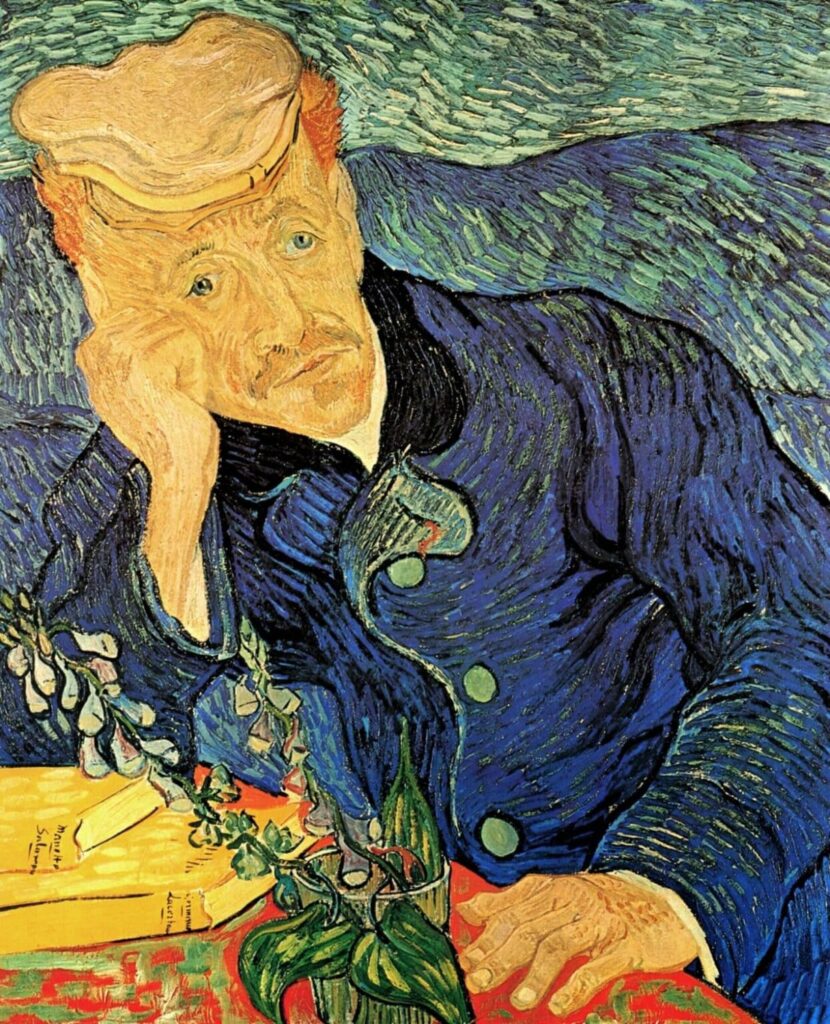
Van Gogh painted the doctor who looked after him in Auvers-sur-Oise twice in June 1890, a few weeks before his death. The first version became the most expensive painting in the world in 1990, and its whereabouts have been a mystery ever since.
Key facts
| Date | June 1890 |
|---|---|
| Place | Auvers-sur-Oise, France |
| Medium | Oil on canvas |
| Versions | Two: the first (sold 1990, private collection) and a second in the Musée d’Orsay, Paris |
| Auction | Christie’s New York, 15 May 1990: $82.5 million |
Who was Dr Gachet?
Paul-Ferdinand Gachet was a doctor, amateur painter and collector who lived in Auvers-sur-Oise, north of Paris. He had known Pissarro and Cézanne, and Theo arranged for him to keep an eye on Vincent when he left the asylum at Saint-Rémy in May 1890. The two men became friends. Van Gogh also painted Gachet’s daughter in Marguerite Gachet in the Garden.
In letters to Theo and to his sister Wil, Van Gogh described the portrait as showing the sad expression of their time, and said Gachet seemed as ill and troubled as he was himself. The doctor leans on a red table, his head on his hand, beside yellow books and a sprig of foxglove, a plant used in heart medicine.
Two versions
Van Gogh painted the first version in early June 1890 and soon made a second. The first, with two novels on the table and brighter colour, is the one that went to auction. The second, simpler version stayed with the Gachet family and was given to the French state in 1949. It now hangs in the Musée d’Orsay. A few critics once questioned the second version, but it is generally accepted as Van Gogh’s.
From Frankfurt to the 1990 sale
The first version was bought by the Städel Museum in Frankfurt in 1911. In 1937 the Nazi regime removed it as “degenerate art”, and it was sold abroad through Hermann Göring’s agents. The banker Siegfried Kramarsky acquired it and took it to New York, where it was often on loan to the Metropolitan Museum of Art.
Kramarsky’s heirs sent it to Christie’s in 1990. On 15 May it sold for $82.5 million to Ryoei Saito, a Japanese paper-company owner, who two days later also bought Renoir’s Bal du moulin de la Galette. Both prices were world records. Saito ran into financial trouble and died in 1996. The Van Gogh was later sold privately, and its current owner has not been publicly confirmed.
How it compares
The 1990 price stood as the Van Gogh record until Orchard with Cypresses made $117.2 million in 2022, and in November 2026 Blossoming Chestnut Trees reached $190.4 million. Adjusted for inflation, though, the Gachet sale is still the highest price ever paid for a Van Gogh. See all the figures in our ten most expensive Van Goghs.
See the whole series: Van Gogh’s portraits
Frequently asked questions
How much did the Portrait of Dr Gachet sell for?
$82.5 million at Christie’s New York on 15 May 1990, a world record for any painting at the time.
Who owns the Portrait of Dr Gachet now?
The first version is in a private collection whose owner has not been publicly confirmed. The second version is in the Musée d’Orsay in Paris.
Who was Dr Gachet?
Paul-Ferdinand Gachet, a doctor in Auvers-sur-Oise who treated Van Gogh in the last months of his life in 1890.
Why is there a foxglove in the painting?
Foxglove (digitalis) was used to treat heart conditions, so it marks Gachet as a doctor.
See every recorded sale in our Van Gogh auction results database, or read how much a Van Gogh is worth.
Sources: The Art Newspaper, “The ten most expensive Van Gogh paintings” (July 2026) and Martin Bailey’s reports on the first version’s whereabouts (2024); Musée d’Orsay collection record; Van Gogh’s letters (vangoghletters.org).