Home › Paintings › Arles › Starry Night Over the Rhône
Arles · 1888
Starry Night Over the Rhône
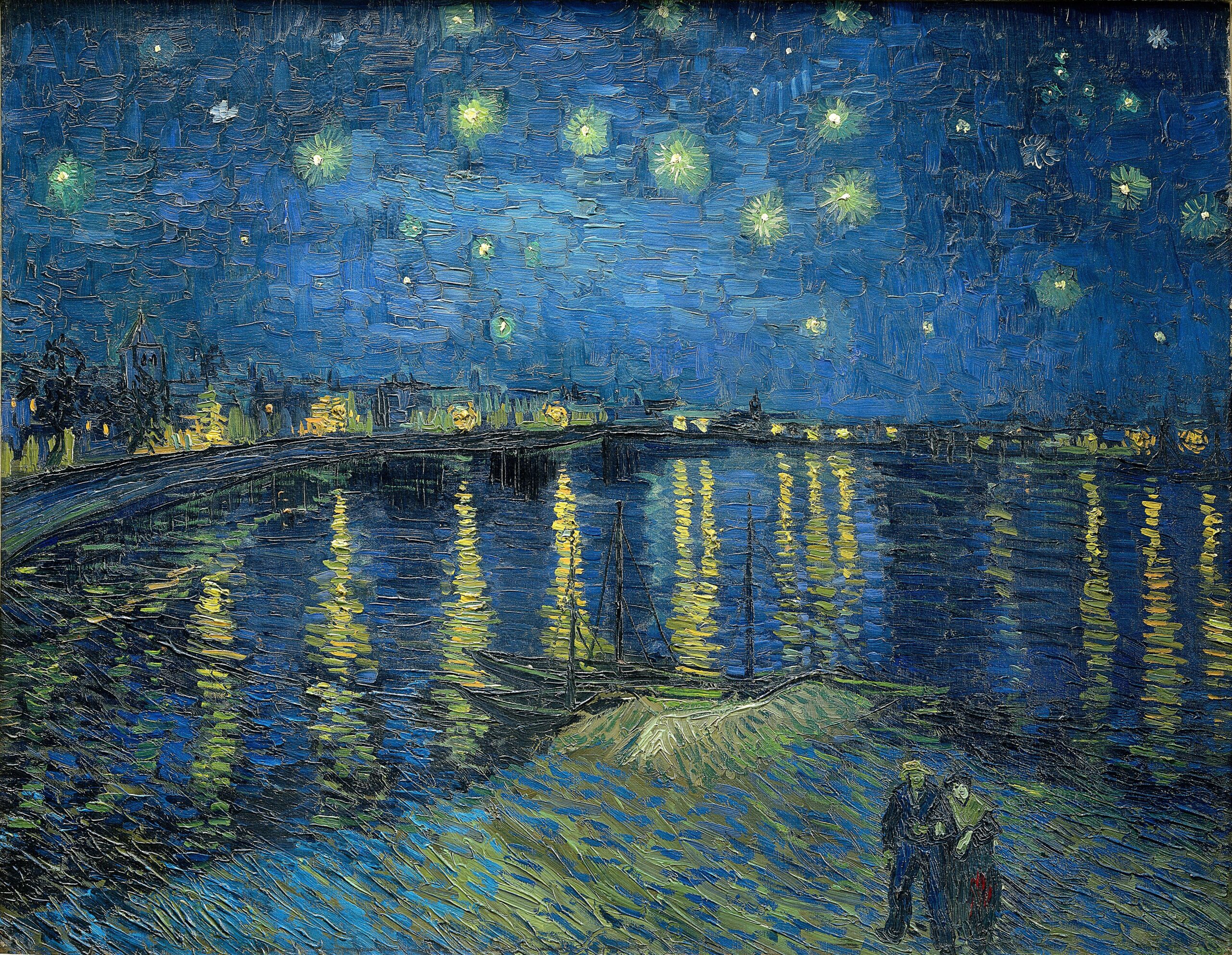
Gaslights shimmer across the dark water of the Rhône while the Great Bear glitters overhead: Van Gogh painted Starry Night Over the Rhône on the riverbank in Arles in September 1888, nine months before The Starry Night.
- Artist
- Vincent van Gogh
- Date
- September 1888
- Painted in
- Arles, France
- Medium
- Oil on canvas
- Size
- 72.5 × 92 cm
- Museum
- Musée d’Orsay, Paris
- Catalogue
- F474 · JH1592
What the painting shows
The river runs across the canvas under a deep blue night sky. On the far bank the gas lamps of Arles glow orange, and their reflections fall in long, broken streaks across the water. Above, the stars of the Plough – part of the Great Bear constellation – shine in green-white and gold. In the foreground, a couple walk arm in arm along the bank, and two boats are moored at the water’s edge.
The palette is limited to blues, greens and yellows, and it is the contrast between the cool night and the warm artificial light that gives the picture its magic.
Painting the night outdoors
Van Gogh had been eager to paint a starry sky since the spring. A few days after finishing the Café Terrace at Night, he set up his easel by the Rhône, a short walk from the Yellow House, and painted the river after dark. He described the picture in a letter to Theo, with a small sketch, listing the colours of the sky, the water and the lights.
The scene was observed rather than invented, although, as always, Van Gogh arranged and heightened what he saw to suit the picture.
Starry Night Over the Rhône and The Starry Night
People often confuse this painting with The Starry Night. The Rhône picture is calm and observed from life; the later painting, made at Saint-Rémy in June 1889, is a swirling, imagined view over a village, painted from memory in the studio.
The story behind Starry Night over the Rhône
In late September 1888, a few days after painting the Café Terrace at Night, Van Gogh went down to the bank of the Rhône, a short walk from the Yellow House, to paint the river at night. He worked outdoors by the light of the gas lamps along the quay. He described the picture to Theo: the starry sky painted at night under a gas lamp, the sky aquamarine, the water royal blue, the ground mauve, the town blue and violet, the gaslight yellow with reflections of red-gold descending to bronze-green, and two coloured figures of lovers in the foreground.
He had wanted to paint a starry sky for months. Earlier that year he had written that he needed a starry night with cypresses or perhaps above a field of ripe wheat. This canvas was his first real attempt, and it is calmer and more naturalistic than the famous Saint-Rémy picture of the following June.
The stars and the lights
Look closely and the bright stars in the upper part of the sky form the Plough, or Big Dipper, the constellation he would have seen to the north-west over the river. Below them the lights of Arles shine along the far bank, their reflections stretching across the water in long streaks of yellow and orange. The contrast between the cool, natural light of the stars and the warm, artificial light of the town was exactly what interested him: modern gaslight, painted on the spot.
Things you might not know
- It was exhibited in his lifetime. Theo sent it to the Salon des Indépendants in Paris in 1889, together with Irises.
- The constellation is real. The group of seven bright stars is the Plough.
- The lovers are tiny. The couple in the foreground are painted with a few quick strokes but give the scene its romantic mood.
- It went to Paris in 1975. It entered the French national collections and is now in the Musée d’Orsay.
Where to see it
Starry Night Over the Rhône belongs to the Musée d’Orsay in Paris and is one of the stars of its Post-Impressionist galleries. It was shown at the Salon des Indépendants in 1889, one of the few times his work was exhibited in his lifetime.
Related paintings
 The Starry Night1889 · Museum of Modern Art
 Café Terrace at Night1888 · Kröller-Müller Museum
 Bedroom in Arles1888 · Van Gogh Museum
 Wheatfield with Crows1890 · Van Gogh Museum
Frequently asked questions
Where is Starry Night Over the Rhône by Van Gogh?
It is in the collection of the Musée d’Orsay, Paris.
When did Van Gogh paint Starry Night Over the Rhône?
In September 1888, in Arles, France.
How big is Starry Night Over the Rhône?
The painting measures 72.5 × 92 cm. It is oil on canvas, catalogued as F474 and JH1592.
What is the difference between Starry Night Over the Rhône and The Starry Night?
Starry Night Over the Rhône (1888, Musée d’Orsay) is a calm night view of the river at Arles painted outdoors. The Starry Night (1889, Museum of Modern Art) is a swirling, partly imaginary view over a village, painted at the asylum in Saint-Rémy.
Which stars are in Starry Night Over the Rhône?
The bright group of stars in the sky is the Plough (Big Dipper), part of the constellation Ursa Major, the Great Bear.
See every painting from his Arles period in the Arles collection, follow his travels on the interactive timeline, or download masterpieces as free wallpapers.
Image: Musée d’Orsay, Paris (public domain), via Wikimedia Commons. Facts checked against the holding museum’s catalogue and the standard Van Gogh catalogues (de la Faille and Hulsker).
What is the difference between Starry Night over the Rhône and The Starry Night?
Starry Night over the Rhône (September 1888, Musée d’Orsay) was painted outdoors in Arles and shows the real river and town at night. The Starry Night (June 1889, MoMA) was painted at the Saint-Rémy asylum, partly from imagination, with swirling stars and a cypress.
Which stars are in Starry Night over the Rhône?
The seven bright stars above the river form the Plough (Big Dipper).


