Home › Paintings › Auvers-sur-Oise › Wheatfield with Crows
Auvers-sur-Oise · 1890
Wheatfield with Crows
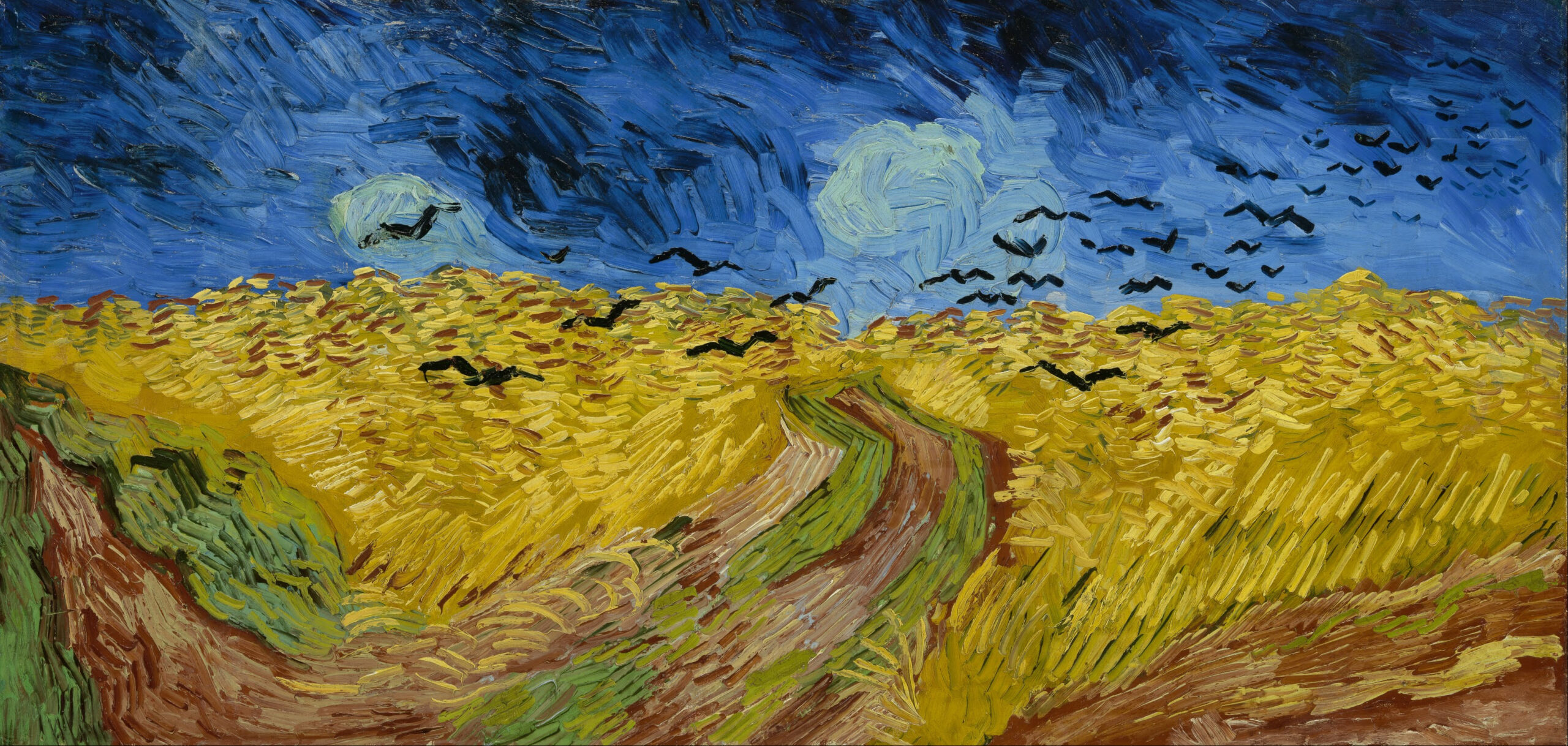
Crows rise over a stormy wheatfield split by three paths that lead nowhere: Wheatfield with Crows, painted in July 1890, is often called Van Gogh’s last painting – though it almost certainly was not.
- Artist
- Vincent van Gogh
- Date
- July 1890
- Painted in
- Auvers-sur-Oise, France
- Medium
- Oil on canvas
- Size
- 50.2 × 103 cm
- Museum
- Van Gogh Museum, Amsterdam
- Catalogue
- F779 · JH2117
What the painting shows
A field of ripe wheat, painted in thick, agitated strokes of yellow and ochre, fills the lower half of a very wide canvas. Three paths cut through it: a red-brown track in the centre and two green ones to the sides, all ending abruptly. Above, a dark blue sky, almost black at the top, is broken by two pale clouds, and a flock of black crows flies low over the field.
The extreme horizontal format, the clashing colours and the violent brushwork give the picture a powerful, unsettled mood.
Was it his last painting?
For decades the painting was presented as Van Gogh’s final work, a farewell painted just before he shot himself on 27 July 1890. The story was popularised by the 1956 film Lust for Life. Research by the Van Gogh Museum shows that it was painted around 10 July, about two weeks earlier, and that several other canvases followed it. The museum now considers Tree Roots the most likely candidate for his last painting.
In a letter written around this time, he described painting vast wheatfields under troubled skies, expressing sadness and extreme loneliness, but also the health and strength he found in the countryside. The painting holds both feelings.
The story behind Wheatfield with Crows
In July 1890, in the last weeks of his life, Van Gogh painted a series of long, double-square canvases of the wheat fields on the plateau above Auvers-sur-Oise. Around 10 July, after an unsettling visit to Theo’s family in Paris, he wrote that he had painted three more large canvases of vast stretches of wheat under troubled skies, and that he had not needed to go out of his way to express sadness and extreme loneliness. In the same letter he said he hoped Theo would soon see them, because he believed they would tell him what he could not say in words: the health and restorative power he found in the countryside.
That double meaning, sadness and solace, is at the heart of the painting. A churning dark blue sky presses down on a field of yellow-orange wheat, three paths of red and green lead nowhere, and a flock of black crows wheels over the field.
Composition and technique
The painting uses the wide double-square format (about 50 by 103 centimetres) that Van Gogh adopted in Auvers for his panoramic landscapes. He painted it quickly, with thick, broken strokes: short dabs for the crows, sweeping horizontal strokes for the sky, and nervous upright strokes for the wheat. The complementary contrasts of blue and orange, red and green give the picture its tension. The three paths, one leading left, one right and one ending in the middle of the field, have prompted many interpretations, but they also show the real farm tracks across the fields above the village.
Things you might not know about Wheatfield with Crows
- It is not his last painting, despite the legend.
- The field is still there. The wheat fields above Auvers, near the cemetery where Van Gogh and Theo are buried, are still farmed, and a sign marks the spot.
- It belongs to a series. It is one of about a dozen double-square canvases he painted in Auvers in his final weeks.
- The crows are only a few strokes each. Each bird is a simple V-shape of dark paint.
- It inspired a film. Akira Kurosawa’s 1990 film Dreams includes a sequence in which a visitor walks into this painting.
The double-square canvases
In Auvers Van Gogh began using an unusual long format: canvases twice as wide as they are high, about 50 × 100 cm. He painted around a dozen of them in June and July 1890, mostly wide views of wheat fields, gardens and the plain under big skies. Wheatfield with Crows is the most famous. The stretched shape makes the fields feel endless, and the three paths that go nowhere add to the sense of unease.
What he said about these fields
In a letter to Theo and Jo written in July 1890, Van Gogh described painting vast fields of wheat under troubled skies, and said he had not needed to go out of his way to express sadness and extreme loneliness in them. In the same letter he added that he hoped they would also show what he found healthy and strengthening about the countryside. The two ideas sit side by side, which is a good warning against reading the painting only as a suicide note.
In film and culture
The painting has become shorthand for Van Gogh’s last days. In Akira Kurosawa’s film Dreams (1990), an art student walks into Van Gogh’s paintings and meets the artist, played by Martin Scorsese, in a wheat field; the sequence ends as a flock of crows rises over the field. It also features in the biopic Lust for Life (1956), where it is shown as his final work.
Where to see it
Wheatfield with Crows belongs to the Van Gogh Museum in Amsterdam and is one of its most famous works.
Related paintings
 Field with Wheat Stacks1890 · Beyeler Foundation
 Rain, Auvers1890 · Amgueddfa Cymru – Museum Wales
 Haystacks under a Rainy Sky1890 · Kröller-Müller Museum
 Almond Blossom1890 · Van Gogh Museum
Frequently asked questions
Where is Wheatfield with Crows by Van Gogh?
It is in the collection of the Van Gogh Museum, Amsterdam.
When did Van Gogh paint Wheatfield with Crows?
In July 1890, in Auvers-sur-Oise, France.
How big is Wheatfield with Crows?
The painting measures 50.2 × 103 cm. It is oil on canvas, catalogued as F779 and JH2117.
Was Wheatfield with Crows Van Gogh’s last painting?
No. It is often described that way, but it was painted around 10 July 1890, more than two weeks before his death, and other works followed it. The Van Gogh Museum considers Tree Roots the most likely last painting.
See every painting from his Auvers-sur-Oise period in the Auvers-sur-Oise collection, follow his travels on the interactive timeline, or download masterpieces as free wallpapers.
Image: Van Gogh Museum, Amsterdam (public domain), via Wikimedia Commons. Facts checked against the holding museum’s catalogue and the standard Van Gogh catalogues (de la Faille and Hulsker).
Is Wheatfield with Crows Van Gogh’s last painting?
No. It was painted in July 1890, but he made several more paintings afterwards. Tree Roots is widely thought to be his last.
Where is Wheatfield with Crows?
In the Van Gogh Museum in Amsterdam.
What format is Wheatfield with Crows?
A double-square canvas, about 50 × 103 cm, a long shape Van Gogh used for around a dozen landscapes in Auvers.