Home › Paintings › Saint-Rémy › Almond Blossom
Saint-Rémy · 1890
Almond Blossom
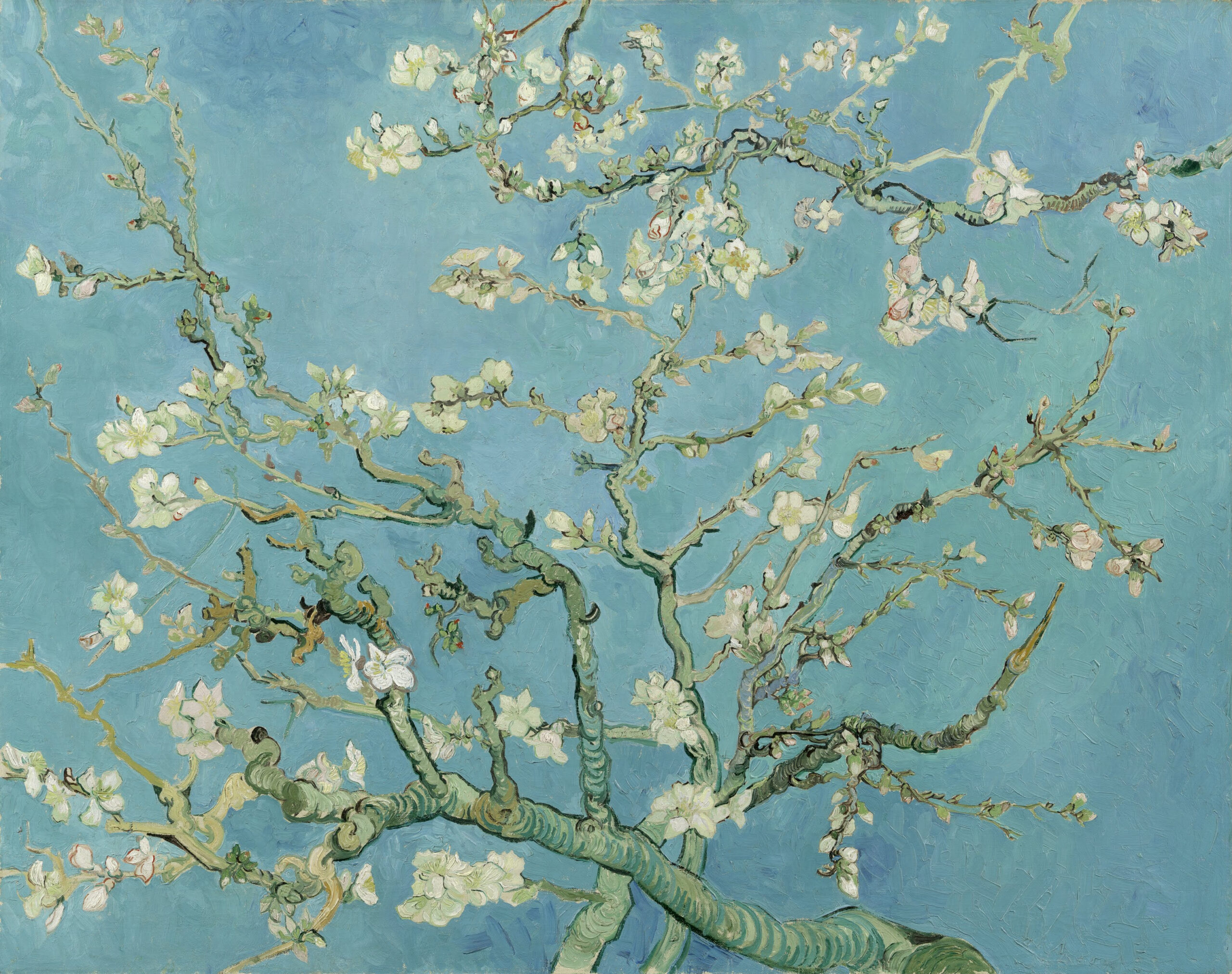
White blossom against a clear blue sky: Van Gogh painted Almond Blossom in February 1890 to celebrate the birth of his nephew and namesake, Vincent Willem van Gogh.
- Artist
- Vincent van Gogh
- Date
- February 1890
- Painted in
- Saint-Rémy-de-Provence, France
- Medium
- Oil on canvas
- Size
- 73.5 × 92.4 cm
- Museum
- Van Gogh Museum, Amsterdam
- Catalogue
- F671 · JH1891
What the painting shows
Branches of an almond tree twist across the canvas, seen from below against a brilliant turquoise sky. Their white and pale pink flowers, some fully open and some still in bud, are outlined in dark contours. There is no ground and no horizon – only the branches and the sky, flattened like a Japanese print.
The almond is among the first trees to bloom in Provence, often in February, and its blossom was a symbol of new life.
A gift for a new baby
On 31 January 1890, Theo and his wife Jo had a son, whom they named after his uncle: Vincent Willem. Vincent wrote to his mother that he had started a painting for the baby’s bedroom, with big branches of white almond blossom against a blue sky. He had just been told of the birth, and the picture is full of joy and hope.
Soon after, he suffered a severe attack of his illness and could not work for weeks. When he recovered, he felt the almond blossom was one of his calmest and best-worked pictures.
From the Van Gogh family to the world
The painting hung in the family’s homes for decades. Vincent Willem van Gogh, the baby for whom it was painted, later founded the Van Gogh Museum in Amsterdam, which opened in 1973, and the painting is one of its best-loved works. Its design is now one of the most reproduced images of any Van Gogh painting.
The story behind Almond Blossom
On 31 January 1890 Theo and Jo van Gogh had a son, and they named him Vincent Willem after his uncle. The news reached Van Gogh at the asylum in Saint-Rémy, and he was deeply moved. In February he wrote to his mother that he had at once started a picture for the baby, to hang in their bedroom: big branches of white almond blossom against a blue sky. Almond trees are among the first to flower in Provence, often in February, so the subject was a natural symbol of new life.
Shortly after finishing it he suffered one of his most serious attacks, which lasted for weeks. He later wrote to Theo that the almond blossom picture was perhaps the most patiently worked and best thing he had done, painted with calm and a surer touch than usual, and that he had been taken ill the day after.
Japan in Provence
The painting is one of Van Gogh’s most Japanese works. Instead of a landscape, he shows a few branches seen from below, cut off by the edges of the canvas, set against a flat, almost cloudless turquoise sky. The dark outlines of the twisting branches, the delicate white and pink flowers and the lack of a horizon all come from the Japanese woodblock prints he collected and admired, in which blossoming branches were a favourite theme. In Arles in 1888 he had already painted small studies of almond twigs in a glass; here the motif becomes a large, decorative picture.
Things you might not know about Almond Blossom
- It was a baby present. It was painted for his newborn nephew and hung over the parents’ bed in Paris.
- The baby founded the Van Gogh Museum. Vincent Willem van Gogh grew up to place the family collection in a foundation and helped create the Van Gogh Museum, which opened in 1973.
- It never left the family until the museum. It was owned by Theo, Jo and their son before going to the Vincent van Gogh Foundation.
- The colours have changed slightly. Like many of his paintings, some pigments have faded with time, so the original effect was a little warmer.
- It is one of the most reproduced paintings in the world. It appears on everything from phone cases to bedding.
- It is one of his last Saint-Rémy works. He left the asylum three months later, in May 1890.
Where to see it
Almond Blossom is one of the highlights of the Van Gogh Museum in Amsterdam and is almost always on display. Book a timed ticket in advance, as the museum regularly sells out. You can download it as a high-resolution phone or desktop background on our Van Gogh wallpapers page, and find its exact colours on our colour palettes page.
Related paintings
 Long Grass with Butterflies1890 · National Gallery
 The Starry Night1889 · Museum of Modern Art
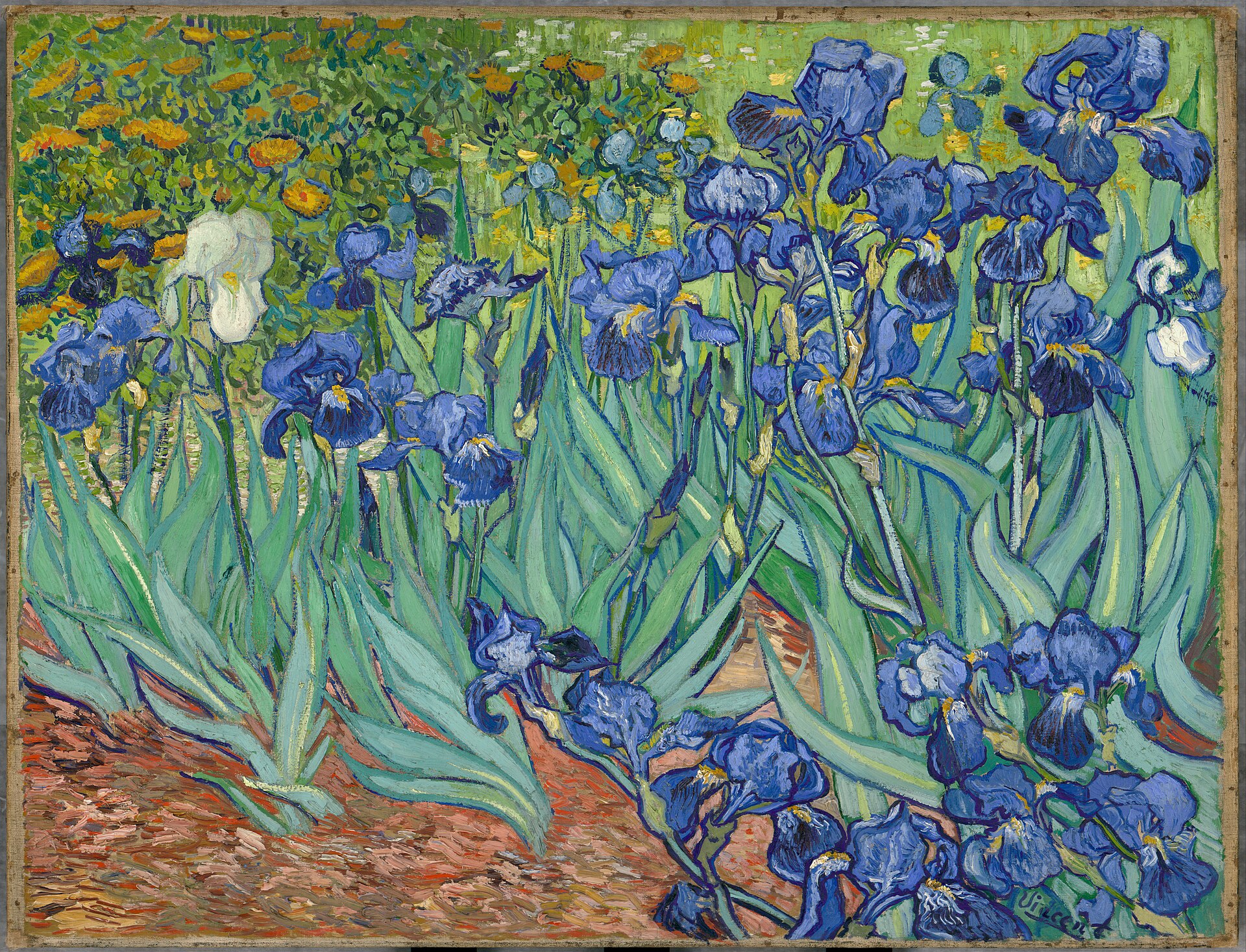 Irises1889 · Getty Museum
 Bridge in the rain, after Hiroshige1887 · Van Gogh Museum
Frequently asked questions
Where is Almond Blossom by Van Gogh?
It is in the collection of the Van Gogh Museum, Amsterdam.
When did Van Gogh paint Almond Blossom?
In February 1890, in Saint-Rémy-de-Provence, France.
Almond trees are among the very first to flower each year; see which flowers bloom in every month of the year.
How big is Almond Blossom?
The painting measures 73.5 × 92.4 cm. It is oil on canvas, catalogued as F671 and JH1891.
Who was Almond Blossom painted for?
For his newborn nephew Vincent Willem van Gogh, the son of his brother Theo and Jo van Gogh-Bonger, born on 31 January 1890.
See every painting from his Saint-Rémy period in the Saint-Rémy collection, follow his travels on the interactive timeline, or download masterpieces as free wallpapers.
Image: Van Gogh Museum, Amsterdam (public domain), via Wikimedia Commons. Facts checked against the holding museum’s catalogue and the standard Van Gogh catalogues (de la Faille and Hulsker).
Why did Van Gogh paint Almond Blossom?
To celebrate the birth of his nephew, Vincent Willem, the son of Theo and Jo, in January 1890. It was meant to hang above the couple’s bed.
What does Almond Blossom symbolise?
Almond trees flower early in spring, so the blossom stands for new life and hope, fitting for a picture painted to welcome a baby.