Home › Paintings › Arles › The Bedroom
Arles · 1888
The Bedroom
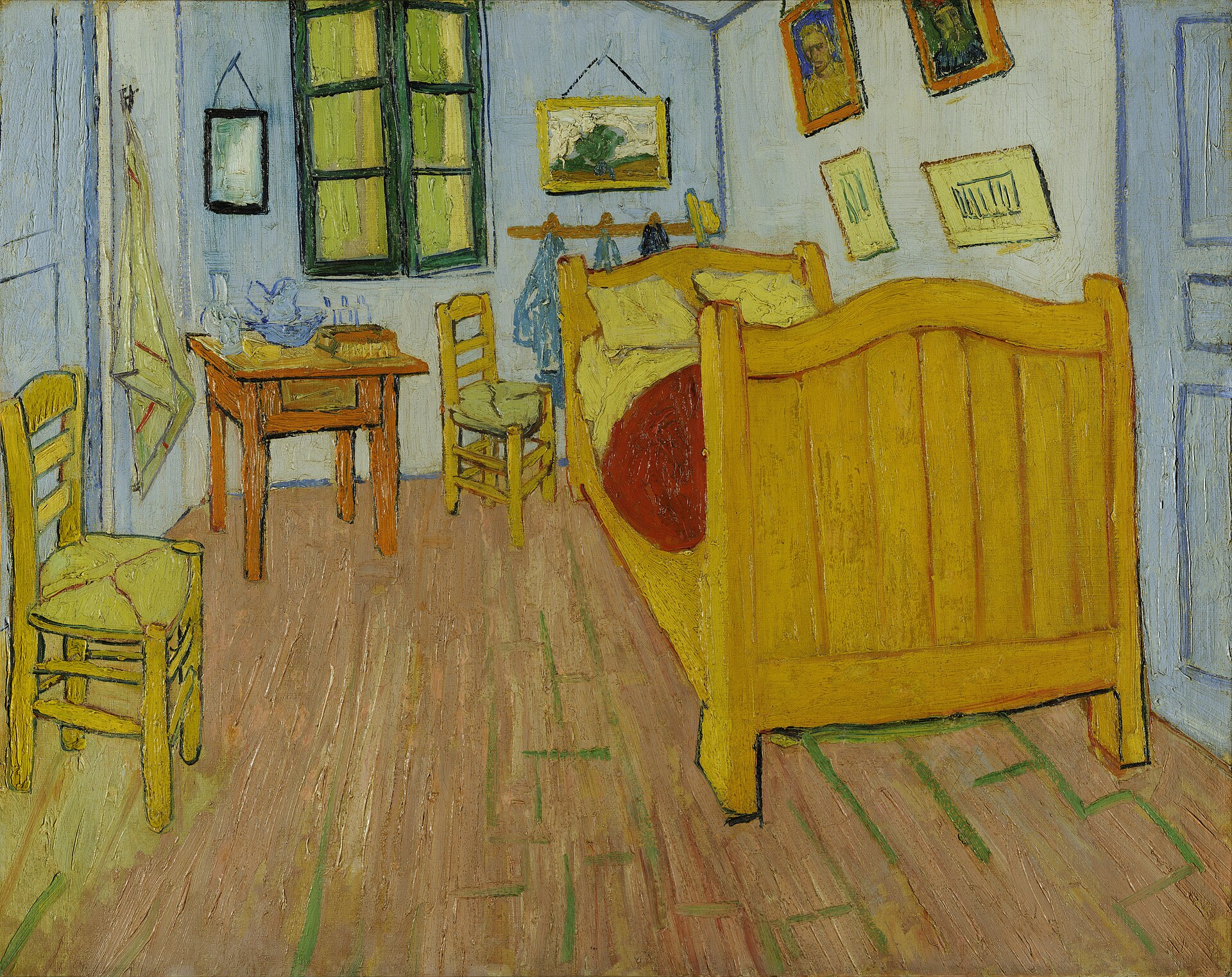
Van Gogh’s own room in the Yellow House, painted in flat, bright colours in October 1888: The Bedroom was meant to express complete rest, and it became one of the best-loved images in modern art.
- Artist
- Vincent van Gogh
- Date
- October 1888
- Painted in
- Arles, France
- Medium
- Oil on canvas
- Size
- 72.4 × 91.3 cm
- Museum
- Van Gogh Museum, Amsterdam
- Catalogue
- F482 · JH1608
What the painting shows
We look into a small room under a sloping ceiling. A wide wooden bed with a red cover fills the right side; two rush-seated chairs, a small table with a jug and basin, and a few towels and clothes on pegs complete the furniture. On the walls hang paintings, including portraits of his friends, and a mirror. The shutters of the window are half open onto the morning.
The colours are deliberately simple: pale violet-blue walls, a red-tiled floor, butter-yellow wood for the bed and chairs, a green window. There are almost no shadows. Van Gogh wrote to his brother Theo that the colour was meant to do everything, suggesting rest and sleep, and that he wanted to paint the room as simply as a Japanese print.
The house he shared with Gauguin
The room was on the first floor of the Yellow House on the Place Lamartine in Arles, where Van Gogh had lived since the autumn of 1888. He painted it shortly after he had furnished the house and while he was waiting for Paul Gauguin to arrive. After days of hard work outdoors, he said, he wanted to make a picture that would rest the mind.
The odd, tilted perspective is partly real: the back wall of the room was not square to the side walls. Van Gogh exaggerated it, so that the floor seems to slope up towards us.
Three versions
In 1889, while he was in hospital, this canvas was damaged by damp. Van Gogh sent it to Theo to be relined, and in September 1889, at the asylum in Saint-Rémy, he painted two repetitions: a full-size copy now in the Art Institute of Chicago, and a smaller version for his mother and sister, now in the Musée d’Orsay in Paris. The portraits on the wall and some of the colours differ between the three.
The Yellow House itself was damaged by bombing in 1944 and later demolished.
The story behind The Bedroom
In September 1888 Van Gogh finally moved into the Yellow House in Arles, after months of furnishing it with Theo’s money. He was exhausted after weeks of non-stop work and, in October, while waiting for Gauguin, he painted his own bedroom as a picture of rest. He explained the idea to Theo: the colour was to do everything, and by simplifying it give a grander style to things, suggesting rest or sleep in general. Looking at the picture, he wrote, ought to rest the brain, or rather the imagination.
He listed the colours like a recipe: pale violet walls, a red floor, chrome yellow bed and chairs, lemon-green pillows and sheet, a scarlet blanket, an orange washstand and a blue basin, with a green window. The shadows are left out and the colours are laid flat, “like Japanese prints”. The room is sparse but cared for: two chairs, two pillows, a towel on a nail, his clothes hanging on pegs and his own paintings on the walls.
Why the room looks strange
Many people think the room in the painting looks distorted, with the back wall tilting and the floor rushing up. Part of the reason is real: the bedroom was not rectangular, and its back wall met the side walls at an angle, which Van Gogh recorded faithfully. Part is deliberate. He used a steep, Japanese-print perspective and flattened the colours to make the picture decorative rather than illusionistic. The result feels intimate, a little unsteady and very personal, which is why the painting has become one of his most popular.
Things you might not know about The Bedroom
- It was meant to be restful. Van Gogh painted it after a period of exhaustion, as an image of sleep and calm.
- The portraits on the wall are real people. In the first version they are thought to show his friends the Belgian painter Eugène Boch and the Zouave lieutenant Paul-Eugène Milliet.
- There are two of everything. Two chairs, two pillows and two doors; some see a hope for company, others simply a room ready for a guest.
- The first version was flood-damaged. Water damage while he was in hospital is why he repainted it in 1889.
- The room no longer exists. The Yellow House was badly damaged in a bombing raid in 1944 and later demolished.
- You could once sleep in it. In 2016 the Art Institute of Chicago built a life-size replica of the room and rented it out to visitors.
The walls were once violet
Today the walls of the bedroom look pale blue. But in his letters Van Gogh described them as pale violet. Research by the Van Gogh Museum, published in 2016, found that he had mixed the violet from blue and a red pigment that has since faded. The doors, also described as lilac, have faded too. The museum made a digital reconstruction showing the room in its original colours, warmer and more contrasting than what we see now.
Portraits on the wall
Above the bed hang two small portraits. In the first version they show his friends Eugène Boch, a Belgian painter, and Paul-Eugène Milliet, a Zouave officer, both of whom he had painted in Arles. In the later versions he changed the faces. The pictures within the picture tell us the room was not just a place to sleep but part of his dream of a house full of art and friends.
The bedroom you could sleep in
The Bedroom has become one of his most popular images. In 2016 the Art Institute of Chicago built a full-size replica of the room, with tilted walls and painted furniture, and listed it for rent on Airbnb for a few dollars a night to publicise its exhibition Van Gogh’s Bedrooms. It sold out within minutes.
Where to see it
This first version belongs to the Van Gogh Museum in Amsterdam, which received it from the artist’s family. In 2016 the Art Institute of Chicago brought all three versions together for the exhibition Van Gogh’s Bedrooms.
Related paintings
 Bedroom in Arles1889 · Art Institute of Chicago
 Café Terrace at Night1888 · Kröller-Müller Museum
 Sunflowers1888 · National Gallery
 Self-Portrait with Bandaged Ear1889 · Courtauld Gallery
Frequently asked questions
Where is The Bedroom by Van Gogh?
It is in the collection of the Van Gogh Museum, Amsterdam.
When did Van Gogh paint The Bedroom?
In October 1888, in Arles, France.
How big is The Bedroom?
The painting measures 72.4 × 91.3 cm. It is oil on canvas, catalogued as F482 and JH1608.
How many versions of The Bedroom are there?
Three: the first from October 1888 in the Van Gogh Museum, a full-size repetition from September 1889 in the Art Institute of Chicago, and a smaller version from the same month in the Musée d’Orsay.
What did Van Gogh want The Bedroom to express?
He told Theo that the simplified colours should suggest rest and sleep, and that looking at the picture should rest the mind.
See every painting from his Arles period in the Arles collection, follow his travels on the interactive timeline, or download masterpieces as free wallpapers.
Image: Van Gogh Museum, Amsterdam (public domain), via Wikimedia Commons. Facts checked against the holding museum’s catalogue and the standard Van Gogh catalogues (de la Faille and Hulsker).
How many versions of The Bedroom did Van Gogh paint?
Three: the original of October 1888 (Van Gogh Museum, Amsterdam), a full-size repetition of September 1889 (Art Institute of Chicago) and a smaller version for his mother (Musée d’Orsay, Paris).
Why does The Bedroom look distorted?
The real room had an irregular, non-rectangular shape, and Van Gogh also used a steep, flattened perspective inspired by Japanese prints.
What colour were the walls in Van Gogh’s Bedroom?
Van Gogh described them as pale violet. The red pigment has faded, so they now look blue.