Home › Paintings › Saint-Rémy › Self-Portrait (1889)
Saint-Rémy · 1889
Self-Portrait (1889)
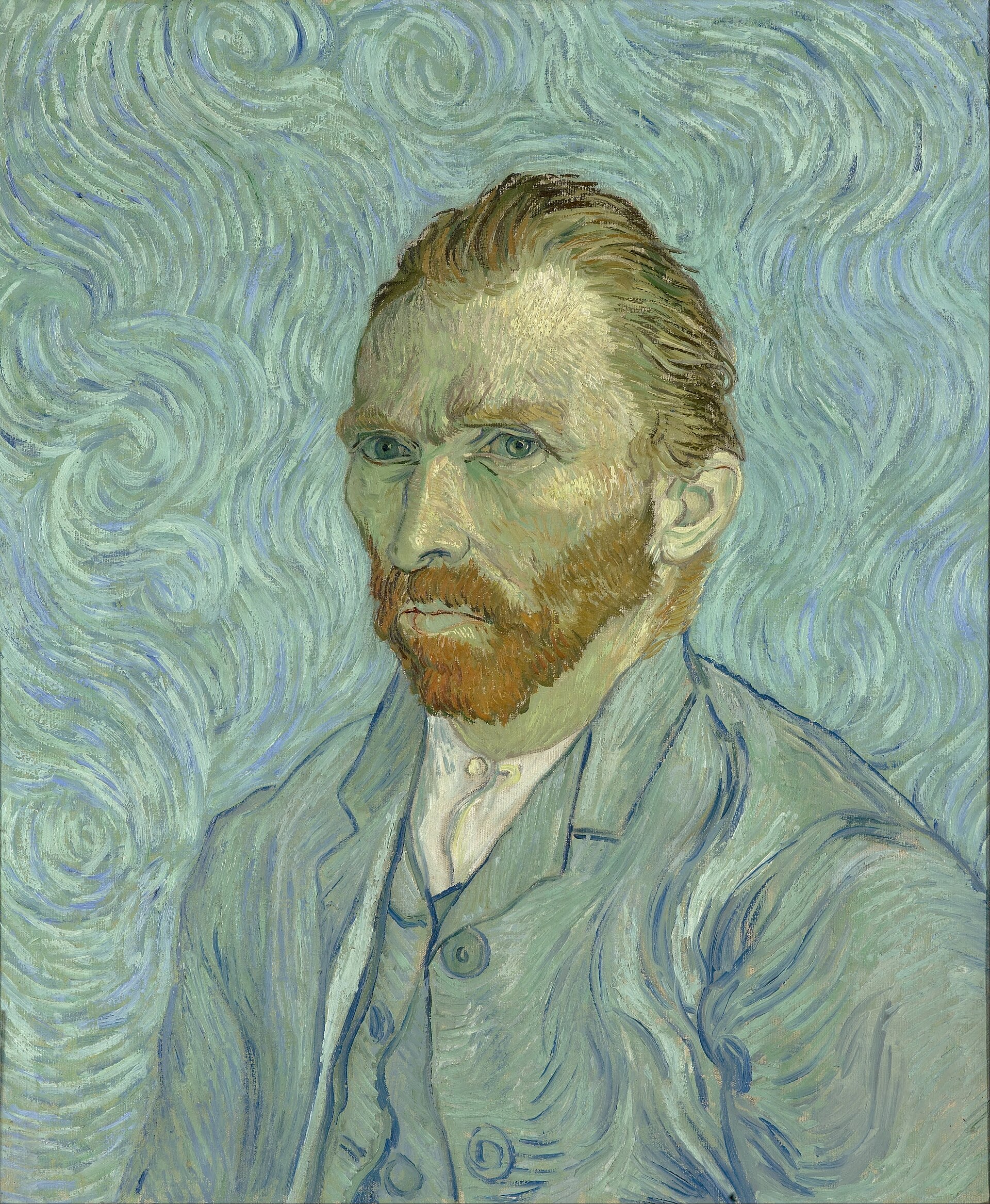
Van Gogh stares out from a background of swirling blue: this self-portrait, painted at the Saint-Rémy asylum in September 1889, is one of the last he made and one of the most famous.
- Artist
- Vincent van Gogh
- Date
- September 1889
- Painted in
- Saint-Rémy-de-Provence, France
- Medium
- Oil on canvas
- Size
- 65 × 54.2 cm
- Museum
- Musée d’Orsay, Paris
- Catalogue
- F627 · JH1772
What the painting shows
Van Gogh is shown half-length, turned slightly to the right, in a blue-grey suit. His red-orange hair and beard and his pale, drawn face are the warmest notes in the picture. The background is filled with flowing, curling strokes of pale blue and turquoise, which continue into his jacket, so the figure seems to merge with the swirling space around him.
His expression is tense and watchful.
Painted after a crisis
In the summer of 1889 Van Gogh suffered a severe attack at the asylum and could not work for weeks. When he recovered in late August and September, he painted two self-portraits. He wrote to Theo that he had started one on the first day he got up, thin and pale, and that he hoped it would show how he really looked. This one, with the swirling background, was sent to Theo. It is often linked in mood and style with The Starry Night.
A portrait in the asylum
Van Gogh painted this self-portrait at Saint-Rémy in September 1889, shortly after recovering from a severe attack in July and August. He had no other models, so he turned to himself. He wears a blue-grey suit and stands against a pale blue background filled with swirling strokes that echo the curls of his hair and beard. The face is drawn and tense, with green and orange shadows.
It is one of the last self-portraits he painted. He made around 35 painted self-portraits in all, most of them in Paris between 1886 and 1888, when he could not afford models.
How it reached Paris
The painting later belonged to Dr Paul Gachet, the doctor who cared for Van Gogh at Auvers in 1890. His son and daughter gave it to the French national collections in 1949, together with other works by Van Gogh, and it is now one of the best-known pictures in the Musée d’Orsay.
Things you might not know
- The background moves. The swirling blue background is unusual among his self-portraits.
- He painted it after an attack. It dates from his recovery in September 1889.
- It came from Dr Gachet’s family. See our Orsay guide for the other Gachet gifts.
Where to see it
The painting belongs to the Musée d’Orsay in Paris, a gift in 1949 of Paul and Marguerite Gachet, the children of Dr Gachet.
Related paintings
 Self-Portrait with Grey Felt Hat1887 · Van Gogh Museum
 Self-Portrait with Bandaged Ear1889 · Courtauld Gallery
 The Starry Night1889 · Museum of Modern Art
 Self-portrait, dedicated to Paul Gauguin1888 · Fogg Museum
Frequently asked questions
Where is Self-Portrait (1889) by Van Gogh?
It is in the collection of the Musée d’Orsay, Paris.
When did Van Gogh paint Self-Portrait (1889)?
In September 1889, in Saint-Rémy-de-Provence, France.
How big is Self-Portrait (1889)?
The painting measures 65 × 54.2 cm. It is oil on canvas, catalogued as F627 and JH1772.
See every painting from his Saint-Rémy period in the catalogue, follow his travels on the interactive timeline, or download masterpieces as free wallpapers.
Image: Musée d’Orsay, Paris (public domain), via Wikimedia Commons. Facts checked against the holding museum’s catalogue and the standard Van Gogh catalogues (de la Faille and Hulsker).
Where is Van Gogh’s 1889 self-portrait with the swirling blue background?
In the Musée d’Orsay in Paris, which received it in 1949 from the son and daughter of Dr Gachet.