Home › Paintings › Arles › Self-Portrait with Bandaged Ear
Arles · 1889
Self-Portrait with Bandaged Ear
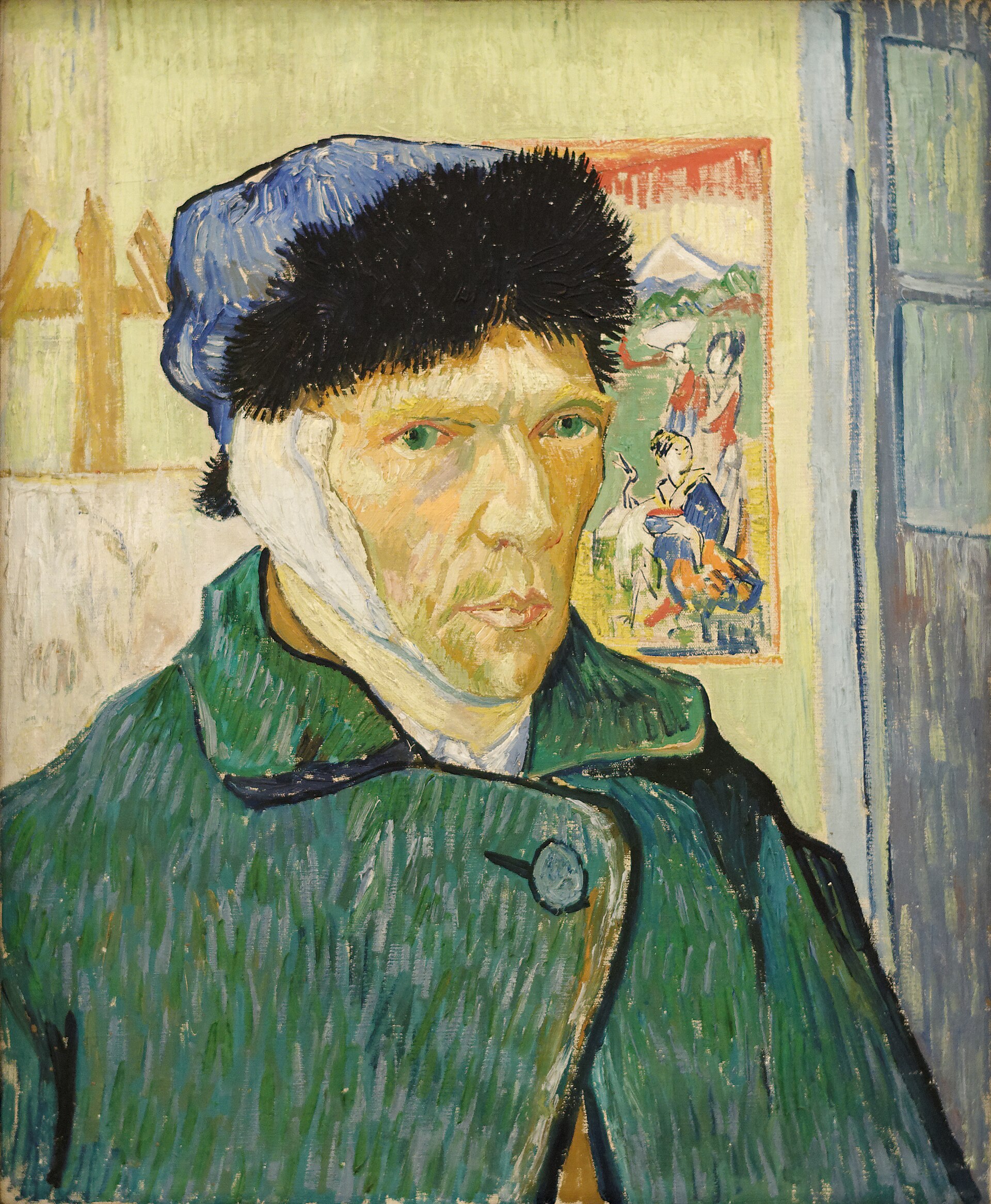
Painted in January 1889, only weeks after he cut off his own ear, Self-Portrait with Bandaged Ear shows Van Gogh calmly facing the mirror in a winter coat and fur cap – a picture of a man determined to get back to work.
- Artist
- Vincent van Gogh
- Date
- January 1889
- Painted in
- Arles, France
- Medium
- Oil on canvas
- Size
- 60.5 × 50 cm
- Museum
- Courtauld Gallery, London
- Catalogue
- F527 · JH1657
What the painting shows
Van Gogh sits half-turned in a green overcoat buttoned to the neck and a dark fur cap, a white bandage wrapped under his chin and over the side of his face. Because he painted himself in a mirror, the bandage appears on the right, although it was his left ear that he had injured.
Behind him are the tools of his trade and his inspiration: an easel holding a canvas that is barely begun, and a Japanese woodblock print of geishas in a landscape pinned to the wall. To the left, an open window or door lets in a cold blue light. The colours are muted but carefully balanced – greens and blues against the orange-red of the cap’s fur and the pale bandage.
The night of 23 December 1888
In the autumn of 1888 Paul Gauguin came to live with Van Gogh in the Yellow House in Arles. Their two months together were intensely productive but increasingly tense. On the evening of 23 December, after a violent argument, Van Gogh cut off his left ear with a razor, wrapped it in paper and took it to a brothel nearby. He was found the next morning and taken to the hospital in Arles; Gauguin left for Paris and the two never met again.
For years it was believed that he had removed only the lobe. A note by his doctor, Félix Rey, published by the researcher Bernadette Murphy in 2016, shows that he cut away almost the whole ear.
Why he painted himself wounded
Van Gogh was released from hospital on 7 January 1889 and was soon painting again. This self-portrait, and a second, more intense version with a pipe against a red-and-orange background, were among the first pictures he made. Rather than hiding the injury, he recorded it plainly, and surrounded himself with signs of the life he meant to resume: the easel, the canvas, the Japanese print he loved.
Many viewers read the painting as a statement of recovery. The face is drawn and pale, but the gaze is steady, and the bold, simplified forms show that his hand was as sure as ever.
The story behind the self-portrait
On 23 December 1888, after a quarrel with Paul Gauguin, Van Gogh suffered a severe mental crisis and cut off his left ear. He was taken to the hospital in Arles, where the young doctor Félix Rey treated him. He recovered quickly and was allowed home on 7 January 1889. Within days he was painting again, and one of the first things he did was to paint himself, bandaged, in his studio.
He was keen to show Theo and himself that he was well and working. In a letter he told Theo he had done two new self-portraits and was making progress. The portrait is calm and steady: he wears a heavy green coat and a fur cap against the winter mistral, his face is thin but composed, and his eyes look out with a direct, slightly wary expression.
The details: the easel and the Japanese print
Behind him are two objects that sum up his art. On the left stands an easel with a canvas on it, a reminder that he was back at work. On the right hangs a Japanese woodblock print showing women in a landscape with Mount Fuji, from his own collection. Japanese prints had shaped his art since Paris, and in Arles he thought of Provence as his Japan. Including the print may have been a way of reaffirming his ideals after the disaster of December.
The bandage appears on his right ear in the painting because he painted himself in a mirror. In reality it was his left ear that was injured. Research published in 2016 by Bernadette Murphy, based on a drawing made by Dr Rey, showed that he had cut off all or nearly all of the ear, not just the lobe as was long believed. Read the full story in what happened to Van Gogh’s ear.
Two bandaged-ear self-portraits
Van Gogh painted two self-portraits with the bandage in January 1889. This one, with the easel and Japanese print, is in the Courtauld Gallery in London. The other, Self-Portrait with Bandaged Ear and Pipe, is smaller and bolder, with the figure set against bands of red and orange; it is in a private collection. A third picture once thought to belong to the group, a bandaged self-portrait with a pipe at Harvard, was exposed as one of the 1920s forgeries sold by the dealer Otto Wacker (see Van Gogh fakes and forgeries).
Things you might not know
- It shows the wrong ear. Because he used a mirror, the bandage appears on the right; he cut his left ear.
- He painted it within days of leaving hospital. It was one of his first works after his release on 7 January 1889.
- The Japanese print was his own. It came from the collection of several hundred prints he and Theo had built up in Paris.
- It is in London. The Courtauld Gallery owns it thanks to the collector Samuel Courtauld.
- He was not left alone afterwards. Further attacks followed in February 1889, and by May he had entered the Saint-Rémy asylum.
Where to see it
The painting belongs to the Courtauld Gallery at Somerset House in London. It was bought in 1928 by the textile industrialist Samuel Courtauld, who gave his collection to found the gallery, and it hangs alongside works by Gauguin, Cézanne and Manet. The second version, with the pipe, is in a private collection. For other galleries holding his work, see where to see Van Gogh.
Related paintings
 Self-Portrait with Pipe and Straw Hat1888 · Van Gogh Museum
 Self-Portrait with Felt Hat1886 · Van Gogh Museum
 Sunflowers1888 · National Gallery
 Café Terrace at Night1888 · Kröller-Müller Museum
Frequently asked questions
Where is Self-Portrait with Bandaged Ear by Van Gogh?
It is in the collection of the Courtauld Gallery, London.
When did Van Gogh paint Self-Portrait with Bandaged Ear?
In January 1889, in Arles, France.
How big is Self-Portrait with Bandaged Ear?
The painting measures 60.5 × 50 cm. It is oil on canvas, catalogued as F527 and JH1657.
Which ear did Van Gogh cut off?
His left ear. In the self-portrait the bandage appears on the right side of his face because he painted his reflection in a mirror.
How many versions of Self-Portrait with Bandaged Ear are there?
Two. The Courtauld version shows him beside an easel and a Japanese print; the other, Self-Portrait with Bandaged Ear and Pipe, has a red and orange background and is in a private collection.
See every painting from his Arles period in the Arles collection, follow his travels on the interactive timeline, or download masterpieces as free wallpapers.
Image: Courtauld Gallery, London (public domain), via Wikimedia Commons. Facts checked against the holding museum’s catalogue and the standard Van Gogh catalogues (de la Faille and Hulsker).
Which ear did Van Gogh cut off?
His left ear. In the self-portrait the bandage appears on the right because he painted his reflection in a mirror.
Where is Self-Portrait with Bandaged Ear?
The version with the easel and Japanese print is in the Courtauld Gallery in London; the version with a pipe is in a private collection.