Home › Paintings › Saint-Rémy › Prisoners Exercising
Saint-Rémy · 1890
Prisoners Exercising
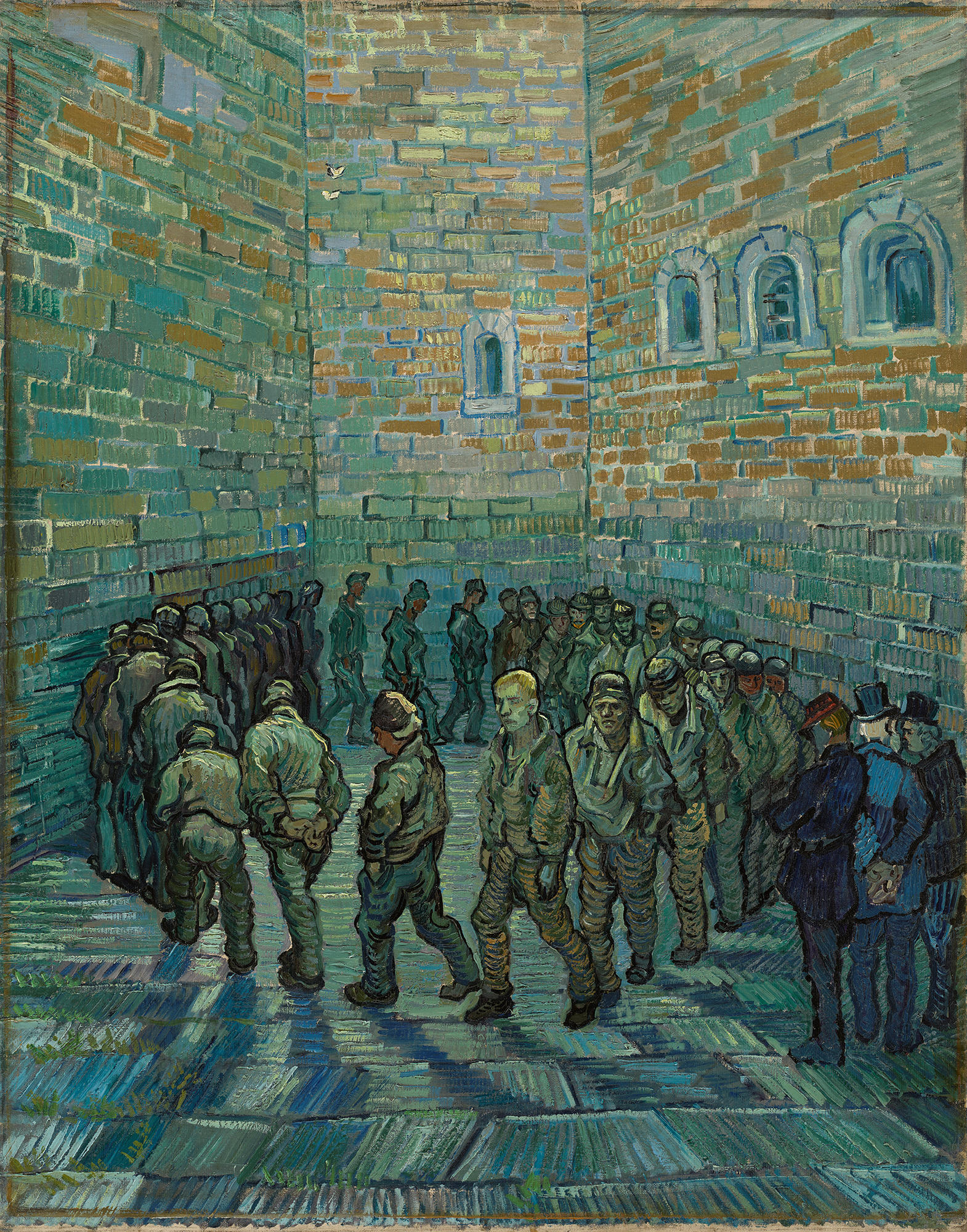
Painted at the asylum in Saint-Rémy in February 1890, Prisoners Exercising turns a Victorian engraving of a London prison yard into one of Van Gogh’s most haunting images, and the prisoner staring out at us is often read as the artist himself.
- Artist
- Vincent van Gogh
- Date
- February 1890
- Painted in
- Saint-Rémy-de-Provence, France
- Medium
- Oil on canvas
- Size
- 80 × 64 cm (31½ × 25¼ in)
- Museum
- Pushkin Museum of Fine Arts, Moscow
- Catalogue
- F669 · JH1885
What the painting shows
A line of prisoners trudges in a tight circle around a walled yard. The walls rise on every side and run off the top of the canvas, built from blue-green and ochre bricks and pierced by small barred windows. High on the wall at the left, two tiny white butterflies flutter – the only things in the picture that are free.
At the right, a small group of men – two of them in top hats – stands watching. In the centre of the circle, one prisoner without a cap has turned his face towards us. With his red-blond hair and pale, greenish face, he has long been seen as a self-portrait – Van Gogh placing himself among men who, like him at that moment, could not leave.
Painted after Gustave Doré
The composition comes from Newgate – Exercise Yard, a wood engraving after Gustave Doré published in 1872 in London: A Pilgrimage, the book Doré made with the journalist Blanchard Jerrold. Van Gogh, who had lived in London in the 1870s, had long admired Doré’s prints, and at the asylum he worked from reproductions of the artists he loved, many of them sent by Theo.
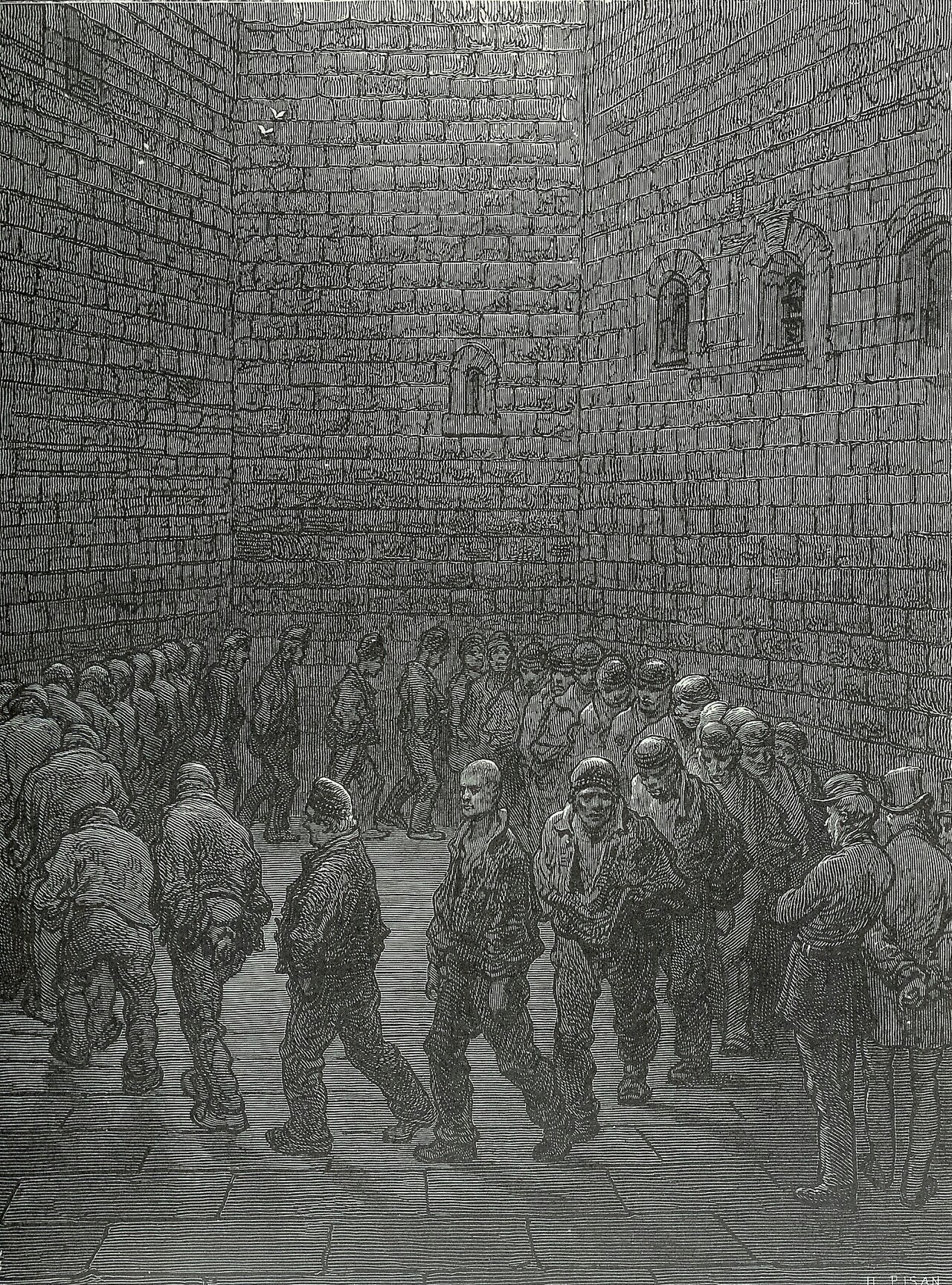
He kept Doré’s composition almost exactly but transformed it with colour. The black-and-white print becomes a world of greens and blues, the stones of the yard are laid in thick, restless strokes, and the circle of men seems to turn endlessly. Many critics consider it one of the finest of his copies, a picture that goes beyond its source.
Why Van Gogh copied other artists
During the winter of 1889–90, when bad weather and recurring attacks of illness kept him indoors, Van Gogh painted more than twenty versions of prints by artists he loved: Jean-François Millet, Eugène Delacroix, Rembrandt, Honoré Daumier and Doré. He did not think of them as mere copies. He compared the process to a musician interpreting a composer’s score: the black-and-white print was the music, and his colours were the performance.
Among these “translations” are Noon: Rest from Work after Millet, the Pietà after Delacroix and The Raising of Lazarus after Rembrandt. Prisoners Exercising, painted in February 1890, is one of the last and darkest.
What happened to the painting
When Van Gogh died in Auvers-sur-Oise in July 1890, Prisoners Exercising was among the canvases hung around his coffin in the inn where he had lodged. It later entered the collection of the Moscow collector Ivan Morozov. After the Russian Revolution his collection was nationalised and displayed in Moscow’s Museum of Modern Western Art, and since 1948 the painting has belonged to the Pushkin Museum of Fine Arts.
Related paintings
 Noon: Rest from Work (after Millet)1890 · Musée d’Orsay
 Pietà (after Delacroix)1889 · Van Gogh Museum
 The Raising of Lazarus (after Rembrandt)1890 · Van Gogh Museum
 Cypresses1889 · The Met, New York
Frequently asked questions
Where is Prisoners Exercising?
The painting is in the Pushkin Museum of Fine Arts in Moscow, which has owned it since 1948.
When did Van Gogh paint Prisoners Exercising?
In February 1890, at the asylum of Saint-Paul-de-Mausole in Saint-Rémy-de-Provence, about five months before his death.
What is Prisoners Exercising based on?
It is based on Newgate – Exercise Yard, a wood engraving after Gustave Doré published in 1872 in London: A Pilgrimage by Doré and Blanchard Jerrold.
Is Van Gogh in Prisoners Exercising?
Van Gogh never said so, but the bare-headed prisoner in the centre, with red-blond hair, who looks out of the picture is widely seen as a self-portrait.
What is the painting also called?
It is also known as The Prisoners’ Round or Prisoners’ Round (after Doré). Its catalogue numbers are F669 and JH1885.
See all the paintings from his year in the asylum in the Saint-Rémy section of the catalogue, or follow his life on the interactive map.
Image: Pushkin Museum of Fine Arts, Moscow (public domain), via Wikimedia Commons; Gustave Doré engraving via Wikimedia Commons. Facts checked against museum catalogue data and published sources.