Home › Paintings › Saint-Rémy › Cypresses
Saint-Rémy · 1889
Cypresses
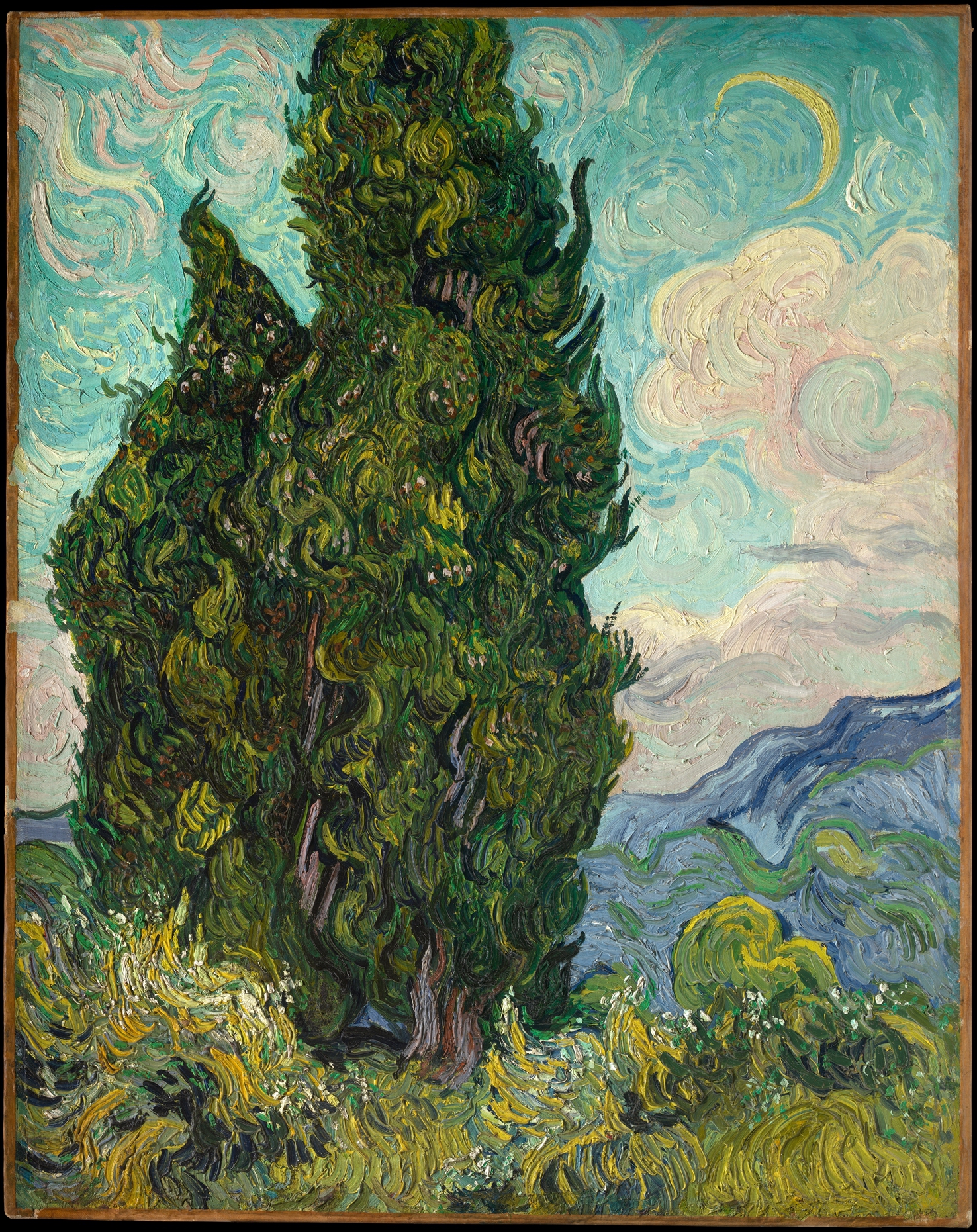
Painted in the summer of 1889, a few weeks after Van Gogh entered the asylum at Saint-Rémy, Cypresses is one of his most intense studies from nature: two dark trees flickering up like flames against a turbulent Provençal sky.
- Artist
- Vincent van Gogh
- Date
- Late June 1889
- Painted in
- Saint-Rémy-de-Provence, France
- Medium
- Oil on canvas
- Size
- 93.4 × 74 cm (36¾ × 29⅛ in)
- Museum
- Metropolitan Museum of Art, New York
- Catalogue
- F613 · JH1746
What the painting shows
Two cypresses, one taller than the other, fill almost the entire height of the canvas; the tip of the taller tree touches the top edge, so it seems to keep growing beyond the frame. At their feet is a tangle of yellow-green grasses and white wildflowers. To the right, the blue ridges of the Alpilles mountains rise beneath a turquoise sky, where swirling pink-and-cream clouds drift past a thin crescent moon.
Nothing in the picture is still. The foliage is built from curling, comma-shaped strokes of green, black-green and blue that twist upwards, and the clouds repeat the same spiralling rhythm. The result is less a portrait of two trees than of the energy Van Gogh felt in the landscape: the heat, the light and the mistral wind that whips through the Provençal countryside.
The story behind Cypresses
In May 1889, after a series of breakdowns in Arles, Van Gogh voluntarily entered the asylum of Saint-Paul-de-Mausole in Saint-Rémy. Once his doctors allowed him to work outside the walls, the cypresses that line the surrounding fields became an obsession. The Met dates its painting to late June 1889, only a few weeks after The Starry Night, which has its own giant cypress in the foreground.
He painted two vertical close-up studies of the trees out of doors that month: this one, now in New York, and a second in the Kröller-Müller Museum. On 25 June he sent his brother Theo a small sketch of the composition. The painting is thought to be the Le Cyprès that was exhibited at the Salon des Indépendants in Paris in 1890, one of the few times his work was shown in public during his lifetime.
In his own words
Van Gogh wrote to Theo that the cypresses were constantly on his mind and that he wanted to make something of them as he had of the sunflowers, because nobody had yet painted them the way he saw them.
It is as beautiful of line and proportion as an Egyptian obelisk… It is a splash of black in a sunny landscape.
Vincent to Theo, Saint-Rémy, 25 June 1889
That “splash of black” was the challenge. A dark green tree against a blazing southern sky is hard to paint without it turning into a flat silhouette, and he admitted it was one of the most difficult notes to get exactly right. His answer was to build the trees from dozens of different greens and blues, so that the darkest part of the picture is also one of its most alive.
How he painted it
Cypresses is famous for its impasto: paint laid on so thickly that the ridges of each brushstroke stand up from the canvas and catch the light. Van Gogh worked quickly and outdoors, and in places the paint is thick enough to cast tiny shadows. The Met notes that the same heavy, vigorous handling appears in its other summer 1889 picture, Wheat Field with Cypresses.
Later he made a pen-and-ink drawing after the painting, now in the Brooklyn Museum, using the same swirling marks in line alone. Comparing the two shows how much of the picture’s movement comes from the direction of his strokes rather than from colour.
Where to see Cypresses
Cypresses belongs to the Metropolitan Museum of Art in New York, which bought it in 1949 (Rogers Fund). It hangs in the European Paintings galleries at The Met Fifth Avenue, close to Wheat Field with Cypresses. In 2023 the museum reunited it with The Starry Night and other cypress paintings in the exhibition Van Gogh’s Cypresses. For other collections near you, see where to see Van Gogh’s paintings.
Cypresses like obelisks
Van Gogh began painting cypresses at Saint-Rémy in June 1889. In a letter to Theo he wrote that he was surprised nobody had painted them the way he saw them, and that they were as beautiful in line and proportion as an Egyptian obelisk. He found the deep green of the trees a hard colour to get right, a dark note in the bright southern landscape.
In this vertical canvas two cypresses fill almost the whole picture, their flame-like forms painted in thick, curling strokes. A small crescent moon and swirling clouds sit in the sky behind them. He also made a reed-pen drawing of the same composition.
The cypress series
Cypresses appear in some of his most famous Saint-Rémy paintings, including The Starry Night and Wheat Field with Cypresses. They were to him what the sunflowers had been in Arles: a motif he could make his own. This painting is in the Metropolitan Museum of Art, New York.
Things you might not know
- He compared them to obelisks. The phrase comes from his letter to Theo of June 1889.
- There is a matching drawing. He drew the same composition in pen and ink.
- It is in the Met. See our Met guide.
Related paintings
 The Starry Night1889 · MoMA, New York
 Wheat Field with Cypresses1889 · The Met, New York
 Road with Cypress and Star1890 · Kröller-Müller Museum
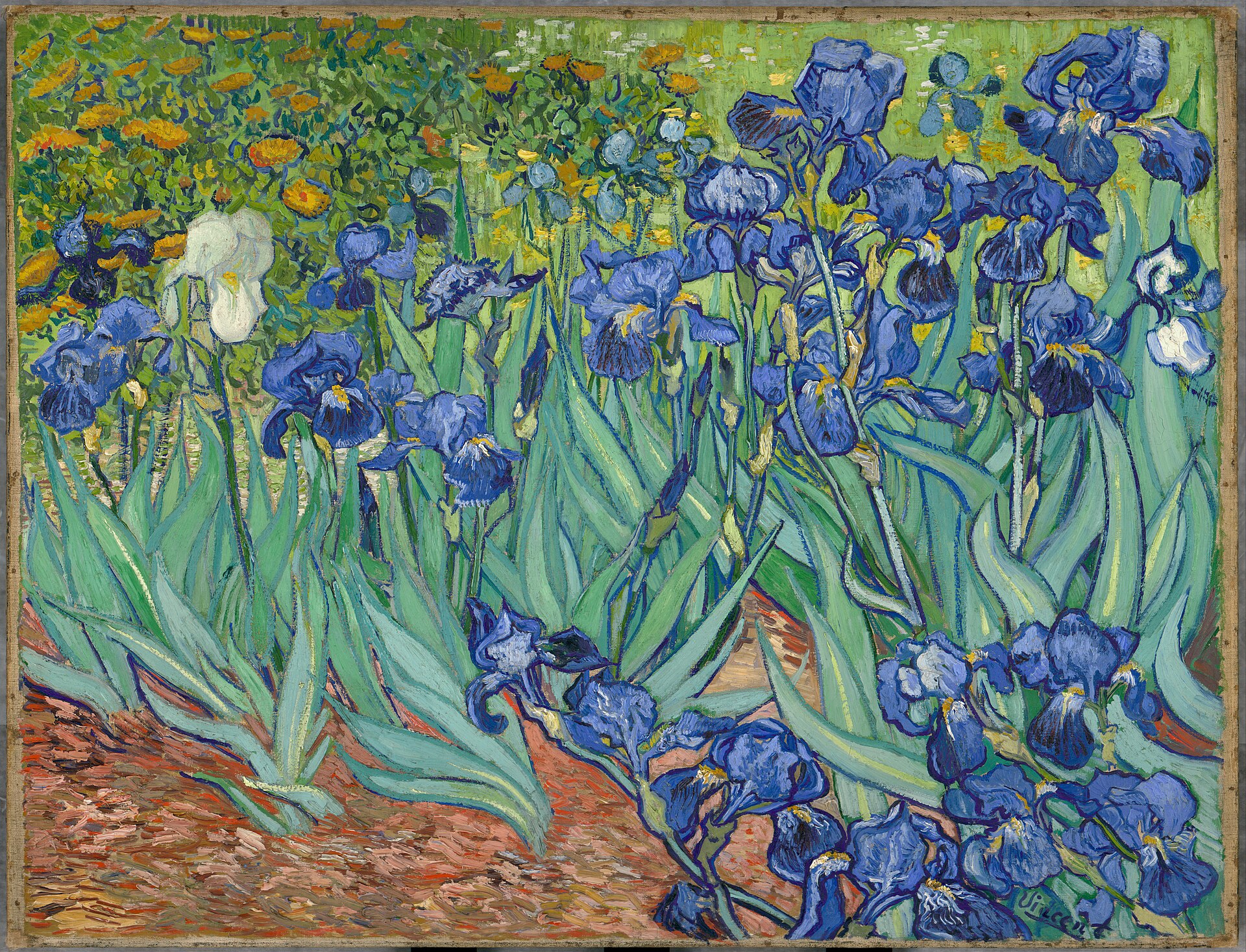 Irises1889 · Getty Museum
Frequently asked questions
Where is Van Gogh’s Cypresses?
It is in the Metropolitan Museum of Art in New York, which acquired it in 1949. A second vertical study of cypresses from the same month is in the Kröller-Müller Museum in the Netherlands.
When did Van Gogh paint Cypresses?
In late June 1889, during his stay at the asylum of Saint-Paul-de-Mausole in Saint-Rémy-de-Provence, a few weeks after The Starry Night.
How big is Cypresses?
The canvas measures 93.4 × 74 cm (36¾ × 29⅛ inches).
Why did Van Gogh paint cypresses?
He found the trees beautiful in line and proportion, comparing them to an Egyptian obelisk, and wanted to make a series of them as he had with the sunflowers, because he felt no one had yet painted them the way he saw them.
Is Cypresses the same painting as The Starry Night?
No. The Starry Night (Museum of Modern Art, New York) also features a large cypress and was painted in the same month, but Cypresses is a separate daytime study made outdoors.
Explore every painting from his year at the asylum in the Saint-Rémy section of the catalogue, download his masterpieces as free wallpapers, or print them as coloring pages.
Image: The Metropolitan Museum of Art, New York, Rogers Fund, 1949 (public domain), via Wikimedia Commons. Facts checked against The Metropolitan Museum of Art and Van Gogh’s letters.
Why did Van Gogh paint cypress trees?
He was struck by their shape and colour at Saint-Rémy in 1889, comparing them to Egyptian obelisks, and made them a signature motif.