Home › Paintings › Arles › The Harvest
Arles · 1888
The Harvest
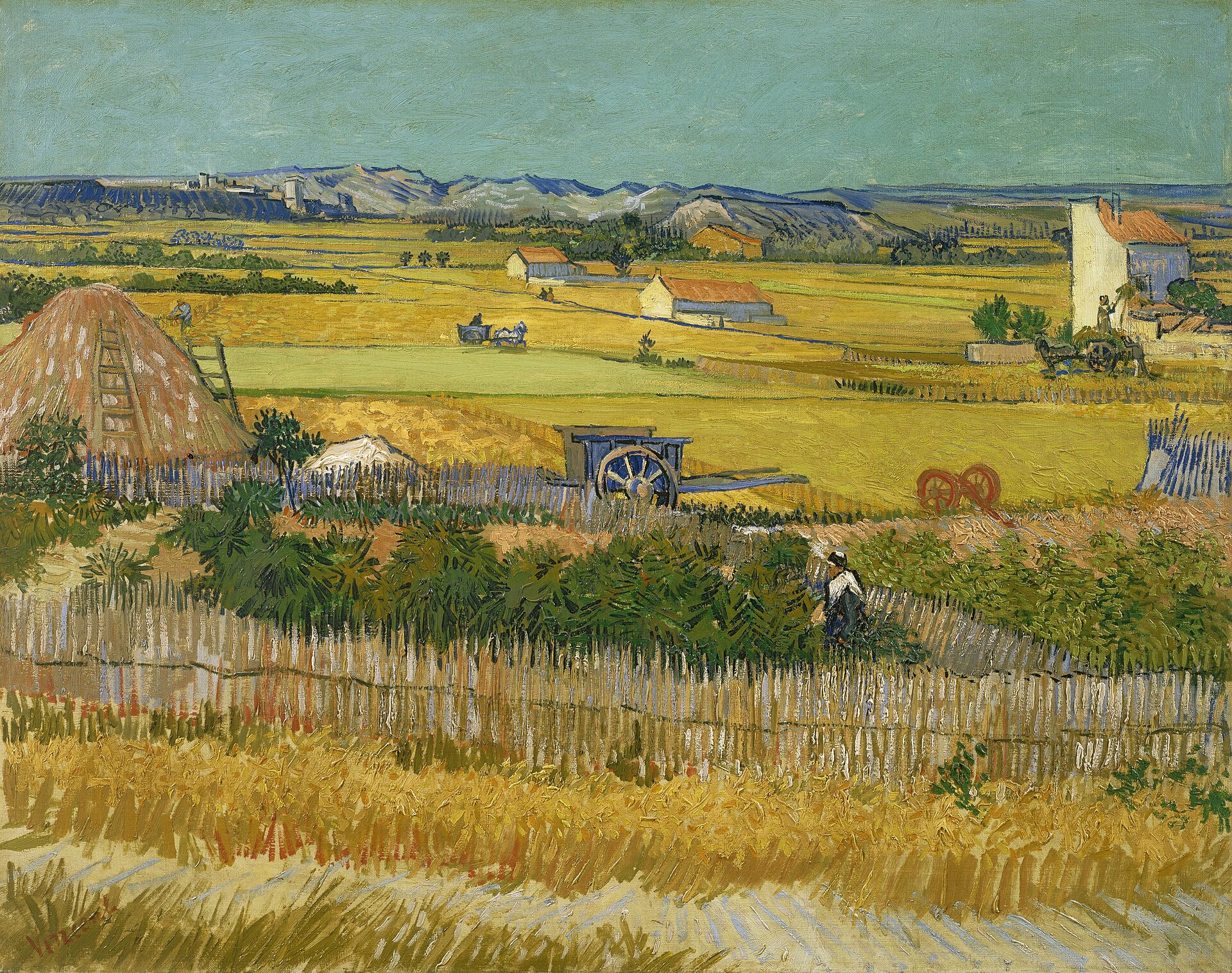
A wide summer panorama of golden fields, haystacks and farm carts on the plain of La Crau near Arles: Van Gogh painted The Harvest in June 1888 and considered it one of his very best pictures.
- Artist
- Vincent van Gogh
- Date
- June 1888
- Painted in
- Arles, France
- Medium
- Oil on canvas
- Size
- 73 × 92 cm
- Museum
- Van Gogh Museum, Amsterdam
- Catalogue
- F412 · JH1440
What the painting shows
The plain stretches away towards a range of blue hills, cut into a patchwork of yellow, ochre and green fields. In the middle ground stand a haystack, a ladder and a blue cart; nearby are farmhouses with red roofs, and tiny figures of harvesters at work. A low wooden fence runs across the foreground above a strip of ripe wheat. On the hill at the far left lie the ruins of the abbey of Montmajour.
The picture has an extraordinary clarity. Every element is sharply outlined, and the high viewpoint lets us see deep into the landscape, like a map.
A week of harvest pictures
Van Gogh painted the scene during an intense week of work in June 1888, when the wheat harvest was under way in Provence. He went out in the full sun and the mistral wind, producing a series of wheatfields and harvest scenes in a few days. He told Theo that this canvas was one of the best things he had done, comparable to the paintings of his favourite old masters of landscape.
His love of the region shows in the detail: he walked to Montmajour often and drew the same view in pen and ink.
The story behind The Harvest
In June 1888 the wheat on the plain of La Crau, east of Arles, was ripe, and Van Gogh spent a week painting the harvest in the blazing sun. He made about ten canvases in that week. He wrote that he worked in the middle of the day, in the full sun, without any shade, and enjoyed it like a cicada. This view, with its blue cart, haystacks and farms spread across the plain to the hills, was the one he valued most: he told Theo that this canvas absolutely killed all the rest.
He had prepared it carefully. Before painting he made drawings of the same view, including a large signed watercolour, La Moisson en Provence, which sold at Sotheby’s in May 2026 for $29.4 million (see our auction results).
A patchwork of colour
The plain is laid out like a quilt of yellow, ochre, green and orange fields, with a low wall, a blue cart and ladders in the foreground and blue hills on the horizon under a turquoise sky. Van Gogh used complementary contrasts, blue against orange, to make the colours vibrate, and different kinds of brushstroke for each texture: short hatchings for the stubble, flat areas for the walls, curved strokes for the trees. The wide, high viewpoint lets the eye travel slowly across the landscape, picking out the haystacks, the workers and the farmhouses one by one.
Things you might not know
- He thought it was his best. He wrote that it killed everything else he had done that summer.
- He painted it at midday. He worked in the full heat of the Provençal sun.
- It has a watercolour twin. The signed watercolour of the same view is now one of the most expensive Van Gogh works on paper.
- It is in Amsterdam. The painting stayed in the family and is in the Van Gogh Museum.
Where to see it
The Harvest is in the Van Gogh Museum in Amsterdam, which holds the largest collection of his paintings in the world, much of it inherited from his brother Theo’s family. It is one of the highlights of the museum’s Arles galleries.
Related paintings
 Peach Trees in Blossom1889 · Courtauld Gallery
 The Sower (Sower at Sunset)1888 · Kröller-Müller Museum
 A Lane in the Public Garden at Arles1888 · Kröller-Müller Museum
 Bedroom in Arles1888 · Van Gogh Museum
Frequently asked questions
Where is The Harvest by Van Gogh?
It is in the collection of the Van Gogh Museum, Amsterdam.
When did Van Gogh paint The Harvest?
In June 1888, in Arles, France.
How big is The Harvest?
The painting measures 73 × 92 cm. It is oil on canvas, catalogued as F412 and JH1440.
See every painting from his Arles period in the Arles collection, follow his travels on the interactive timeline, or download masterpieces as free wallpapers.
Image: Van Gogh Museum, Amsterdam (public domain), via Wikimedia Commons. Facts checked against the holding museum’s catalogue and the standard Van Gogh catalogues (de la Faille and Hulsker).
Where is Van Gogh’s The Harvest?
In the Van Gogh Museum in Amsterdam.
When did Van Gogh paint The Harvest?
In June 1888, on the plain of La Crau near Arles, during a week of painting the wheat harvest.