Home › Paintings › Olive trees
Painting series
Van Gogh’s Olive Trees: The Saint-Rémy Series
Around the asylum at Saint-Rémy, the slopes were covered with olive groves. Van Gogh painted them in every season of his year there, around fifteen canvases in all, and saw in their twisted trunks and silver-green leaves something old, secret and almost sacred.
A difficult, beloved motif
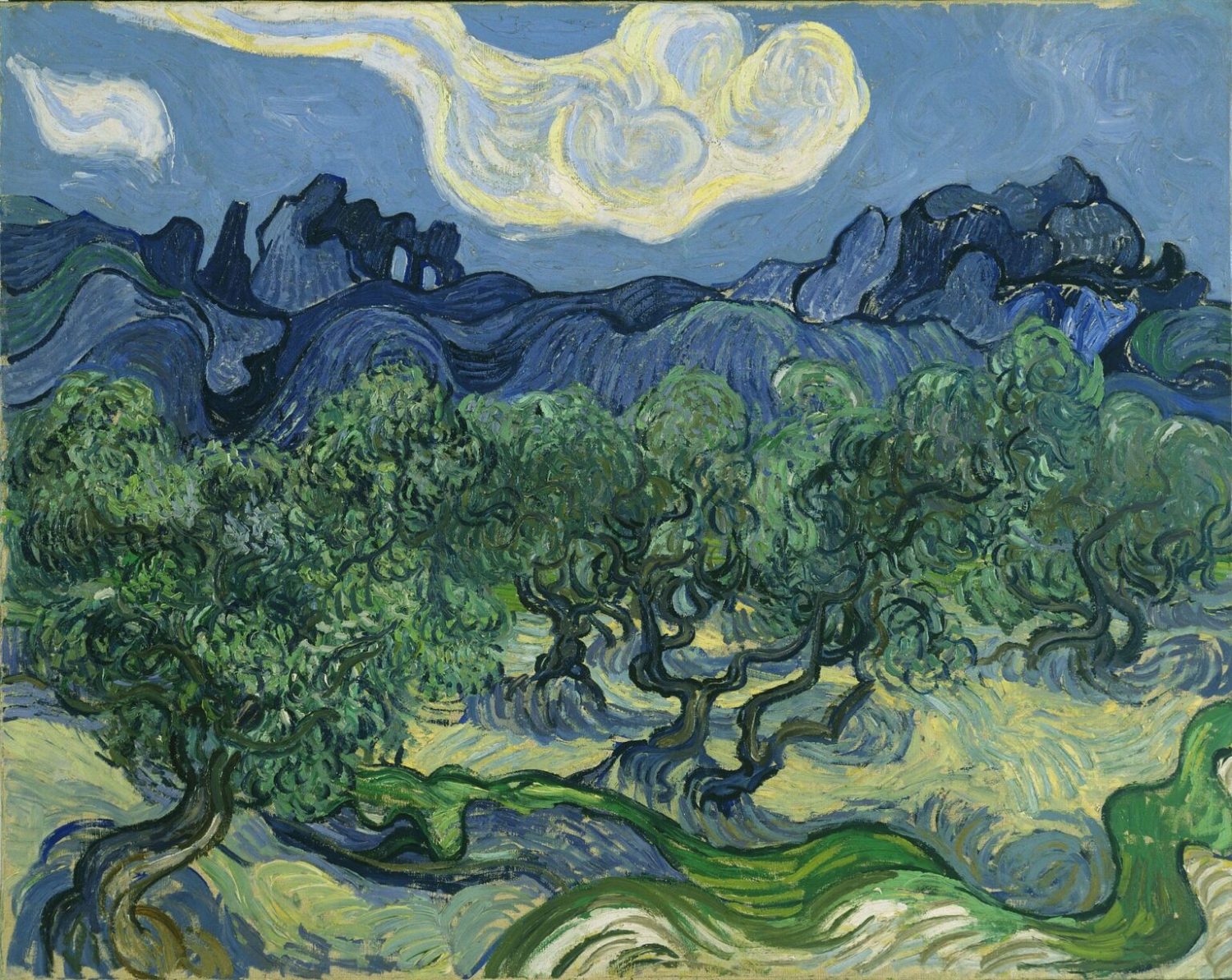
Van Gogh had seen olive trees in Arles, but at Saint-Rémy they surrounded him. He found them hard to paint: the leaves change from green to silver to blue depending on the light and the wind, and the trunks twist into strange shapes. In letters to Theo he said the rustle of an olive grove had something very secret and immensely old about it, too beautiful for him to dare to paint or even imagine. In June 1889, at the same time as The Starry Night, he painted Olive Trees with the Alpilles in the Background, its rolling hills and swirling clouds echoing the night sky; the two were conceived as companions and both are now at MoMA.
An answer to Gauguin and Bernard
In November 1889 Émile Bernard sent him photographs, and Gauguin a description and sketch, of their new religious paintings, including scenes of Christ in the Garden of Olives painted from imagination. Van Gogh disliked them. He told Bernard that one could express anguish without going straight to the historical Garden of Gethsemane, and that the real olive groves of Provence were enough. His response was a burst of olive paintings in late autumn: groves under pink and yellow skies, silvery leaves against blue mountains, trees with low suns. See Van Gogh and religion.
The olive harvest
In December 1889 he watched the olive picking and painted it: figures on ladders and with baskets among the trees, in rhythmic, almost decorative strokes. He made three versions of Women Picking Olives, one painted from life and two repetitions in the studio, one of which he made for his mother and sister. One version is in the Metropolitan Museum; another, Olive Grove with Picking Figures, is in the Kröller-Müller Museum.
The grasshopper in the paint
Van Gogh painted many of the olive groves outdoors, and the pictures still carry traces of it. In 2017 a conservator at the Nelson-Atkins Museum of Art in Kansas City, examining Olive Trees (1889) under magnification, found the tiny body of a grasshopper embedded in the paint, which must have landed on the wet canvas while he worked in the grove. Sand and plant debris have been found in other outdoor pictures. In 2021–22 the Dallas Museum of Art and the Van Gogh Museum reunited many of the olive paintings in the exhibition Van Gogh and the Olive Groves.
Every olive tree painting
All the olive grove paintings in our catalogue, in date order. Click any picture for its full page.
 Olive Trees on a Hillside1889 · Van Gogh Museum, Amsterdam
 The Olive Orchard1889 · Private collection
 Women Picking Olives1889 · Metropolitan Museum of Art, New York
 Olive trees1889 · National Galleries Scotland, Edinburgh
 Olive Grove1889 · Van Gogh Museum, Amsterdam
 Olive Trees1889 · Minneapolis Institute of Art, Minneapolis
 Olive Grove1889 · Van Gogh Museum, Amsterdam
 Olive Orchard1889 · The Nelson-Atkins Museum of Art, Kansas City
 Olive Trees with the Alpilles in the Background1889 · Museum of Modern Art, New York
 Olive Grove1889 · Kröller-Müller Museum, Otterlo
 Olive Trees1889 · Private collection
 Olive Trees1889 · Metropolitan Museum of Art, New York
 Olive Grove, Saint-Rémy1889 · Gothenburg Museum of Art
 Olive Picking1889 · Basil and Elise Goulandris Foundation, Athens
 Landscape with Olive Tree and Mountains in the Background1889 · Private collection
 The white cottage among the olive trees1889 · Private collection
 Olive Grove with Picking Figures1889 · Kröller-Müller Museum, Otterlo
Frequently asked questions
How many olive tree paintings did Van Gogh make?
About fifteen, all painted in 1889 at Saint-Rémy-de-Provence, mainly in June and in November–December.
Where are Van Gogh’s olive tree paintings?
They are spread across museums including MoMA and the Metropolitan Museum in New York, the Van Gogh Museum and Kröller-Müller Museum in the Netherlands, the Nelson-Atkins Museum in Kansas City, the Minneapolis Institute of Art, the Gothenburg Museum of Art and the National Galleries of Scotland, plus private collections.
Is there really a grasshopper in a Van Gogh painting?
Yes. In 2017 a conservator at the Nelson-Atkins Museum found a grasshopper embedded in the paint of Olive Trees (1889), which Van Gogh painted outdoors.
Sources: Van Gogh Museum; Van Gogh Letters; Nelson-Atkins Museum of Art.