Painting series
Van Gogh’s Flower Paintings: Still Lifes, Irises and Roses
Flowers run right through Van Gogh’s career: dozens of bright bouquets painted in Paris to teach himself colour, the oleanders and sunflowers of Arles, the irises and roses of the asylum garden at Saint-Rémy and the small glasses of wild flowers he painted in his last weeks at Auvers.
Flowers as a colour school
When Van Gogh arrived in Paris in March 1886 his palette was still the dark browns and greens of Nuenen. Flowers were how he changed it. Through the summer of 1886 he painted bouquet after bouquet: poppies, gladioli, carnations, zinnias, asters, peonies, chrysanthemums. They were cheap, they kept still, and they did not have to be paid like a model.
He explained what he was doing in a letter to the English painter Horace Mann Livens that autumn. Having no money for models, he had painted a series of colour studies of flowers, looking for oppositions of blue with orange, red with green and yellow with violet, and trying to bring the extremes into harmony. Many of these canvases have dark backgrounds that recall the flower pieces of Adolphe Monticelli, whose work he and Theo admired (Theo owned one of Monticelli’s bouquets). By 1887 the backgrounds were lighter and the brushwork broken into separate strokes, as in Vase with Cornflowers and Poppies and Fritillaries in a Copper Vase.
Arles: oleanders, zinnias and sunflowers
In Arles flowers moved outdoors and into his gardens and fields, and in August 1888 into the series he is best known for, the Sunflowers, painted to decorate the Yellow House for Gauguin. Alongside them he painted pink Oleanders in a majolica jug, set next to a copy of Zola’s novel La Joie de vivre, a vase of zinnias and the flowering gardens of the town, crowded with marigolds, geraniums and poppies.
Saint-Rémy: irises, lilac and roses
In his first week at the asylum of Saint-Paul-de-Mausole in May 1889 he painted Irises, a bed of the flowers in the garden, with one white iris among the blue. Theo sent it to the Salon des Indépendants that September. From the same spring come the Lilac Bush (Hermitage) and close-up studies of the garden, such as Butterflies and Poppies.
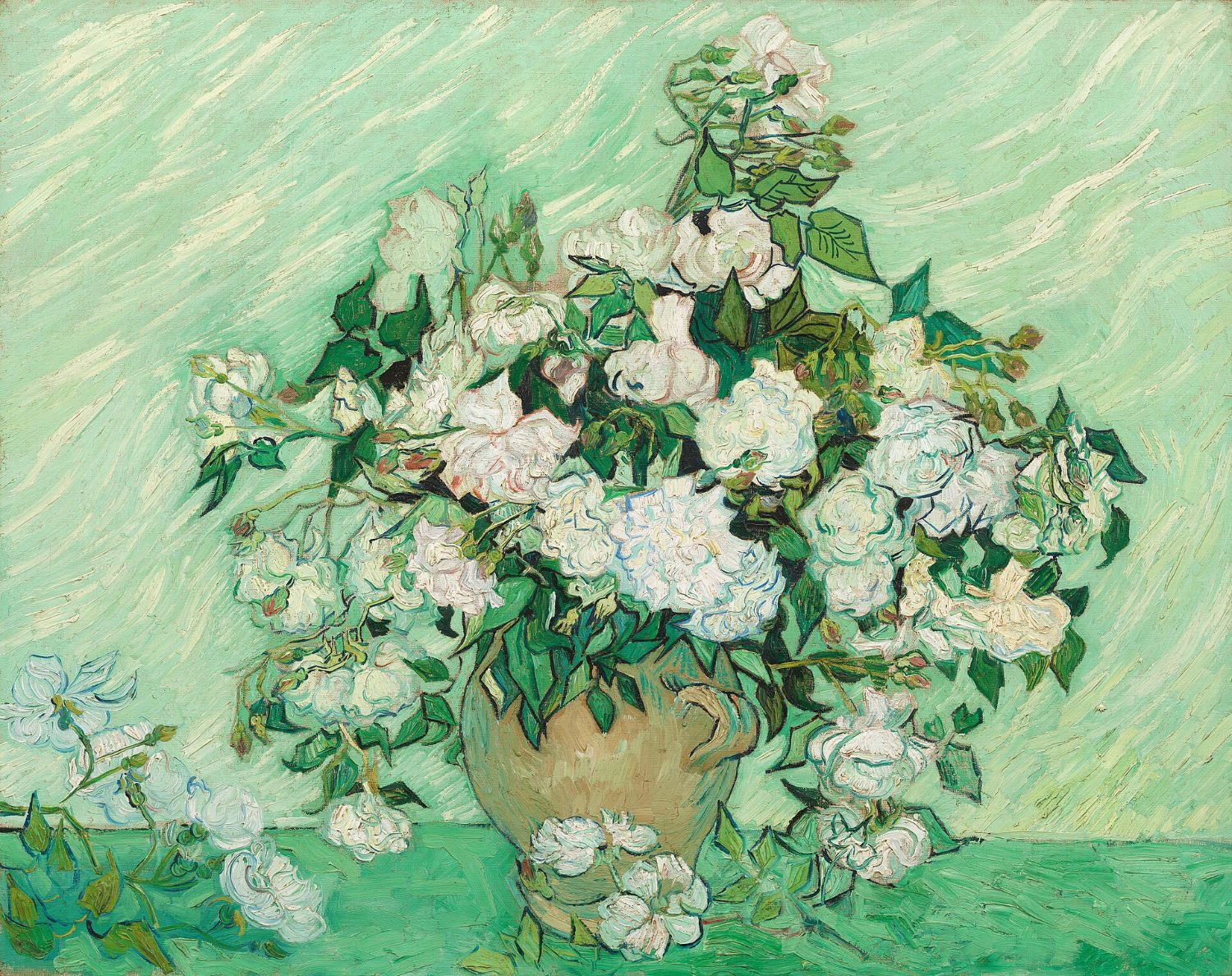
In February 1890 he painted Almond Blossom for his newborn nephew. Then, in May 1890, in the days before he left the asylum, he painted four large bouquets: two of irises, one against a yellow background (Van Gogh Museum) and one against pink (Metropolitan Museum), and two of roses, now in the Metropolitan Museum and the National Gallery of Art. The pinks and purples have faded with time, so the backgrounds and blossoms looked warmer when he painted them.
Auvers: wild flowers in a glass
In Auvers-sur-Oise, in June and July 1890, the bouquets became smaller and wilder: field flowers, thistles and ears of wheat stuck in a glass or a jug. Several were painted at the house of Dr Paul Gachet, whose garden and collection of old pots gave him subjects. Among them are Japanese Vase with Roses and Anemones, now in the Musée d’Orsay, Wild Flowers and Thistles in a Vase and Vase with Daisies and Poppies, painted at Gachet’s in mid-June and sold at Sotheby’s New York in 2014 for $61.8 million.
Every flower painting
All the flower still lifes and flower pieces in our catalogue, in date order (sunflowers and orchards have their own pages: Sunflowers, Orchards in Blossom). Click any picture for its full page.
 Vase with Honesty1884 · Van Gogh Museum, Amsterdam
 Fritillaries1886 · Private collection
 Vase with Red Poppies1886 · Wadsworth Atheneum Museum of Art, Hartford
 Bowl with Peonies and Roses1886 · Kröller-Müller Museum, Otterlo
 Small Bottle with Peonies and Blue Delphiniums1886 · Van Gogh Museum, Amsterdam
 Vase with Peonies1886 · Private collection
 Ginger Jar Filled with Chrysanthemums1886 · Private collection
 Vase with red and white carnation on a yellow background1886 · Kröller-Müller Museum, Otterlo
 Vase with Flowers1886 · Kunstmuseum Den Haag, The Hague
 Vase with Gladioli and Lilac1886 · Private collection
 Vase with Carnations1886 · Detroit Institute of Arts, Detroit
 Vase with White and Red Carnations1886 · Private collection
 Vase with Red and White Flowers1886 · Museum Boijmans Van Beuningen, Rotterdam
 Vase with Carnations and Zinnias1886 · Private collection
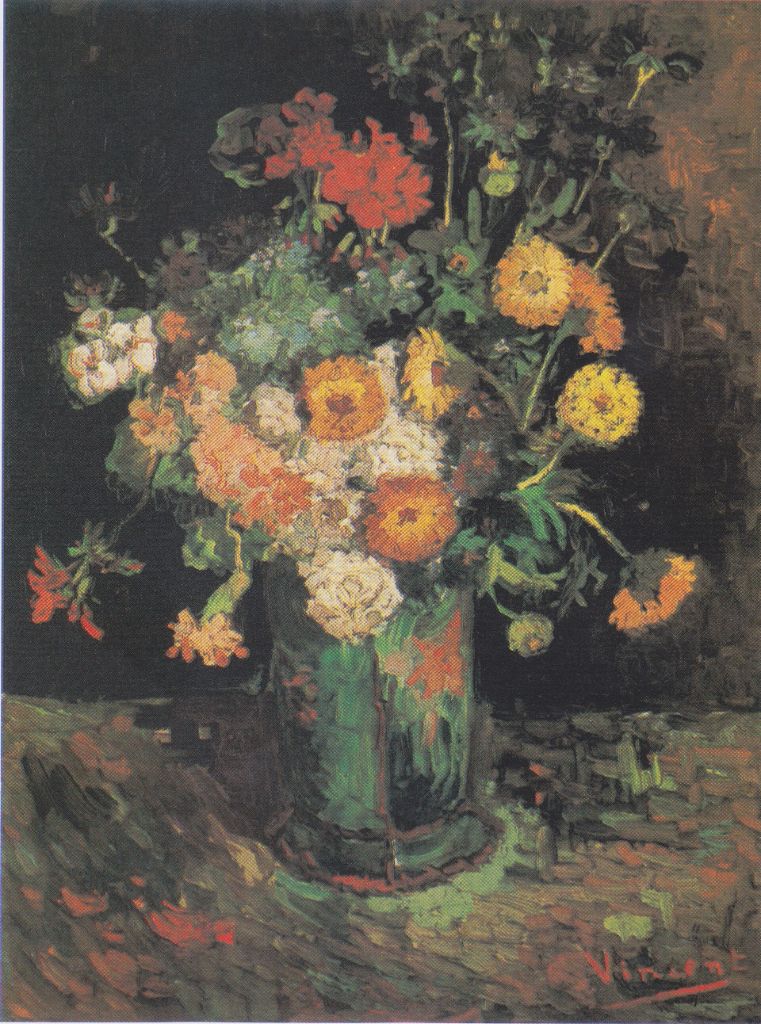 Vase with Zinnias and Geraniums1886 · National Gallery of Canada, Ottawa, Canada
 Vase with Carnations and Other Flowers1886 · Kreeger Museum, Washington, D.C.
 Vase with Musk-mallows1886 · Kunsthaus Zürich, Zurich
 Vase with Carnations1886 · Museum Boijmans Van Beuningen, Rotterdam
 Geranium in a Flowerpot1886 · Private collection
 Bowl with Zinnias1886 · Kreeger Museum, Washington, D.C.
 White Vase with Roses and Other Flowers1886 · Private collection
 Bowl with Zinnias and Other Flowers1886 · National Gallery of Canada, Ottawa, Canada
 Flame Nettle in a Flowerpot1886 · Van Gogh Museum, Amsterdam
 Glass with Yellow Roses1886 · Van Gogh Museum, Amsterdam
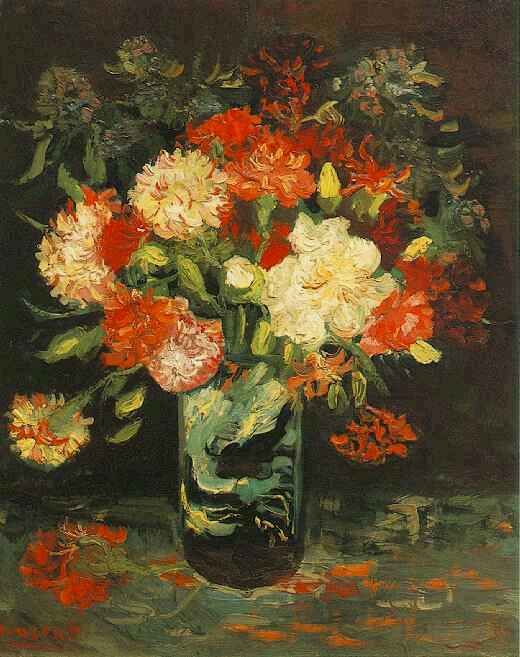 Vase with Carnations1886 · Van Gogh Museum, Amsterdam
 Vase with Red Gladioli1886 · Private collection
 Vase with Gladioli and Carnations1886 · Private collection
 Vase with Gladioli and China Asters1886 · Van Gogh Museum, Amsterdam
 Vase with Red Gladioli1886 · Private collection
 Bouquet of gladioli of various colors1886 · Fondation Jean et Suzanne Planque, Lausanne
 Bowl with Chrysanthemums1886 · Private collection
 Still Life with a Bouquet of Daisies1886 · Philadelphia Museum of Art, Philadelphia
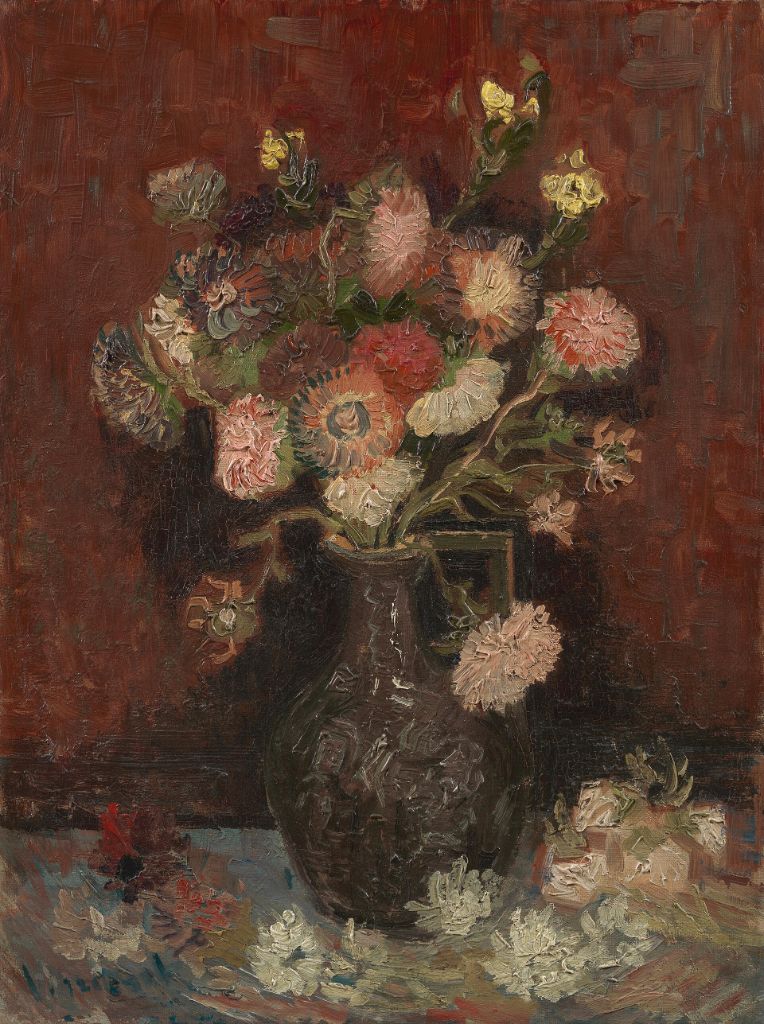 Vase with Chinese Asters and Gladioli1886 · Van Gogh Museum, Amsterdam
 Bouquet of Flowers in a Vase · Metropolitan Museum of Art, New York
 Poppy Flowers1887 · Private collection
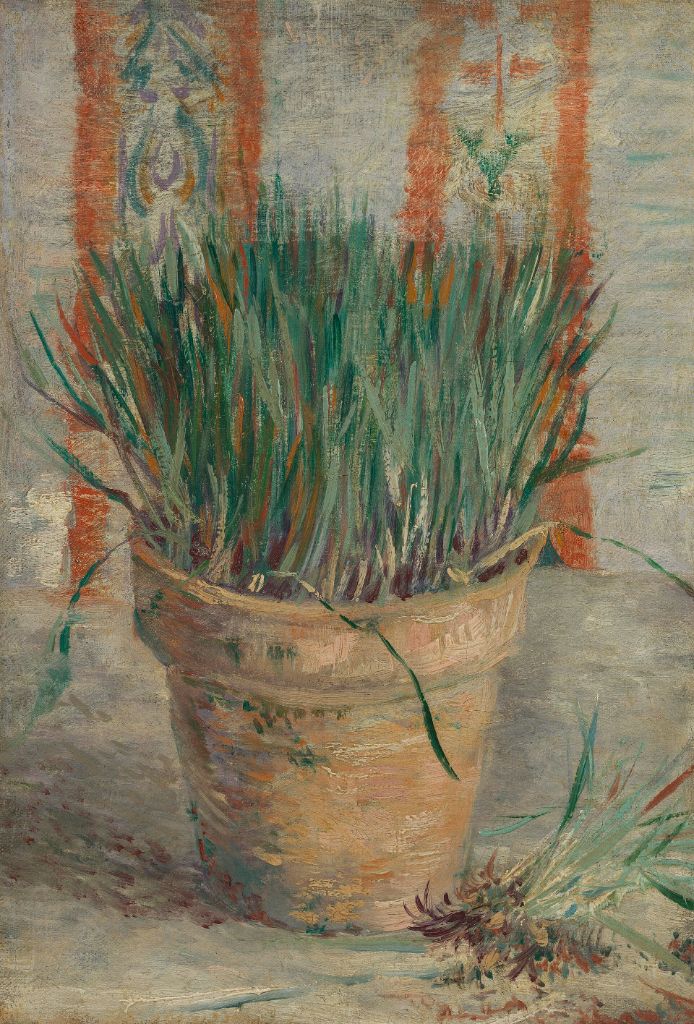 Flowerpot with Garlic Chives1887 · Van Gogh Museum, Amsterdam
 Fritillaries in a Copper Vase1887 · Musée d’Orsay, Paris
 Vase with Lilacs, Daisies and Anemones1887 · Museum of Art and History Geneva, Geneva
 Vase with Cornflowers and Poppies1887 · Triton Collection
 Lilacs1887 · Hammer Museum, Los Angeles
 Vase with daisies and anemones1887 · Kröller-Müller Museum, Otterlo
 Flowers in a Blue Vase1887 · Private collection
 Vase with Flowers1887 · Private collection
 Still Life: Majolica with Wildflowers1888 · Barnes Foundation, Philadelphia
 Still Life: Bowl with Daisies1888 · Virginia Museum of Fine Arts, Richmond
 Oleanders1888 · Metropolitan Museum of Art, New York
 Still Life: Vase with Oleanders1888 · Private collection
 Flowering Garden1888 · Private collection
 Flowering Garden with Path1888 · Kunstmuseum Den Haag, The Hague
 Still Life: Vase with Zinnias1888 · Private collection
 Lilac Bush1889 · Hermitage Museum, St Petersburg, Russia
 Irises1889
 Roses1889 · National Museum of Western Art, Ueno-kōen, Japan
 Wild Roses1889 · Van Gogh Museum, Amsterdam
 Roses1889 · Van Gogh Museum, Amsterdam
 Butterflies and Poppies1889 · Van Gogh Museum, Amsterdam
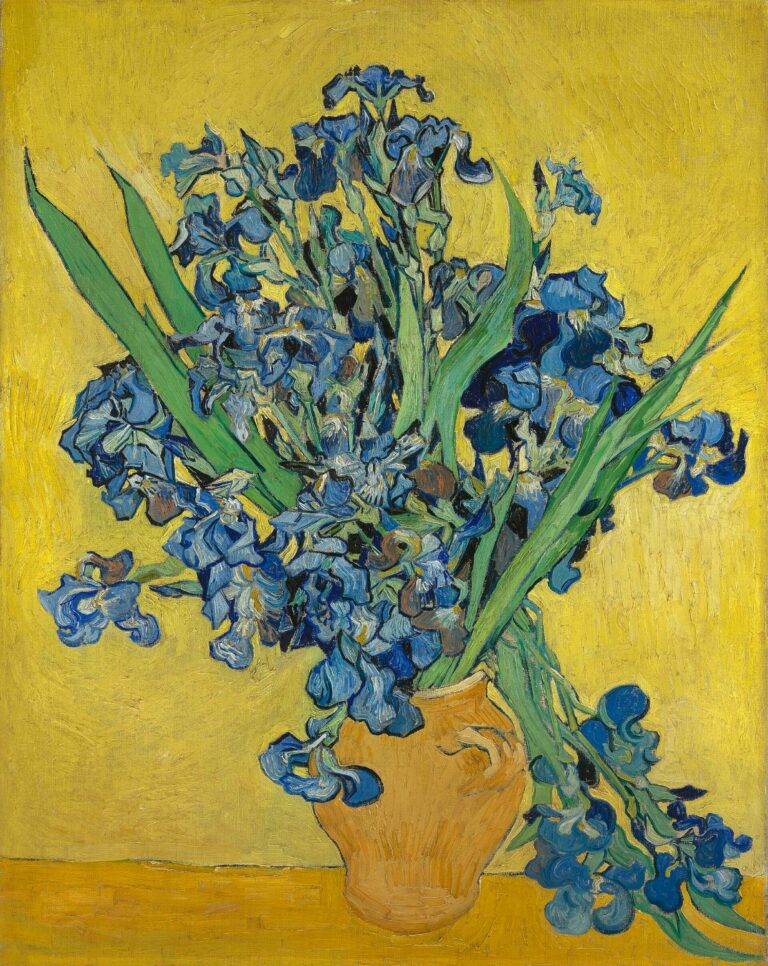 Irises (1890)1890
 Still Life: Vase with Pink Roses1890
 Irises1890 · Metropolitan Museum of Art, New York
 Roses1890 · Metropolitan Museum of Art, New York
 Pink Roses1890 · Ny Carlsberg Glyptotek, Copenhagen, Denmark
 Wild Flowers and Thistles in a Vase1890 · Private collection
 Still Life, Vase with Daisies and Poppies1890
 Still Life: Glass with Wild Flowers1890 · Private collection
 Glass with Carnations1890 · Private collection
 Vase with flowers and thistles1890 · Pola Museum of Art, Hakone, Japan
 Still Life: Japanese Vase with Roses and Anemones1890 · Musée d’Orsay, Paris
 Vase of Flowers1890 · Van Gogh Museum, Amsterdam
Frequently asked questions
How many flower paintings did Van Gogh paint?
There is no single agreed figure, but flower still lifes run to many dozens, and more than thirty were painted in Paris in the summer of 1886 alone. Counting the sunflowers, the orchards in blossom and the garden pictures, flowers are one of the largest subjects in his work. Our gallery lists 68 flower still lifes and studies.
Why did Van Gogh paint so many flowers?
In Paris he used flowers to learn modern colour: they were cheap, they kept still and he could not afford models. He was looking for strong contrasts of complementary colours, red against green, blue against orange, yellow against violet.
What is Van Gogh’s most famous flower painting?
The Sunflowers, especially the version in the National Gallery in London and the one in the Van Gogh Museum. Irises (1889, Getty Center) and Almond Blossom (1890, Van Gogh Museum) are close behind.
Where can I see Van Gogh’s flower paintings?
The Van Gogh Museum in Amsterdam has the largest group, including Almond Blossom and the yellow-background Irises. The Metropolitan Museum in New York has Oleanders and the May 1890 Irises and Roses, the Getty Center in Los Angeles has the 1889 Irises, the National Gallery of Art in Washington has the pink Roses and the Musée d’Orsay has the Japanese vase with roses and anemones.
Why do Van Gogh’s roses look white?
Several of his pinks and purples were made with pigments that fade in light, particularly a red lake. The roses in the Washington and New York paintings were pink, and the backgrounds of the May 1890 bouquets were warmer than they look today.
Sources: Van Gogh Museum; Vincent van Gogh – The Letters (letter to H. M. Livens, 1886); Metropolitan Museum of Art; National Gallery of Art.