Home › Travel › Van Gogh in Belgium
Travel guide · Belgium
Van Gogh in Belgium: the Borinage, Brussels and Antwerp
Belgium is where Vincent van Gogh decided to become an artist. In the coal-mining Borinage he failed as a preacher and started to draw; in Brussels he took his first lessons; and in Antwerp he discovered Rubens, colour and Japanese prints before leaving for Paris.
Three spells in Belgium
Van Gogh’s Belgian years are the hinge of his life. He arrived in 1878 as a failed art dealer who wanted to be an evangelist, and he left Antwerp in 1886 as a painter on his way to Paris. In between came the most desperate and the most decisive period of his career.
- Brussels and the Borinage, 1878–80. After a short course at an evangelical training school near Brussels, he went to the Borinage, the coal basin west of Mons, as a lay preacher.
- Brussels, 1880–81. Having decided to become an artist, he moved to the capital to learn to draw.
- Antwerp, 1885–86. After two years painting peasants in Nuenen, he spent three months in Antwerp, studying at the Academy and in the museums.
The Borinage: where the preacher became an artist
Van Gogh arrived in the Borinage at the end of 1878. He lodged first at Wasmes, in the house of the baker Jean-Baptiste Denis at 81 rue du Petit-Wasmes (today rue Wilson, Colfontaine), and preached and nursed among the miners. In April 1879 he went down the Marcasse mine, one of the deepest in the district. His zeal, including giving away his own clothes and living in a hut, alarmed the church authorities, who did not renew his post.
In August 1879 he moved a short distance to Cuesmes, lodging first with the evangelist Édouard Francq and then with the miner Charles Decrucq at 3 rue du Pavillon. There, poor and isolated, he began to draw seriously, copying exercises and sketching miners and their wives. In 1880 he wrote to Theo that he had picked up his pencil again. It was the moment he became an artist.
Visiting the Van Gogh houses near Mons
Maison Van Gogh, Cuesmes (3 rue du Pavillon) is the Decrucq house where he decided to become an artist. The visit starts in the garden and a renovated pavilion and ends with an audio installation about the Borinage; tickets start at about €4. Maison Van Gogh, Wasmes (Colfontaine), the restored Denis house where he first lodged, has more limited opening, often weekends only. You can also visit the Marcasse mine site, whose pithead buildings survive. Visit Mons sells a Van Gogh Pass covering the houses and runs guided tours of the trail.
Mons is about an hour by train from Brussels. Cuesmes is a short bus or taxi ride south of the centre; Wasmes and Marcasse are a few kilometres further west, easiest by car or bike (there is a signed cycle route linking the sites). Check opening days with Visit Mons before you travel.
Brussels: first lessons
In October 1880 Van Gogh moved to Brussels and took a room at 72 boulevard du Midi, above a café, paying 50 francs a month for board. He worked through drawing courses that Theo’s colleagues sent him, studied anatomy and perspective, and briefly attended classes at the Academy of Fine Arts. On Theo’s advice he called on Anthon van Rappard, a young Dutch aristocrat studying at the Academy, who became one of his few artist friends and lent him his studio. In April 1881 he left for his parents’ home at Etten.
Brussels played one more part in his story. In January 1890 six of his paintings were shown with the avant-garde group Les XX, and the Belgian painter Anna Boch, sister of his friend Eugène Boch, bought The Red Vineyard for 400 francs, the only sale of a painting that is documented in his lifetime.
Antwerp: Rubens, colour and Japanese prints
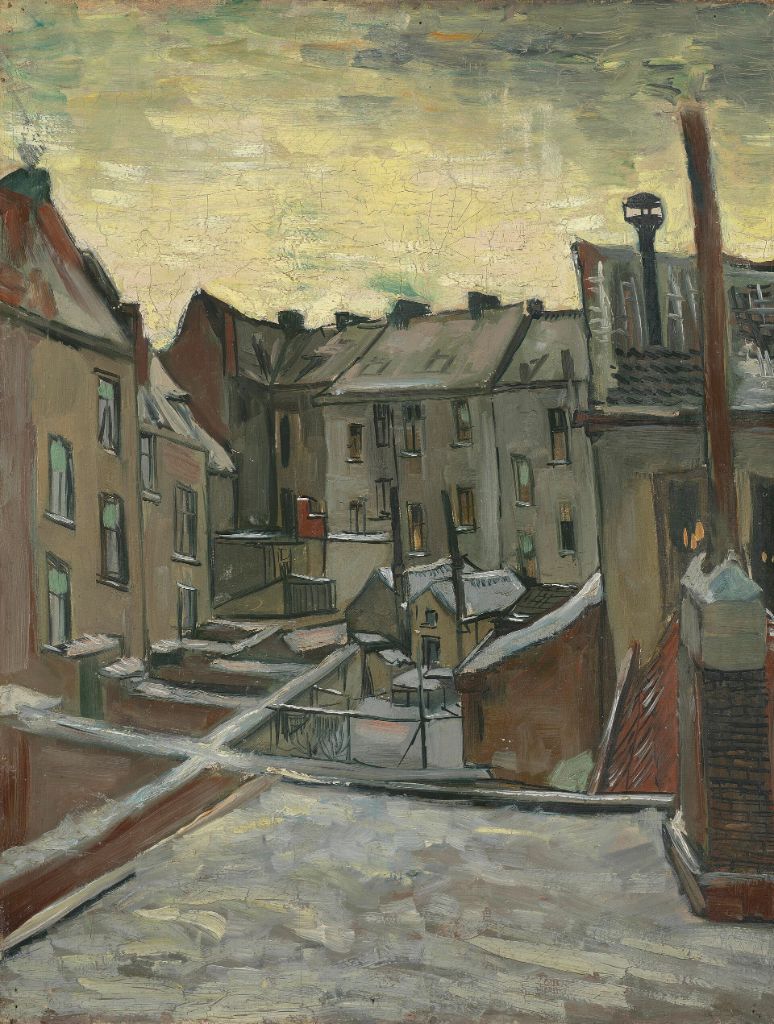
Van Gogh arrived in Antwerp in late November 1885 and rented a small room above a paint dealer at what was then rue des Images 194, today Lange Beeldekensstraat 224, in the working-class Stuivenberg district. A small square nearby is named Vincent van Goghplein. He painted the backyards seen from the stairwell window (Van Gogh Museum), walked the docks, bought Japanese prints and decorated his room with them.
He went often to the city’s museum, then housed in the Academy building and now the KMSKA (Royal Museum of Fine Arts Antwerp), and was overwhelmed by Rubens’s colour and handling. In January 1886 he enrolled at the Royal Academy of Fine Arts, but clashed with its teachers. It was there that he painted the joke Skull of a Skeleton with Burning Cigarette. Exhausted and ill, he left for Paris at the end of February 1886 and moved in with Theo.
Seeing his paintings: Belgium and beyond
Do not expect to see many Van Goghs in Belgian museums: his Borinage drawings and Antwerp pictures are mostly in Amsterdam and Otterlo. The good news is that both are close. Antwerp to Amsterdam is about 70 minutes by Eurostar or Intercity, and the Van Gogh Museum shows his Antwerp paintings, the Skull and the backyards. The Kröller-Müller Museum holds a large group of early drawings. A Belgium-and-Netherlands trip can follow his whole early life in a week; see our Netherlands travel guide.
Frequently asked questions
Where did Van Gogh live in Belgium?
In the Borinage mining district near Mons (Wasmes and Cuesmes, 1878–80), in Brussels (72 boulevard du Midi, 1880–81) and in Antwerp (Lange Beeldekensstraat, then numbered 194, 1885–86).
Can you visit Van Gogh’s house in Belgium?
Yes. The Maison Van Gogh in Cuesmes, near Mons, where he decided to become an artist, is open to visitors, and the restored house in Wasmes (Colfontaine) has more limited opening. Visit Mons sells a combined Van Gogh Pass.
Why did Van Gogh go to the Borinage?
He went in 1878 as a lay preacher to the coal miners. The church dismissed him in 1879 for his extreme zeal, and while living in poverty at Cuesmes he began to draw, deciding in 1880 to become an artist.
Did Van Gogh study in Antwerp?
Yes. He enrolled at the Royal Academy of Fine Arts in Antwerp in January 1886 but stayed only a few weeks before leaving for Paris at the end of February.
Which Van Gogh painting was sold in Brussels?
The Red Vineyard, bought by the Belgian painter Anna Boch for 400 francs at the Les XX exhibition in Brussels in early 1890.
Sources: Visit Mons – Van Gogh House Cuesmes; Visit Mons – Van Gogh House Wasmes; KMSKA – Vincent van Gogh in Antwerp; Van Gogh Letters – letter 544 (Antwerp); Van Gogh Letters – letter 160 (Brussels); Art Institute of Chicago – Van Gogh’s bedrooms timeline.