Home › Paintings › Auvers-sur-Oise › The Church at Auvers
Auvers-sur-Oise · 1890
The Church at Auvers
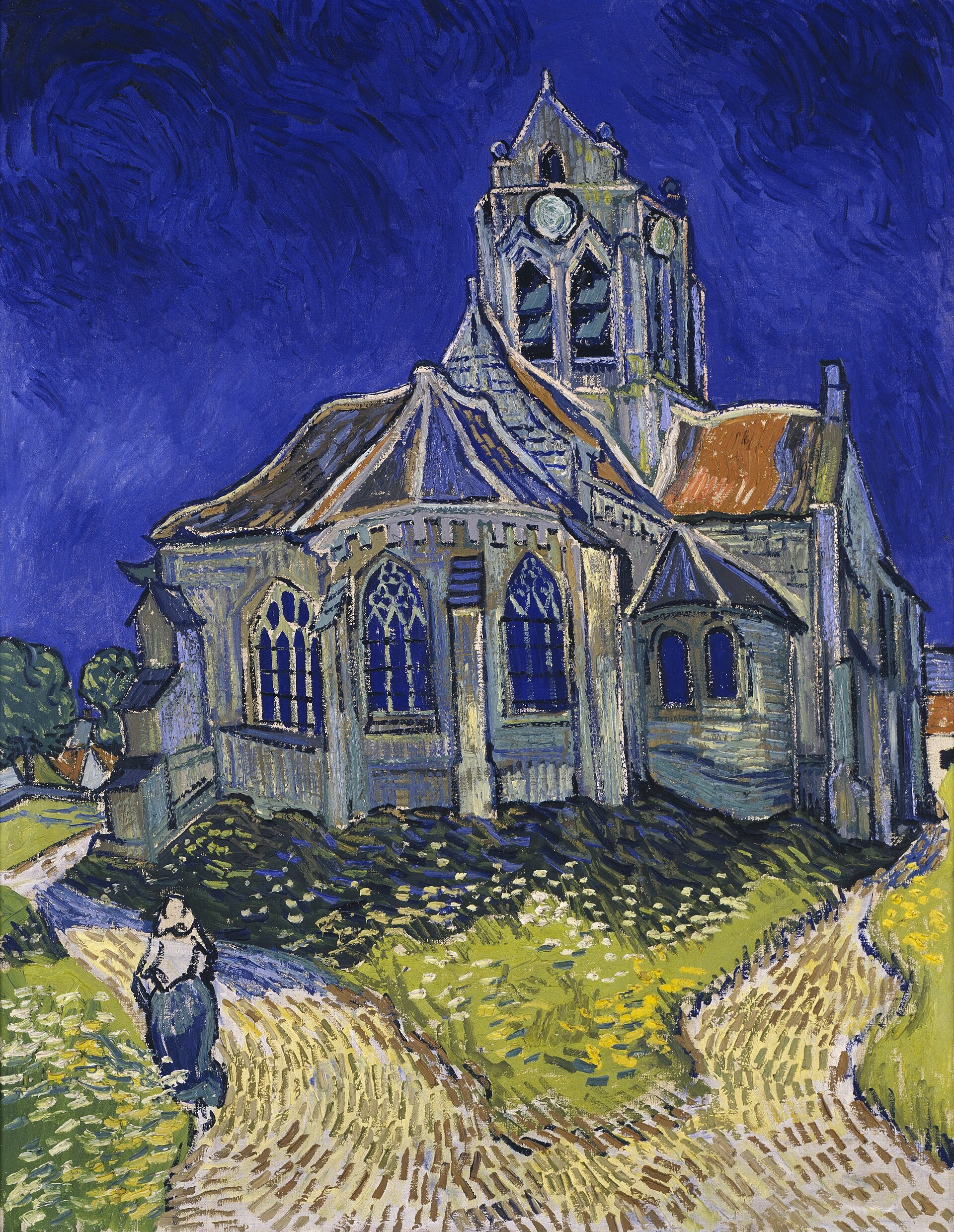
The village church of Auvers seems to sway beneath a deep cobalt sky while a path splits around it: The Church at Auvers, painted in June 1890, is one of the masterpieces of Van Gogh’s final weeks.
- Artist
- Vincent van Gogh
- Date
- June 1890
- Painted in
- Auvers-sur-Oise, France
- Medium
- Oil on canvas
- Size
- 94 × 74 cm
- Museum
- Musée d’Orsay, Paris
- Catalogue
- F789 · JH2006
What the painting shows
The Gothic church fills the centre of the canvas, seen from behind. Its walls are painted in blues, violets and orange, and its outline bends and ripples as if it were alive. Above, the sky is an intense, almost black blue. In front, a sandy path divides into two around a patch of grass and flowers, and a peasant woman walks away along the left-hand branch.
The church is in shadow while the ground in front is in sunlight, an unusual effect that adds to the strangeness of the picture.
A memory of the North
Van Gogh described the painting to his sister Willemien, saying it was almost the same as the studies he had made in Nuenen of the old tower and cemetery, but that the colour was now more expressive and more sumptuous. The church of Notre-Dame-de-l’Assomption still stands above the village; the view is easily recognised today.
The story behind The Church at Auvers
Van Gogh painted the church of Notre-Dame-de-l’Assomption in Auvers-sur-Oise in early June 1890, a couple of weeks after arriving in the village. The church, a 12th–13th century Gothic building, stands on a rise above the village, and he set up his easel behind it, so that we see the apse and the tower rather than the entrance. He described the picture to his sister Wil: the building appears violet-hued against a sky of a simple, deep blue, pure cobalt; the stained-glass windows look like ultramarine blotches; the roof is violet and partly orange; in the foreground some green plants in flower and sand with the pink glow of sunshine on it.
He compared it to studies he had made in Nuenen of the old tower and cemetery, noting that the colour was now more expressive and sumptuous. The comparison is telling: the subject of a village church took him back to the beginning of his career, but his way of painting had changed completely.
Colour and distortion
The church seems to be moving. Its walls bend and sway, the windows are dark pools, and the building is held between a deep, almost black blue sky and a sunlit path that splits in two in the foreground. The path forks around the church, and a woman in a Breton-style bonnet walks away up the left-hand track. Van Gogh painted the church in shadow while the ground in front is bright, which gives the building a heavy, brooding presence. Many viewers find it unsettling; others see in it his love of the Gothic churches of the north.
Things you might not know
- The church still stands. It looks much as it did in 1890, and a panel nearby shows the painting.
- He is buried nearby. Van Gogh and Theo lie in the village cemetery, a short walk up the hill past the wheat fields.
- He painted it from behind. The view shows the east end of the church, not the main entrance.
- It is in Paris. The painting was bought from Dr Gachet’s son, Paul Gachet junior, and given to the French state in 1951; it is in the Musée d’Orsay.
- He painted another view of the church. A smaller, distant view of the church and village is in the RISD Museum in Providence, USA.
Visiting the church
Auvers-sur-Oise is about an hour from central Paris by train. From the station it is a short climb to the church, then up the lane to the cemetery and the wheat fields of Wheatfield with Crows. Combine it with the Auberge Ravoux, where he died, using our Auvers-sur-Oise travel guide.
Where to see it
The painting belongs to the Musée d’Orsay in Paris. It was given to the French national museums by Paul Gachet junior, the son of Dr Gachet, in 1951.
Related paintings
 Wheatfield with Crows1890 · Van Gogh Museum
 Tree Roots1890 · Van Gogh Museum
 White House at Night1890 · Hermitage Museum
 Marguerite Gachet in the Garden1890 · Musée d’Orsay
Frequently asked questions
Where is The Church at Auvers by Van Gogh?
It is in the collection of the Musée d’Orsay, Paris.
When did Van Gogh paint The Church at Auvers?
In June 1890, in Auvers-sur-Oise, France.
How big is The Church at Auvers?
The painting measures 94 × 74 cm. It is oil on canvas, catalogued as F789 and JH2006.
See every painting from his Auvers-sur-Oise period in the catalogue, follow his travels on the interactive timeline, or download masterpieces as free wallpapers.
Image: Musée d’Orsay, Paris (public domain), via Wikimedia Commons. Facts checked against the holding museum’s catalogue and the standard Van Gogh catalogues (de la Faille and Hulsker).
Is the church in Van Gogh’s The Church at Auvers still there?
Yes. Notre-Dame-de-l’Assomption in Auvers-sur-Oise still stands, close to the cemetery where Van Gogh is buried.
Where is The Church at Auvers painting?
In the Musée d’Orsay in Paris.