Home › Paintings › Arles › Gauguin’s Armchair
Arles · 1888
Gauguin’s Armchair
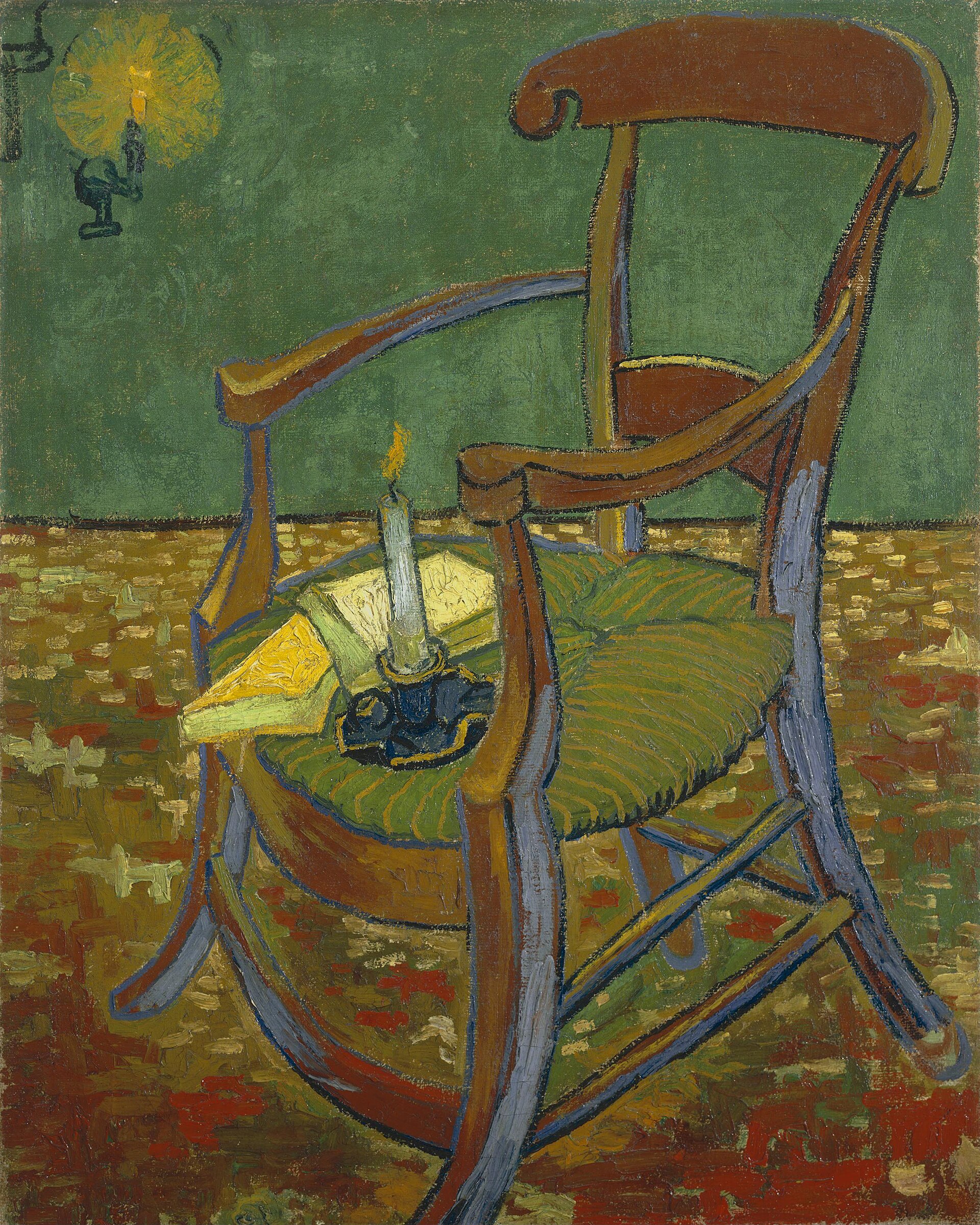
An elegant armchair at night, with a lit candle and two novels on its seat: Van Gogh painted Paul Gauguin’s chair in November 1888 as a portrait of his friend – and a pair to his own humble chair.
- Artist
- Vincent van Gogh
- Date
- November 1888
- Painted in
- Arles, France
- Medium
- Oil on canvas
- Size
- 90.5 × 72.7 cm
- Museum
- Van Gogh Museum, Amsterdam
- Catalogue
- F499 · JH1636
What the painting shows
A curved wooden armchair, painted in reds and browns, stands on a patterned green and red carpet. On the seat burns a candle in a holder, beside two paperback novels. On the wall behind, a gas lamp glows. The scene is lit by artificial light and dominated by deep reds and greens.
It is a much richer, more sophisticated image than Van Gogh’s Chair, with its plain wood and tobacco.
A portrait of an absent friend
Gauguin was living with Van Gogh in the Yellow House when the two chairs were painted. Later Van Gogh wrote that he had tried to paint Gauguin’s “empty place”. The candle and the books are usually read as symbols of Gauguin’s imagination and intellect, in contrast to Van Gogh’s down-to-earth pipe. A few weeks later, after their quarrel in December 1888, Gauguin left Arles for good.
Night and day
Van Gogh painted Gauguin’s Armchair in November 1888, while Gauguin was living with him in the Yellow House, as a companion to Van Gogh’s Chair. The two pictures are opposites. His own chair is a plain rush-seated chair in daylight, with his pipe and tobacco on it. Gauguin’s is an elegant armchair with curved arms, seen at night by the light of a gas lamp on the wall, with a lit candle and two novels lying on the seat. The books and the flame stand for Gauguin’s learning and imagination, the qualities Van Gogh admired in him.
An empty place
In a letter of February 1890 to the critic Albert Aurier, Van Gogh explained that a few days before he and Gauguin parted, he had tried to paint Gauguin’s empty place. Read in that light, the empty armchair becomes a portrait of an absent friend, and a sad sign of the breakdown of their partnership after the crisis of 23 December 1888. Gauguin left Arles a few days later and the two never met again, though they went on writing to each other. Read more in Van Gogh and Gauguin.
Things you might not know
- The pair is split. Gauguin’s Armchair is in the Van Gogh Museum in Amsterdam; Van Gogh’s Chair is in the National Gallery in London.
- It shows his new gas lighting. Van Gogh had gas installed in the Yellow House so he could work in the evenings.
- No people, but two portraits. Many art historians see the two chairs as portraits of the two men.
Where to see it
The painting belongs to the Van Gogh Museum in Amsterdam. Its companion, Van Gogh’s Chair, is in the National Gallery, London.
Related paintings
 Van Gogh’s Chair1888 · National Gallery
 Self-portrait, dedicated to Paul Gauguin1888 · Fogg Museum
 The Yellow House1888 · Van Gogh Museum
 The Red Vineyard1888 · Pushkin Museum of Fine Arts
Frequently asked questions
Where is Gauguin’s Armchair by Van Gogh?
It is in the collection of the Van Gogh Museum, Amsterdam.
When did Van Gogh paint Gauguin’s Armchair?
In November 1888, in Arles, France.
How big is Gauguin’s Armchair?
The painting measures 90.5 × 72.7 cm. It is oil on canvas, catalogued as F499 and JH1636.
See every painting from his Arles period in the catalogue, follow his travels on the interactive timeline, or download masterpieces as free wallpapers.
Image: Van Gogh Museum, Amsterdam (public domain), via Wikimedia Commons. Facts checked against the holding museum’s catalogue and the standard Van Gogh catalogues (de la Faille and Hulsker).
Why did Van Gogh paint Gauguin’s armchair?
As a pendant to his own chair, painted while Gauguin lived with him in Arles in November 1888. He later said he had tried to paint Gauguin’s empty place.