Home › Paintings › Arles › Van Gogh’s Chair
Arles · 1888
Van Gogh’s Chair
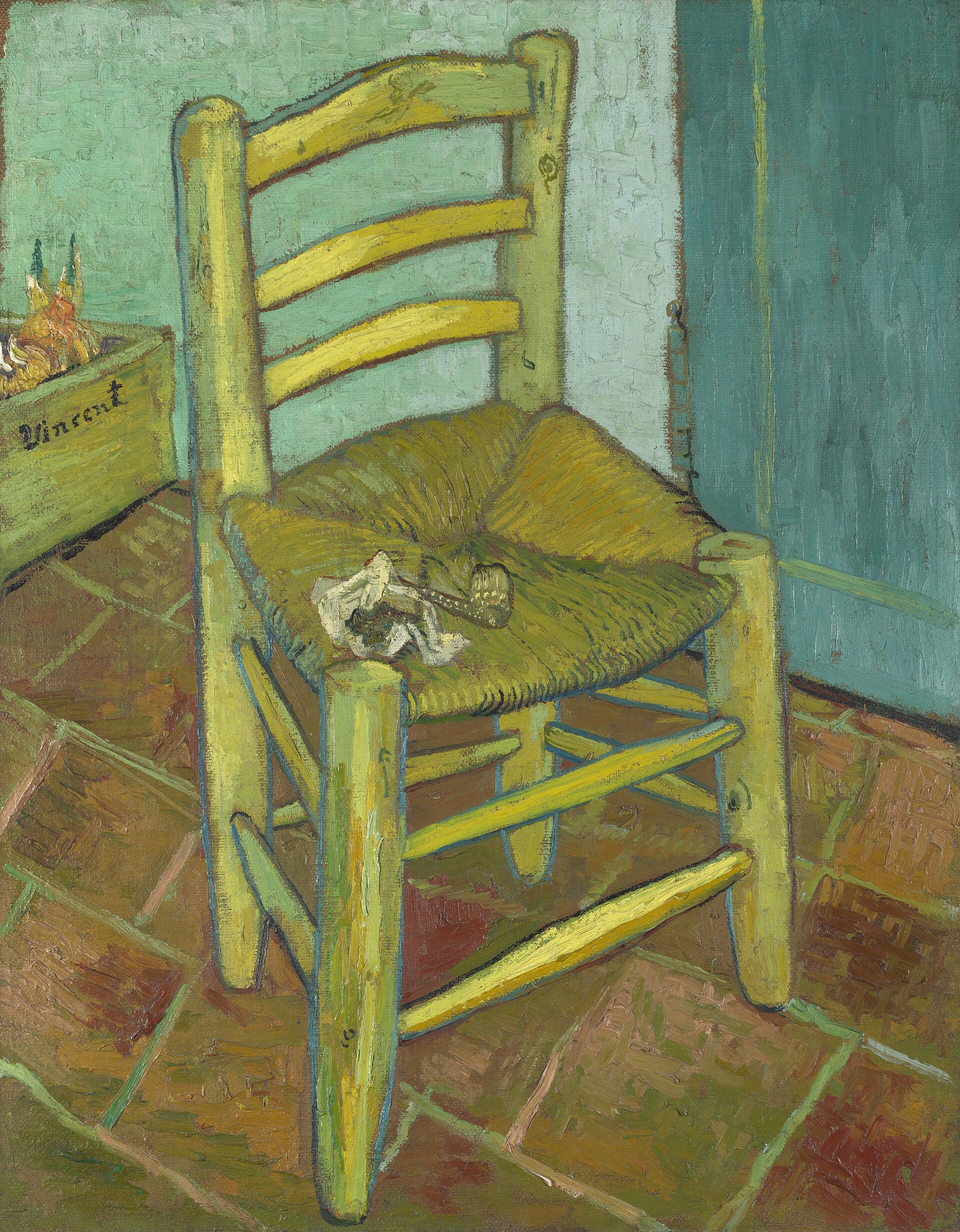
A plain wooden chair with a rush seat, a pipe and a pouch of tobacco: Van Gogh’s Chair is a self-portrait without a face, painted as a pair with Gauguin’s armchair in November 1888.
- Artist
- Vincent van Gogh
- Date
- November 1888
- Painted in
- Arles, France
- Medium
- Oil on canvas
- Size
- 91.8 × 73 cm
- Museum
- National Gallery, London
- Catalogue
- F498 · JH1635
What the painting shows
A simple yellow chair stands on a red-tiled floor. On its straw seat lie Van Gogh’s pipe and a twist of tobacco in paper. Behind it, in the corner of the room, a box holds sprouting onions, on which he has written his name, “Vincent”. The colours are bright and simple, and the viewpoint looks down on the chair from above.
Two chairs, two painters
Van Gogh painted his own chair and Gauguin’s armchair as a pair while Gauguin was living with him in the Yellow House. His chair is in daylight, plain and rustic; Gauguin’s Armchair is painted at night, with a candle and novels on its seat. The two empty chairs are often read as portraits of the two men and their different personalities.
A pair of chairs
In November 1888, while Gauguin was staying with him in the Yellow House, Van Gogh painted two empty chairs as a pair. His own is a simple rush-seated kitchen chair standing on a red-tiled floor in daylight, with his pipe and a pouch of tobacco on the seat and a box of sprouting onions behind it. Gauguin’s Armchair is a more elegant chair with a curved back and arms, shown at night by the light of a gas lamp and a candle, with two modern novels on the seat.
The contrast is a double portrait in objects: Van Gogh plain, practical and of the daylight, Gauguin sophisticated, literary and of the night. Van Gogh later wrote that he had tried to paint Gauguin’s “empty place”.
The empty chair
Van Gogh had admired, years earlier in London, an engraving by Luke Fildes called The Empty Chair, showing Charles Dickens’s study on the day of the writer’s death. Empty chairs became for him a symbol of absence and loss. Painted just weeks before the breakdown of 23 December and Gauguin’s departure, the two pictures now feel almost like a premonition of the friendship ending.
Things you might not know
- The pair has been split up. Van Gogh’s Chair is in the National Gallery, London; Gauguin’s Armchair is in the Van Gogh Museum, Amsterdam.
- He signed the onion box. His name, “Vincent”, appears on the box in the background.
- The chair was real. He bought a dozen simple chairs to furnish the Yellow House; one appears in The Bedroom.
- London bought it in 1924. The National Gallery acquired it, together with Sunflowers, from the Van Gogh family.
Where to see it
Van Gogh’s Chair belongs to the National Gallery in London, which acquired it in 1924. Gauguin’s Armchair is in the Van Gogh Museum.
Related paintings
 Paul Gauguin’s Armchair1888 · Van Gogh Museum
 Bedroom in Arles1888 · Van Gogh Museum
 The Yellow House1888 · Van Gogh Museum
 Sunflowers1888 · National Gallery
Frequently asked questions
Where is Van Gogh’s Chair by Van Gogh?
It is in the collection of the National Gallery, London.
When did Van Gogh paint Van Gogh’s Chair?
In November 1888, in Arles, while Paul Gauguin was staying with him in the Yellow House. Some sources date it to early 1889.
How big is Van Gogh’s Chair?
The painting measures 91.8 × 73 cm. It is oil on canvas, catalogued as F498 and JH1635.
See every painting from his Arles period in the catalogue, follow his travels on the interactive timeline, or download masterpieces as free wallpapers.
Image: National Gallery, London (public domain), via Wikimedia Commons. Facts checked against the holding museum’s catalogue and the standard Van Gogh catalogues (de la Faille and Hulsker).
What does Van Gogh’s Chair mean?
It is a self-portrait without a figure: a plain chair with his pipe and tobacco, painted as a pair with a picture of Gauguin’s more elegant armchair to contrast the two artists.