Home › Paintings › Paris › The Courtesan (after Eisen)
Paris · 1887
The Courtesan (after Eisen)
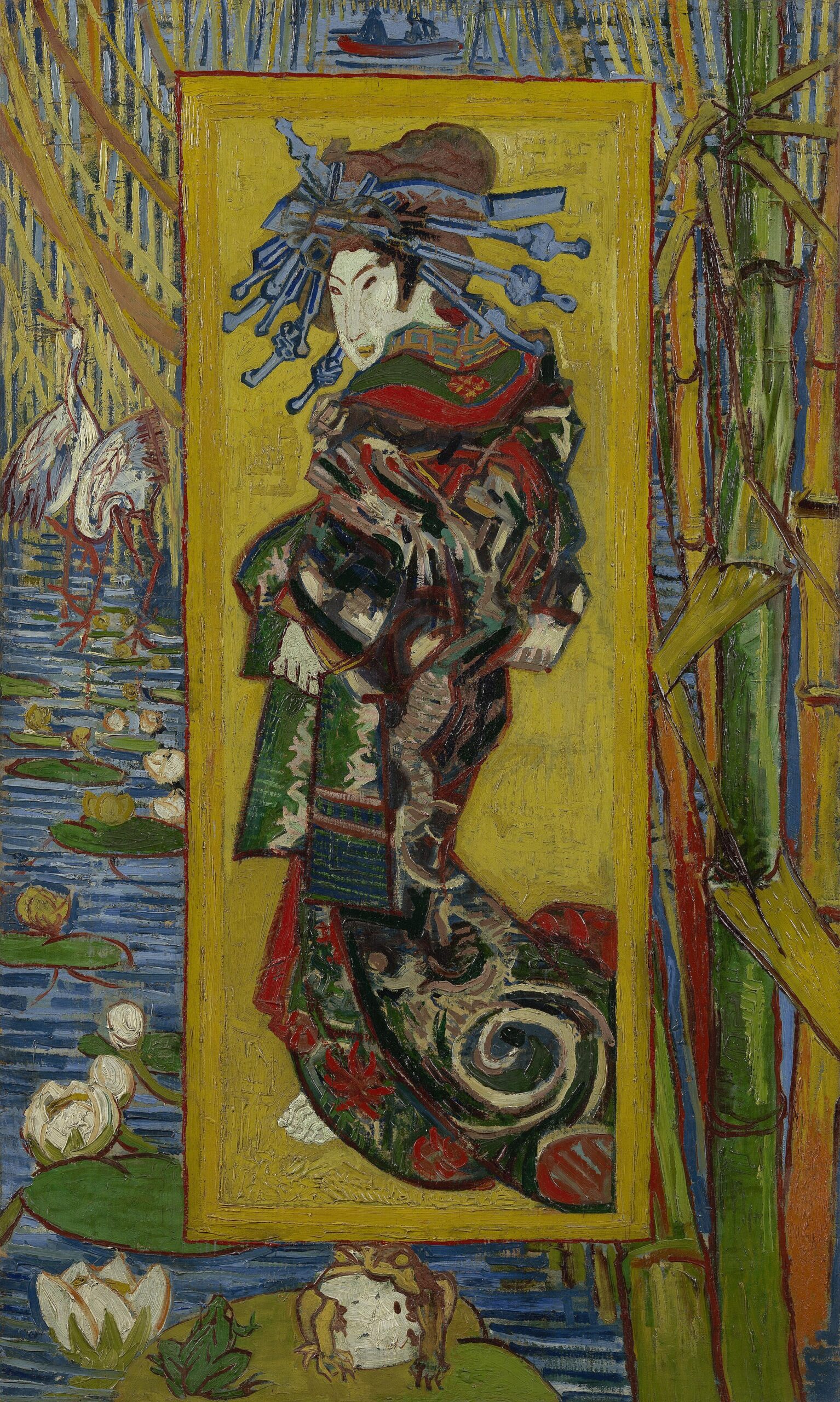
A Japanese courtesan in a magnificent robe, surrounded by frogs, cranes and bamboo: Van Gogh copied the figure from a magazine cover and turned it into one of the boldest images of his Paris years.
- Artist
- Vincent van Gogh
- Date
- 1887
- Painted in
- Paris, France
- Medium
- Oil on canvas
- Size
- 105.5 × 60.5 cm
- Museum
- Van Gogh Museum, Amsterdam
- Catalogue
- F373 · JH1298
What the painting shows
A tall courtesan in an elaborate kimono, decorated with dragons and patterns in green, red and blue, turns her head over her shoulder. She stands on a yellow ground, framed by a pool with water lilies, bamboo stalks, two frogs, cranes and a small boat. The colours are flat and brilliant, and the outlines thick and dark.
From a magazine cover
The figure comes from a print by Keisai Eisen reproduced on the cover of a special Japan issue of the magazine Paris Illustré in May 1886. Van Gogh traced and enlarged it and placed it in a setting of his own, taken from other Japanese prints. The frogs and cranes are a pun: in French slang, grue (crane) and grenouille (frog) were words for prostitutes.
It is one of three oil copies he made after Japanese prints in 1887, together with Flowering Plum Orchard and Bridge in the Rain.
Copying Japan
In Paris in 1887 Van Gogh became fascinated by Japanese woodblock prints. He bought hundreds from the dealer Siegfried Bing and made three painted copies of prints in oil. Courtesan is based on a figure by Keisai Eisen that appeared on the cover of a special Japan issue of the magazine Paris Illustré in May 1886. Van Gogh traced the figure, enlarged it with a grid and reversed it.
He placed the courtesan in an invented setting: a pond with water lilies, bamboo, cranes and frogs, and a boat at the top. The bright, flat colours and the thick border show how he was turning Japanese ideas into his own style.
Hidden jokes
The animals around the courtesan are not random. In French slang of the time, grue (crane) and grenouille (frog) were words for prostitutes, so the setting is a pun on the subject. It is a reminder of Van Gogh’s sense of humour, often lost in the story of the tortured artist.
Things you might not know
- It comes from a magazine cover. The figure was copied from Paris Illustré, May 1886.
- He made three Japanese copies. The others copy Hiroshige’s plum garden and bridge in the rain.
- It is in the Van Gogh Museum. The museum also owns his collection of Japanese prints.
Where to see it
The painting belongs to the Van Gogh Museum in Amsterdam, together with the copy of Paris Illustré that he used.
Related paintings
 Bridge in the rain, after Hiroshige1887 · Van Gogh Museum
 Flowering plum tree, after Hiroshige1887 · Van Gogh Museum
 Portrait of Père Tanguy1887 · Musée Rodin
 Self-portrait, dedicated to Paul Gauguin1888 · Fogg Museum
Frequently asked questions
Where is The Courtesan (after Eisen) by Van Gogh?
It is in the collection of the Van Gogh Museum, Amsterdam.
When did Van Gogh paint The Courtesan (after Eisen)?
In 1887, in Paris, France.
How big is The Courtesan (after Eisen)?
The painting measures 105.5 × 60.5 cm. It is oil on canvas, catalogued as F373 and JH1298.
See every painting from his Paris period in the catalogue, follow his travels on the interactive timeline, or download masterpieces as free wallpapers.
Image: Van Gogh Museum, Amsterdam (public domain), via Wikimedia Commons. Facts checked against the holding museum’s catalogue and the standard Van Gogh catalogues (de la Faille and Hulsker).
What is Van Gogh’s Courtesan based on?
A figure by Keisai Eisen printed on the cover of Paris Illustré in May 1886, which Van Gogh enlarged and reversed.