Home › Van Gogh Facts › Van Gogh’s technique
Van Gogh’s Art
How Van Gogh Painted: His Technique Explained
Thick, swirling brushstrokes and blazing colour make a Van Gogh recognisable at a glance. Here is how he achieved it – the materials, the methods and the ideas behind his style.
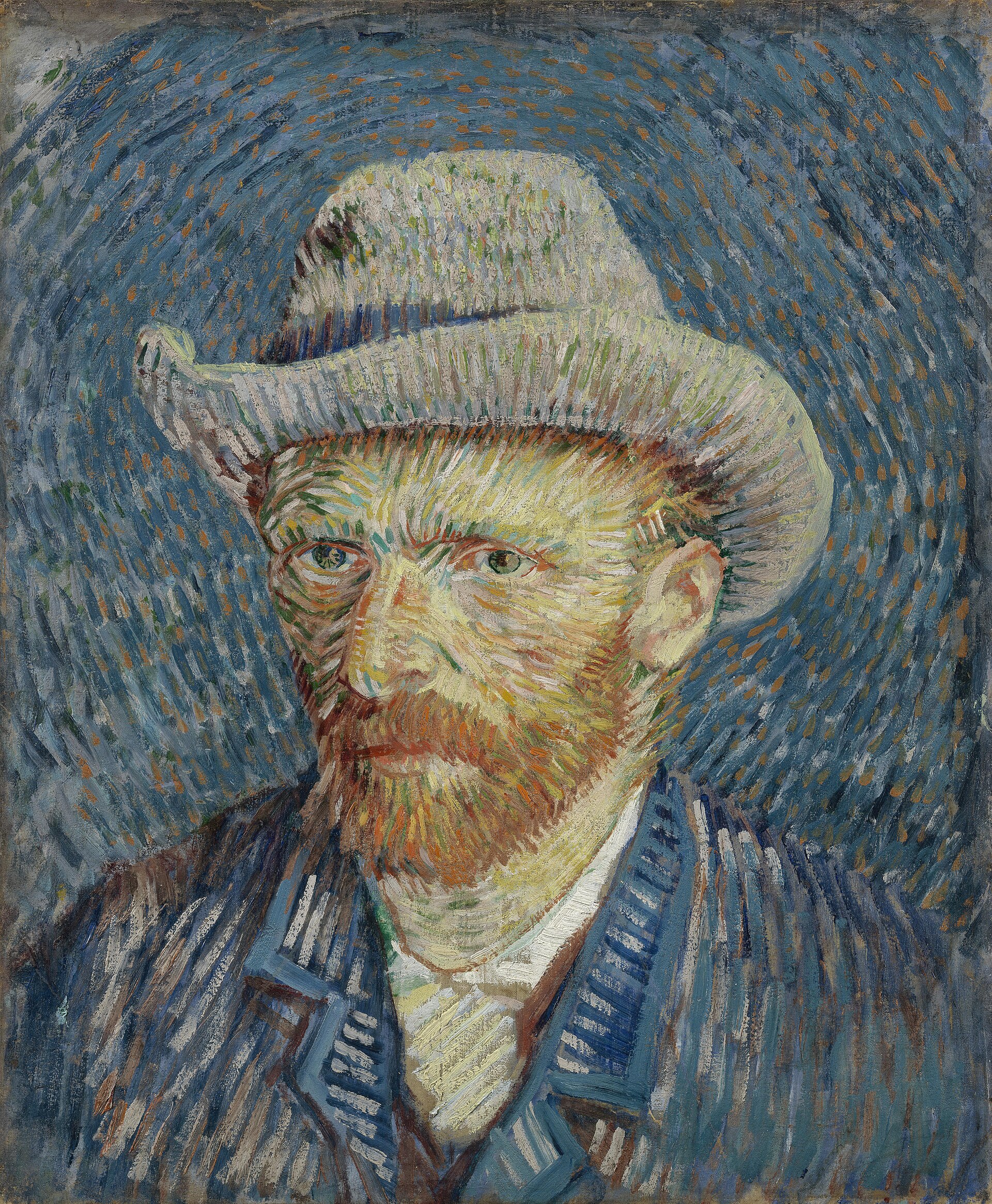
Visible, directional brushstrokes
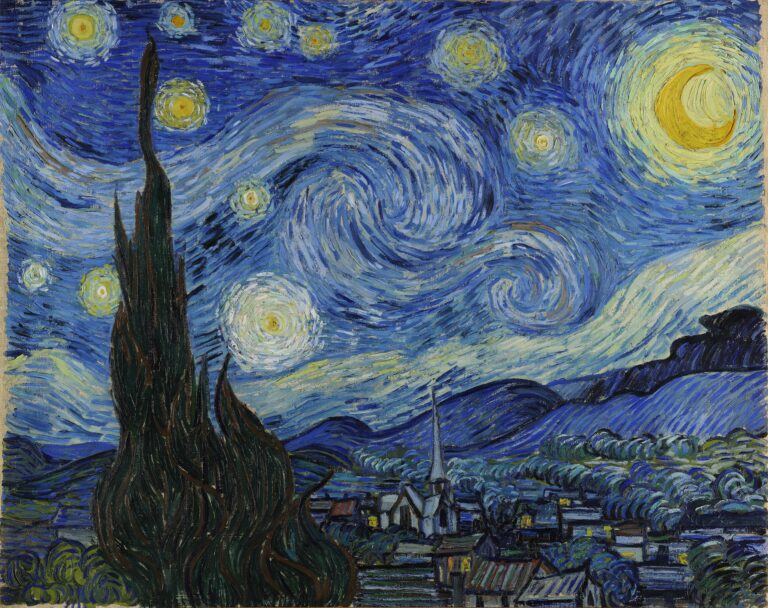
Van Gogh’s brushstrokes are never hidden. In his mature work each stroke has a direction that describes the form: curving around a cypress, rippling across wheat, spiralling in the sky. In The Starry Night and Wheat Field with Cypresses the rhythm of the strokes gives the whole picture a sense of movement.
He developed this way of painting in Paris, where he saw the dots and dashes of the Neo-Impressionists Seurat and Signac, and made it his own – looser, longer and more expressive.
Impasto
He applied paint thickly, sometimes straight from the tube, so that the ridges of paint stand up from the canvas and catch the light. This technique, called impasto, gives his paintings a sculptural, physical surface. In some places the paint is several millimetres thick. Because he painted wet into wet and fast, many pictures were finished in a single session.
Colour
In the Netherlands Van Gogh painted in dark earth tones, as in The Potato Eaters. In Paris he discovered the Impressionists and the colour theories of Delacroix and Charles Blanc, and his palette brightened dramatically. He loved complementary contrasts – yellow with violet, blue with orange, red with green – because they make each other more intense. In The Night Café he used red and green to express “the terrible passions of humanity”.
He used the newest synthetic pigments, such as chrome yellow, emerald green and cobalt blue. Some have changed over time: certain red lakes have faded, turning pink roses white, and some chrome yellows have darkened.
Lessons from Japan
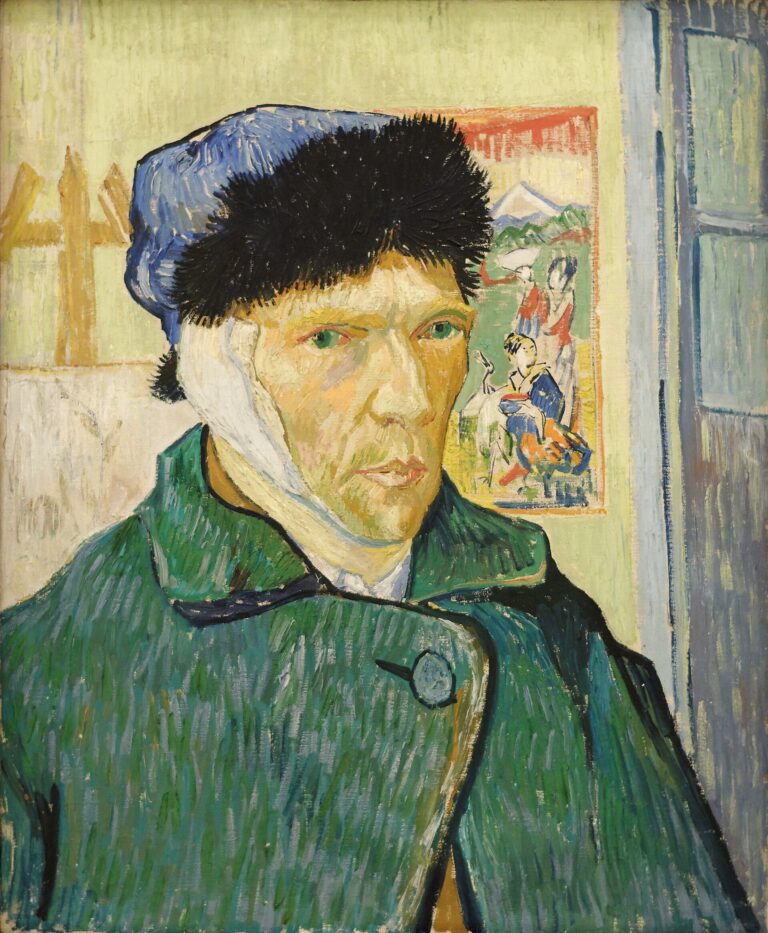
Van Gogh collected hundreds of Japanese woodblock prints and copied several in oil, such as Bridge in the Rain. From them he learned to use strong outlines, flat areas of colour, high viewpoints and bold cropping. In Arles he said he wanted to see the world with Japanese eyes.
Drawing and tools
Van Gogh was a superb draughtsman. In Arles he drew with a reed pen cut from local reeds, using dots, dashes and hatching to suggest texture and light. For perspective he built a wooden frame strung with threads, which he set up in the landscape to help him place the lines. He painted on ready-primed canvas, often of cheap quality, and sometimes reused canvases, painting over earlier works.
Paintings mentioned on this page
 Self-Portrait with Grey Felt Hat1887 · Van Gogh Museum
 The Starry Night1889 · Museum of Modern Art
 Wheat Field with Cypresses1889 · Metropolitan Museum of Art
 Bridge in the rain, after Hiroshige1887 · Van Gogh Museum
Frequently asked questions
What is impasto in Van Gogh’s paintings?
Impasto is paint laid on so thickly that the brushstrokes stand out in relief. Van Gogh used it to give his surfaces texture and energy.
What paint did Van Gogh use?
Oil paint, bought in tubes from colour merchants such as Père Tanguy in Paris, including modern pigments like chrome yellow, emerald green and cobalt blue.
Did Van Gogh paint outdoors?
Yes, very often. He painted landscapes in front of the motif, sometimes in strong wind, but he also worked in the studio, repeating compositions and painting from memory.
See his technique close up on the Cypresses page, try the colour palettes, or download a colouring page to try his style yourself.
Sources: the Van Gogh Museum, the Metropolitan Museum of Art and Van Gogh’s letters.