Home › Van Gogh Facts › Fakes and forgeries
Van Gogh Facts
Van Gogh Fakes and Forgeries
Van Gogh is one of the most forged artists in history. A 1920s scandal put dozens of fakes into the standard catalogue, experts have argued over famous museum pictures, and genuine works have been dismissed as fakes. Here is how the cases unfolded and how attributions are decided today.
Why Van Gogh is so often faked
Several things make Van Gogh a target. His prices are enormous, his style looks easy to imitate, and he made around 860 paintings in about ten years, many of them repeated in versions. He also sold almost nothing in his lifetime, so for decades most of his work moved informally, through his family, fellow artists and small dealers, leaving gaps in the records. His published letters describe paintings that are now lost, giving forgers a ready-made story to attach to a fake.
The Wacker affair
In 1927 the Berlin dealer Otto Wacker began selling Van Gogh paintings he said came from an anonymous Russian émigré collector. Leading experts accepted them, and Jacob-Baart de la Faille included them in his first catalogue of Van Gogh’s work in 1928. When several were shown at Paul Cassirer’s gallery in Berlin that year, they were quickly challenged as fakes. In all, 33 suspect paintings were traced to Wacker.
Wacker was tried in Berlin in April 1932; Van Gogh’s nephew, Vincent Willem van Gogh, testified that the family had no record of any Russian buyer. Wacker was convicted of fraud and, after an appeal, sentenced to 19 months in prison. The paintings were probably made by his brother Leonhard, a painter and restorer. De la Faille withdrew them and in 1930 published Les faux Van Gogh, listing 174 works he now regarded as forgeries. Some Wacker fakes ended up in museums, including a Self-Portrait with Bandaged Ear and Pipe at Harvard.
Doubts about famous paintings
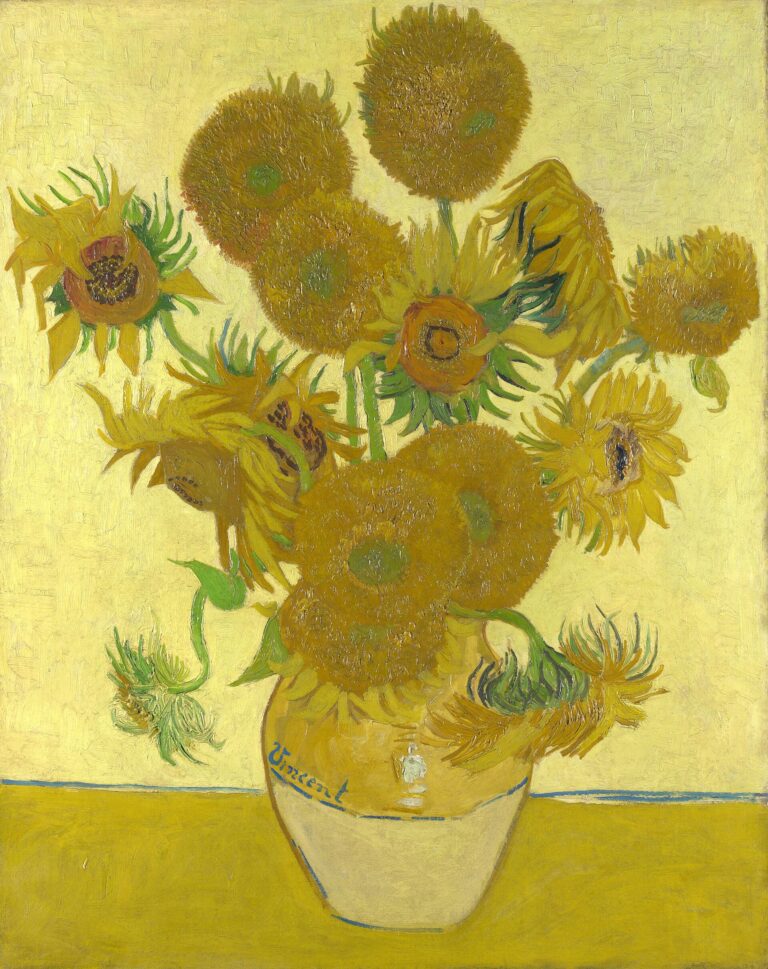
In 1997 The Art Newspaper reported that at least 45 accepted Van Goghs might be fakes, including works in major museums. The most famous case was the Tokyo Sunflowers, bought for $39.9 million in 1987. Critics suggested it had been painted by Émile Schuffenecker, a painter friend of Gauguin who, with his brother Amédée, owned and handled many Van Goghs. In 1998 new research found letters showing that Schuffenecker bought a version of Sunflowers in 1894 for 300 francs, and technical study around 2001–02 supported the attribution. The painting is now generally accepted as Van Gogh’s own repetition, though its canvas was later enlarged with extra strips.
The Schuffenecker brothers remain a recurring question. Several works that passed through their hands, including Woman Sitting in the Grass, are accepted, but their role in retouching or copying Van Goghs has fed doubts about others.
Real paintings dismissed as fakes
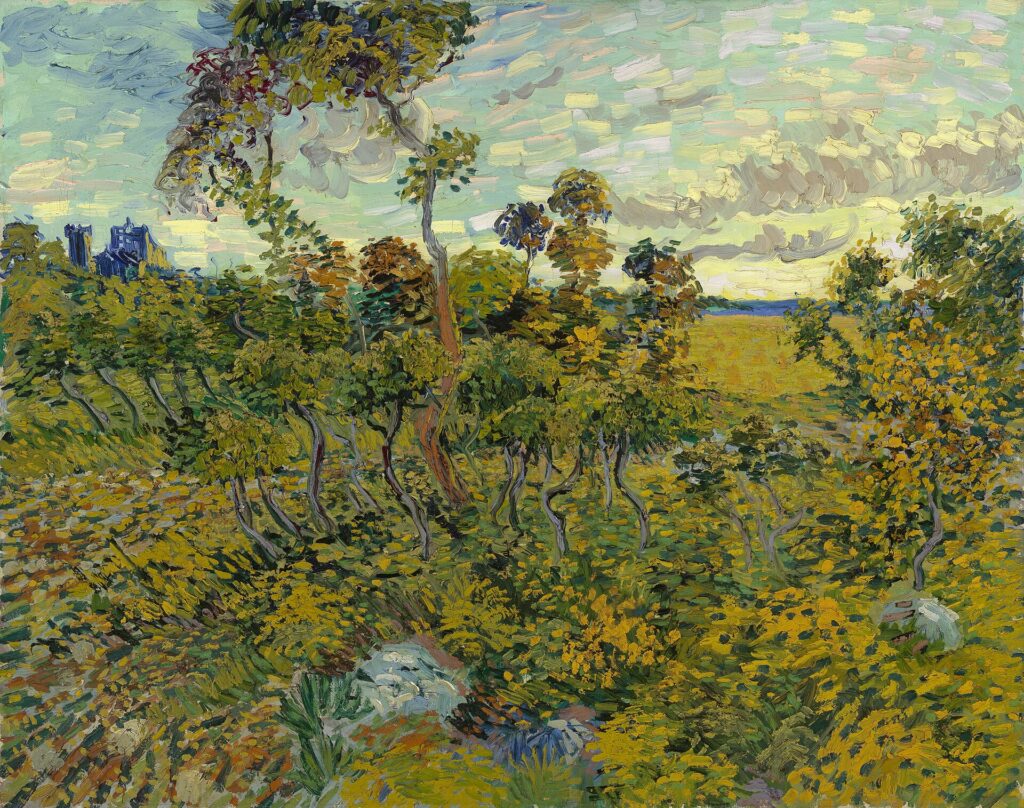
Mistakes run both ways. Sunset at Montmajour, painted near Arles on 4 July 1888, belonged to a Norwegian collector who was told it was not a Van Gogh and stored it in his attic. The Van Gogh Museum rejected it in 1991. After two years of new research into its pigments, canvas, an inventory number on the back and Van Gogh’s letters describing the scene, the museum announced in September 2013 that it was genuine: the first full-size Van Gogh canvas found since 1928.
Claims of new discoveries are frequent, though. In 2025 a portrait called Elimar, bought at a Minnesota garage sale, was promoted by an authentication company as a lost Van Gogh. The Van Gogh Museum, which had examined it in 2019, said it maintained its view that it was not by Van Gogh.
How attribution works today
No single test proves a Van Gogh. Experts weigh several kinds of evidence together:
- Provenance: a chain of owners back to Theo, Jo van Gogh-Bonger, early dealers or exhibitions. Gaps are normal; a total absence of history is a warning sign.
- Documents: mentions in the letters, Jo van Gogh-Bonger’s account book, exhibition catalogues and inventory numbers on the back.
- Materials: pigments, canvas weave and ground layers that match those Van Gogh is known to have used at that time and place.
- Style and technique: brushwork, drawing and composition compared with securely documented works.
The Van Gogh Museum is the leading authority. Under its current procedure, owners cannot apply directly: requests go through accredited art dealers and auction houses, and the museum has said that about 99% of the works it is asked about cannot be attributed to Van Gogh. For what genuine works are worth, see how much a Van Gogh is worth and our auction results.
Frequently asked questions
How many fake Van Goghs are there?
Nobody knows. The Wacker affair alone involved 33 forged paintings, de la Faille listed 174 suspected forgeries in 1930, and The Art Newspaper reported in 1997 that at least 45 accepted works might be fakes. The Van Gogh Museum turns down the great majority of works submitted to it.
Who decides if a painting is a real Van Gogh?
The Van Gogh Museum in Amsterdam is the leading authority. It reviews works submitted through accredited dealers and auction houses, using provenance, documents, technical analysis and style.
Is the Tokyo Sunflowers a fake?
It was questioned in the late 1990s, but archival research and technical study supported it, and it is generally accepted as a genuine version painted by Van Gogh in early 1889.
Has a lost Van Gogh ever been found?
Yes. Sunset at Montmajour (1888), long dismissed as a fake and kept in a Norwegian attic, was authenticated by the Van Gogh Museum in 2013.
Sources: Van Gogh Museum Journal 2001 and 2002 (Tokyo Sunflowers; Stefan Koldehoff, “The Wacker forgeries: a catalogue”); The Art Newspaper (July 1997, March 1998, February 2024, February 2025); AP, NPR and Irish Times reports on Sunset at Montmajour (September 2013); Minnesota Star Tribune and Hyperallergic on Elimar (2025); Van Gogh Museum authenticity research procedure.