Home › Paintings › Arles › Café Terrace at Night
Arles · 1888
Café Terrace at Night
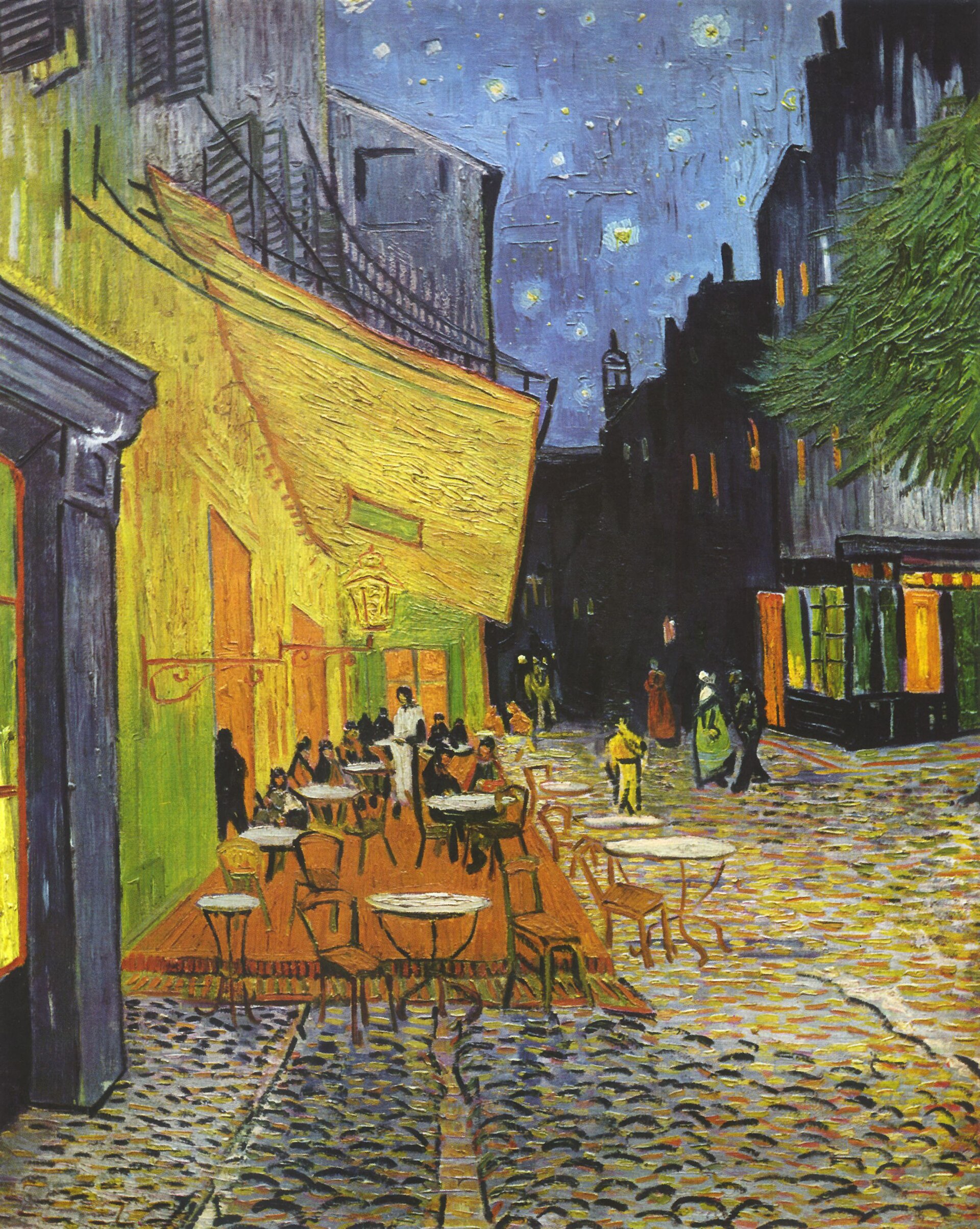
Under a deep blue sky full of stars, the gaslit terrace of a café on the Place du Forum glows yellow: Café Terrace at Night, painted on the spot in September 1888, is the first of Van Gogh’s starry night skies.
- Artist
- Vincent van Gogh
- Date
- September 1888
- Painted in
- Arles, France
- Medium
- Oil on canvas
- Size
- 80.7 × 65.3 cm
- Museum
- Kröller-Müller Museum, Otterlo
- Catalogue
- F467 · JH1580
What the painting shows
A café terrace, lit by a large gas lamp under its awning, spills out into a cobbled square. The awning, the wall and the terrace floor blaze in yellow and orange, while the street beyond falls into blue and violet shadow. Above the dark houses, the narrow strip of sky is a rich ultramarine scattered with large, flower-like stars.
Customers sit at small round tables and a waiter in a white apron moves between them. Figures stroll across the square, and on the right a horse-drawn carriage clatters past. The perspective draws us straight down the street, as if we are about to step into the scene.
A night painting without black
Van Gogh painted the picture outdoors at night, working by the light of the café’s lamp, which was then an unusual practice. Writing to his sister Willemien, he described it as a night painting without black, made only with blues, violets and greens, with the square lit in pale sulphur and citron yellow. The complementary contrast between the warm yellows and the cool blues is what makes the scene glow.
The café still stands on the Place du Forum in Arles. Repainted yellow to match the picture, it now trades as the Café Van Gogh.
The first starry sky
A few weeks later he returned to the same idea in Starry Night Over the Rhône, and the following June, in the asylum at Saint-Rémy, he painted The Starry Night. Some writers have suggested that the composition, with a central figure among twelve others and a cross-shaped window frame behind the waiter, hides a reference to the Last Supper; Van Gogh never said so, and most scholars treat the idea with caution.
The story behind Café Terrace at Night
In September 1888 Van Gogh set up his easel in the Place du Forum in Arles, in the evening, to paint the terrace of a café lit by a big gas lamp. He described the painting to his sister Wil in a letter: an enormous yellow lamp lighting the terrace, the front of the café and the pavement, with the pointed gables of the street running towards a blue sky with stars. He was delighted to have painted a night scene without any black, using only beautiful blues, violets and greens, and said that painting at night on the spot interested him enormously.
It was a new idea. Most artists painted night scenes in the studio from memory, if at all. Van Gogh wanted the real effect of artificial light against the night sky, and over the following weeks he painted the river in Starry Night over the Rhône and the interior of the all-night café in The Night Café. Together they are the beginning of the night paintings that culminate in The Starry Night.
Colour and composition
The picture is built on the contrast of complementary colours: the warm yellow and orange of the lamplit awning, wall and cobbles against the deep blue of the sky and the shadowed street. The awning and the terrace pull the eye in on a sharp diagonal, while the dark doorways and the figures walking up the street lead it towards the stars. Van Gogh used Japanese-style flat areas of colour in the awning and the walls, but rich, varied brushwork in the cobbles, which seem to glow with reflected light. The stars are painted as small flowers of white and yellow, an idea he would develop further in Saint-Rémy.
Things you might not know about Café Terrace at Night
- It contains his first starry sky. This is the first of his paintings to show stars against the night sky.
- The café is still there. A café still stands on the corner of the Place du Forum in Arles and trades on its connection with the painting.
- He did not name the café. It is often called the Café de Nuit or Café Van Gogh today, but he simply called the picture a café terrace at night.
- He wrote about it before he finished it. His letter to Wil describes the painting while he was working on it, with a small sketch.
- There is a drawing of the same scene. He made a reed-pen drawing of the composition, now in the Dallas Museum of Art.
- Some see a Last Supper in it. One modern theory counts twelve figures around a central figure and a cross shape in the window frame, but there is no evidence Van Gogh intended this.
- It is in a Dutch forest. The painting belongs to the Kröller-Müller Museum, inside the Hoge Veluwe National Park, where it is one of the most popular works.
Visiting the café today
The Place du Forum is a short walk from the Roman arena in the centre of Arles, and the yellow-painted café on the corner has been restored to look much as it does in the painting. In the evening, with the terrace lit, you can stand roughly where Van Gogh set up his easel. Our Arles travel guide has a walking route linking this square with the other places he painted, including the hospital garden and the site of the Yellow House.
A scene from a novel
Van Gogh read widely, and he linked this picture to a book. In a letter to his sister Wil he mentioned the opening of Guy de Maupassant’s novel Bel-Ami, which describes a starry night in Paris with brightly lit cafés on the boulevard. He wrote that he had painted something along those lines. Art historians also point to Avenue de Clichy (1887) by his friend Louis Anquetin, a night street scene in blue and yellow that Van Gogh would have known from Paris.
Painting outdoors at night
Unlike most night pictures of the time, which were painted in the studio from memory, Van Gogh set up his easel in the square and painted the café on the spot. He enjoyed the challenge of judging colours under gaslight, and told his sister that he liked painting night scenes on the spot. A few days later he painted Starry Night over the Rhône the same way, on the riverbank.
The Last Supper theory
In 2015 a researcher suggested that the painting hides a version of Leonardo’s Last Supper: twelve seated diners around a central figure in white with cross-shaped window frames behind. Van Gogh came from a religious family and had trained as a preacher, so the idea attracted attention. Most specialists are sceptical. The number of figures is hard to count, and there is nothing in his letters to support it. It is best seen as an interesting reading rather than a known fact.
Where it is now
The painting belongs to the Kröller-Müller Museum in the Hoge Veluwe National Park near Otterlo, in the Netherlands, which holds the second-largest Van Gogh collection in the world. Helene Kröller-Müller bought it in the early twentieth century, when she was building her collection. Plan your visit with our Kröller-Müller guide.
Where to see it
Café Terrace at Night belongs to the Kröller-Müller Museum in Otterlo, the Netherlands, which holds the second-largest collection of Van Gogh’s work after the Van Gogh Museum. The painting is unsigned, but is identified from his letters, where he describes it in detail.
Related paintings
 Starry Night Over the Rhône1888 · Musée d’Orsay
 The Starry Night1889 · Museum of Modern Art
 A Lane in the Public Garden at Arles1888 · Kröller-Müller Museum
 Bedroom in Arles1888 · Van Gogh Museum
Frequently asked questions
Where is Café Terrace at Night by Van Gogh?
It is in the collection of the Kröller-Müller Museum, Otterlo.
When did Van Gogh paint Café Terrace at Night?
In September 1888, in Arles, France.
How big is Café Terrace at Night?
The painting measures 80.7 × 65.3 cm. It is oil on canvas, catalogued as F467 and JH1580.
Is the café in Café Terrace at Night still there?
Yes. The café on the Place du Forum in Arles still operates and has been painted yellow to look as it does in the picture; it is known as the Café Van Gogh.
Did Van Gogh paint Café Terrace at Night outside?
Yes. He set up his easel in the square and painted the scene at night by the light of the café’s gas lamp.
See every painting from his Arles period in the Arles collection, follow his travels on the interactive timeline, or download masterpieces as free wallpapers.
Image: Kröller-Müller Museum, Otterlo (public domain), via Wikimedia Commons. Facts checked against the holding museum’s catalogue and the standard Van Gogh catalogues (de la Faille and Hulsker).
Where is the café from Café Terrace at Night?
On the Place du Forum in Arles, in Provence. A café still operates on the same corner.
Did Van Gogh paint Café Terrace at Night outside?
Yes. He painted it on the spot in the evening in September 1888, by the light of the gas lamps, which was unusual at the time.
Did Van Gogh paint Café Terrace at Night outside?
Yes. He set up his easel in the Place du Forum in Arles and painted the café at night on the spot.