Home › Paintings › Arles › Sunflowers
Arles · 1888
Sunflowers
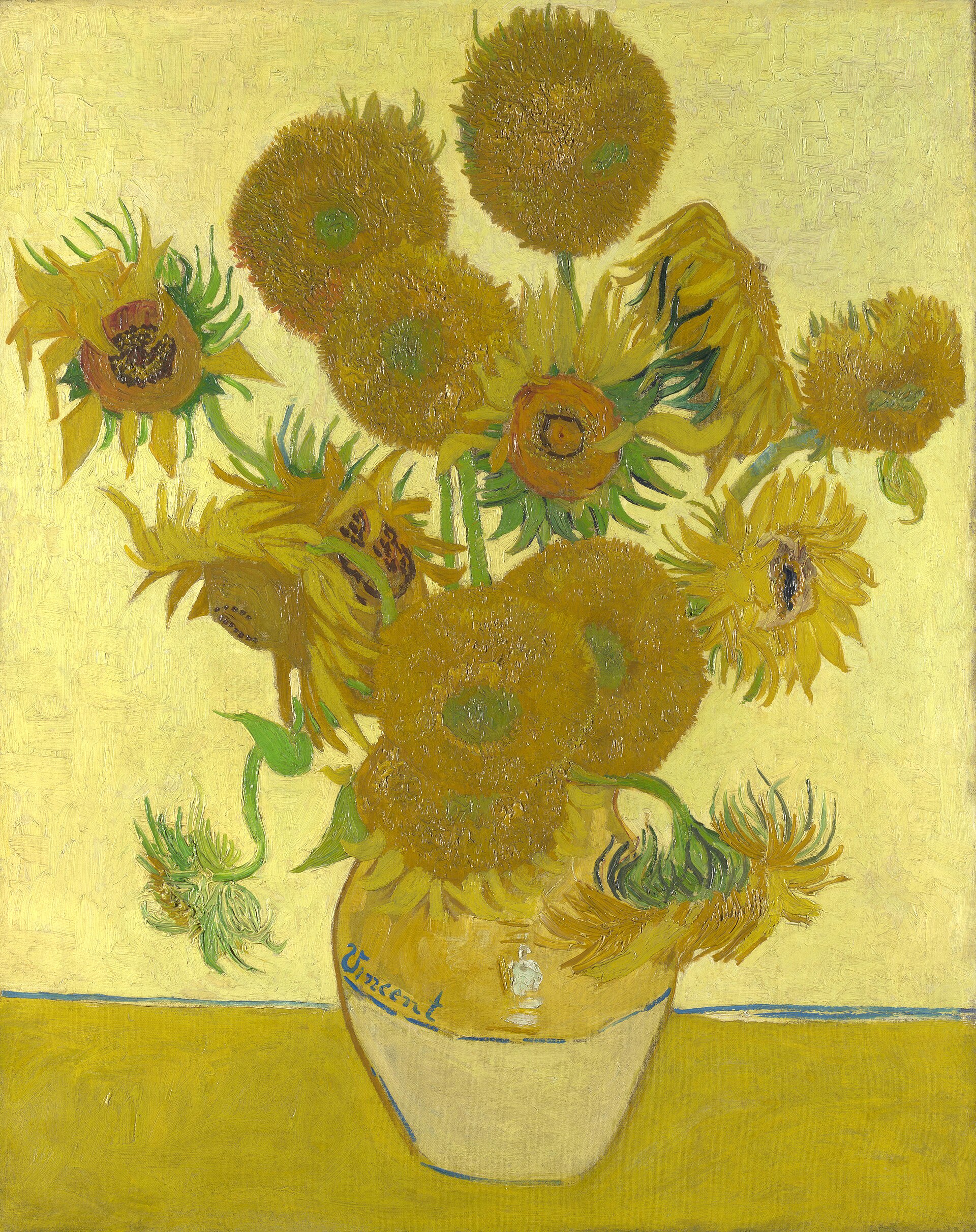
Fifteen sunflowers in a yellow pot against a yellow wall: the National Gallery’s Sunflowers, painted in Arles in August 1888, is the most famous of Van Gogh’s series and perhaps the most recognisable still life in the world.
- Artist
- Vincent van Gogh
- Date
- August 1888
- Painted in
- Arles, France
- Medium
- Oil on canvas
- Size
- 92.1 × 73 cm
- Museum
- National Gallery, London
- Catalogue
- F454 · JH1562
What the painting shows
A simple earthenware vase, glazed yellow above and left plain below, stands on a table. It holds fifteen sunflowers at every stage of life, from fresh blooms with bright petals to heads that have dropped their petals and turned into dark, seed-filled discs. Van Gogh signed the picture on the vase itself: “Vincent”.
Almost everything is yellow – the flowers, the pot, the table and the background – separated only by a thin blue line and by the ochres, browns and greens of the stems and seed heads. Painting yellow on yellow was a deliberate challenge, made possible by new, bright chrome yellow pigments.
Painted for Gauguin
In the summer of 1888 Van Gogh was waiting for Paul Gauguin to join him in the Yellow House in Arles, where he dreamed of starting an artists’ community. He decided to decorate the guest room with paintings of sunflowers, a flower he associated with gratitude and with the southern sun. In a few days in August he painted four canvases; this was the fourth, and the one he considered the best.
When Gauguin arrived in October, he admired the pictures. After their quarrel in December, Gauguin even asked for one of them, and in January 1889 Van Gogh painted repetitions based on this version.
The other Sunflowers
Van Gogh painted seven vases of sunflowers in Arles. In August 1888 he made four: a vase of three flowers (private collection), a vase of six (destroyed in Japan during the Second World War), a vase of twelve (Neue Pinakothek, Munich) and this vase of fifteen. In January 1889 he repeated the fifteen-flower picture twice – the versions now in the Van Gogh Museum, Amsterdam, and the Sompo Museum of Art, Tokyo, which bought its canvas in 1987 for almost £25 million, then a world record for a painting – and the twelve-flower picture once, now in the Philadelphia Museum of Art.
Van Gogh had already painted cut sunflowers lying on the ground in Paris in 1887, so the subject was one he returned to for two years.
The story behind the London Sunflowers
In August 1888 Van Gogh was waiting for Paul Gauguin to join him in Arles. He wanted the Yellow House to feel like a real studio, and he decided to decorate Gauguin’s bedroom with paintings of sunflowers. He told Theo he was painting with the gusto of a Marseillais eating bouillabaisse, working from early morning because the flowers wilted so quickly. Within about a week he had made four canvases, each larger and more ambitious than the last: three flowers, five, twelve and finally fifteen.
This fifteen-flower version was the one he was proudest of. He hung it with its twelve-flower companion in Gauguin’s room, and Gauguin admired it enough to ask for one as a gift. Van Gogh refused to give up the original but painted repetitions in January 1889, after Gauguin had left and he himself had come out of hospital. He also imagined the Sunflowers hung on either side of his portrait of Madame Roulin, La Berceuse, like the wings of an altarpiece. See how the whole series fits together on our Sunflowers series page.
Yellow on yellow: colour and technique
The London Sunflowers is a deliberate experiment in painting yellow against yellow. The flowers, the vase and the background are all in shades of yellow and ochre, separated only by changes of tone, thin blue outlines and the texture of the paint. Van Gogh used new, bright, factory-made pigments, especially chrome yellow, which let him reach intensities older painters could not. He laid the paint on thickly, modelling the seed heads with heavy dabs that stand up from the surface, and signed the vase itself with his first name, “Vincent”, in blue.
Those modern pigments came at a cost. Scientific studies of the Sunflowers paintings have found that some chrome yellows have darkened over time, and that some red lake pigments have faded, so the pictures were once even brighter and the background had more contrast than today. Conservators now keep light levels carefully controlled.
Things you might not know about Sunflowers
- The flowers are at every stage of life. Some are in full bloom, some are wilting and some have gone to seed, which many viewers read as a meditation on life and death.
- He painted it in about a week. The four August 1888 Sunflowers were all painted in a burst of work in the second half of the month.
- Gauguin painted him painting it. In late 1888 Gauguin made a portrait of Van Gogh at work on a sunflower still life, now in the Van Gogh Museum.
- The National Gallery bought it in 1924. It was acquired from the Van Gogh family and has been one of the most popular paintings in London ever since.
- It has a near-twin in Amsterdam. The January 1889 repetition in the Van Gogh Museum copies this composition closely.
- Another version set a world record. The Tokyo repetition sold for $39.9 million in 1987, then the highest price ever paid for a painting at auction.
- One version no longer exists. The five-flower painting was destroyed in Japan in 1945.
- It rarely leaves London. A loan to the Philadelphia Art Museum in 2026, where it hung beside the turquoise Philadelphia version, was a rare exception.
Why sunflowers?
Sunflowers meant several things to Van Gogh. They were the flower of the south, of summer heat and the sun he had come to Provence to find. They also carried associations with gratitude and devotion, and he wrote later that they expressed his idea of friendship and thanks. Gauguin had admired the Paris sunflower studies, so painting them for his room was also a gesture of welcome. Today the Sunflowers are so closely linked with Van Gogh that the flower has become a kind of signature; even the Van Gogh Museum uses a sunflower in its logo.
“The sunflower is mine”
Van Gogh knew the sunflowers had become his signature. In January 1889, back from hospital and preparing repetitions of the Arles pictures, he told Theo that Gauguin liked them very much and that the sunflower was, in a way, his own motif, as the peony belonged to the painter Jeannin and the hollyhock to Quost. He planned to show the sunflowers on either side of his portrait of Madame Roulin, La Berceuse, making a triptych with a lullaby in the middle and two blazes of yellow as wings.
That plan tells us how he thought about these pictures. They were not just flower studies but decorations meant to be hung together, part of a scheme to fill the Yellow House with colour for the artists he hoped would join him in the south.
How the National Gallery got it
After Vincent’s death the Sunflowers passed to Theo, and after Theo’s death six months later to his widow, Jo van Gogh-Bonger, who spent the rest of her life promoting Vincent’s work. In 1924 she agreed to sell this version to the National Gallery in London, which bought it with money from the Courtauld Fund. Jo was reluctant to part with it, but she understood that a picture in the national collection in London would make Vincent’s name in Britain. She was right: it is now one of the gallery’s most visited paintings.
Fading yellows
Van Gogh used a new, cheap pigment called chrome yellow, which he loved for its brilliance. Scientists have since found that some chrome yellows darken and turn brownish when exposed to light. Parts of the Sunflowers paintings are a little duller than when they were painted, and museums now keep the light levels low to slow the change. The Amsterdam version is considered too fragile to travel and is no longer lent to exhibitions.
The Sunflowers on the market
Only one of the five vase paintings has ever been sold at public auction. In March 1987 the Japanese insurance company Yasuda bought the version with a yellow background for £24.75 million at Christie’s in London, at the time by far the highest price ever paid for a painting. It is now in the Sompo Museum of Art in Tokyo. The sale opened a decade of record Van Gogh prices; see every major Van Gogh auction result.
Where to see it
The painting has belonged to the National Gallery in London since 1924, when it was bought with money from the Courtauld Fund. It is one of the gallery’s most visited works and hangs among its Impressionist and Post-Impressionist paintings on Trafalgar Square, where entry is free. Find the other versions on our museum map.
Related paintings
 Almond Blossom1890 · Van Gogh Museum
 Café Terrace at Night1888 · Kröller-Müller Museum
 Bedroom in Arles1888 · Van Gogh Museum
 Irises1889 · Getty Museum
Frequently asked questions
Where is Sunflowers by Van Gogh?
It is in the collection of the National Gallery, London.
When did Van Gogh paint Sunflowers?
In August 1888, in Arles, France.
How big is Sunflowers?
The painting measures 92.1 × 73 cm. It is oil on canvas, catalogued as F454 and JH1562.
How many Sunflowers paintings did Van Gogh paint?
He painted two series: four still lifes of cut sunflowers lying on the ground in Paris in 1887, and seven vases of sunflowers in Arles in 1888–89, three of which show fifteen flowers. One Arles version was destroyed in Japan in 1945.
Why did Van Gogh paint sunflowers?
He painted them to decorate the room of his friend Paul Gauguin in the Yellow House in Arles, and saw them as a symbol of gratitude and of the southern sun.
See every painting from his Arles period in the Arles collection, follow his travels on the interactive timeline, or download masterpieces as free wallpapers.
Image: National Gallery, London (public domain), via Wikimedia Commons. Facts checked against the holding museum’s catalogue and the standard Van Gogh catalogues (de la Faille and Hulsker).
How many sunflowers are in Van Gogh’s Sunflowers?
The London painting shows fifteen sunflowers. The other Arles versions show three, five and twelve, and the January 1889 repetitions copy either the fifteen or the twelve-flower picture.
Why are Van Gogh’s Sunflowers so famous?
They are among his most joyful and recognisable works, painted for Paul Gauguin’s visit to Arles, and the series includes one of the most expensive paintings ever sold. Their bold yellow-on-yellow colour was radical for its time.
How did the National Gallery get Sunflowers?
It bought the painting in 1924 from Jo van Gogh-Bonger, Theo’s widow, using money from the Courtauld Fund.
Have the Sunflowers faded?
Some of the chrome yellow pigment has darkened over time, so museums keep light levels low to protect the paintings.