Home › Paintings › Nuenen › The Potato Eaters
Nuenen · 1885
The Potato Eaters
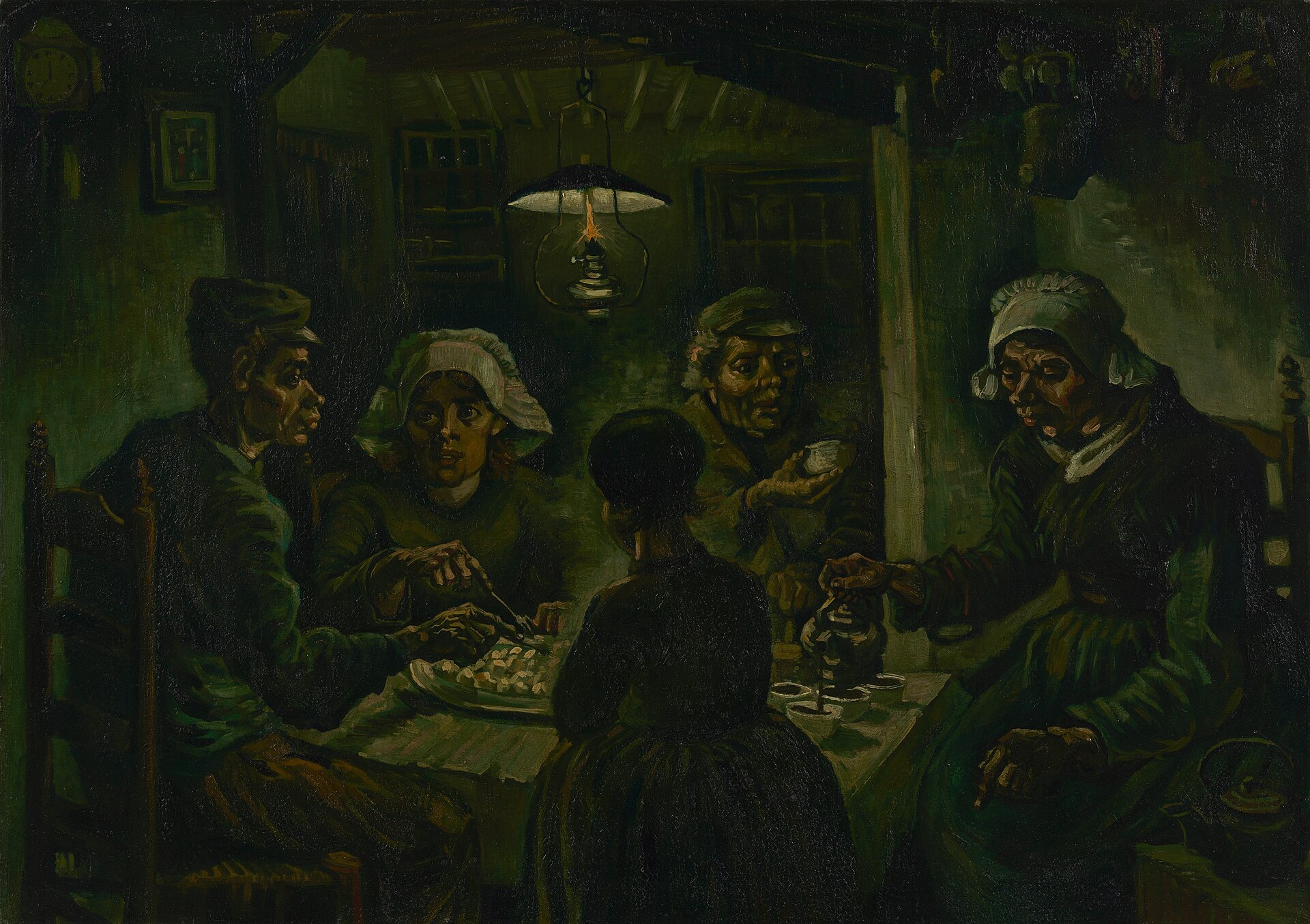
A family of peasants eats potatoes by lamplight in their dark cottage: The Potato Eaters was Van Gogh’s first major work, painted in Nuenen in 1885, and he believed it was among the best things he ever made.
- Artist
- Vincent van Gogh
- Date
- April–May 1885
- Painted in
- Nuenen, Netherlands
- Medium
- Oil on canvas
- Size
- 82 × 114 cm
- Museum
- Van Gogh Museum, Amsterdam
- Catalogue
- F82 · JH764
What the painting shows
Five people sit around a rough wooden table in a cramped room. An oil lamp hangs above them, casting a dim yellow light on their faces and on the dish of steaming potatoes. A woman on the right pours coffee or chicory; a man on the left reaches into the dish; a child is seen from behind, silhouetted against the lamp. A clock and a small religious print hang on the wall.
The faces are coarse and bony, the hands knotted and large, and the colours are dark greens and browns, which Van Gogh compared to the colour of a very dusty potato, unpeeled.
Honest food, honestly earned
Van Gogh explained his intention in a long letter to Theo. He wanted to make it clear that these people, eating their potatoes under the lamp, had dug the earth with the very hands they were putting into the dish, so that the picture spoke of manual labour and of a meal honestly earned. He deliberately avoided making the peasants look pleasant or picturesque.
He worked on the composition for months, painting dozens of studies of heads and hands, a full-size oil study now in the Kröller-Müller Museum, and a lithograph.
How it was received
When he sent a print to his friend Anthon van Rappard, Van Rappard criticised the drawing harshly, ending their friendship. Theo and others in Paris also found it too dark. Van Gogh never changed his mind: years later he still counted it among his best work. Today it is seen as the masterpiece of his Dutch years and a powerful statement of his sympathy for the poor.
The story behind The Potato Eaters
By the spring of 1885 Van Gogh had spent more than a year in Nuenen painting the local weavers and farm labourers, and he wanted to prove himself with a large figure composition. He chose a poor family, the De Groots, eating their evening meal of potatoes and coffee by the light of a single oil lamp. Over the winter he had painted dozens of studies of peasant heads and hands, and in April he made a preparatory oil sketch, now in the Kröller-Müller Museum, before painting the final version from memory in his studio.
He explained his aim to Theo: he wanted to show that these people, eating their potatoes under the lamp, had dug the earth with the same hands they put in the dish, so that the picture spoke of manual labour and of a meal honestly earned. He did not want to make peasants look pretty. The colour, he said, should be like that of a good dusty potato, unpeeled of course.
Light, colour and the faces
The scene is lit only by the lamp hanging from the ceiling, which picks out the faces, hands, the steaming dish and the steam rising from the coffee. Everything else is dark green, brown and grey. The figures are deliberately rough and bony, with large hands and coarse features: Van Gogh wanted them to look like real peasants, not the idealised country people of fashionable painting. The table forms a circle, and the five figures, including a girl seen from behind, are bound together by the light. Look closely and you will see the clock on the wall and a small religious print hanging beside the window.
Things you might not know about The Potato Eaters
- There are three versions. An oil sketch (Kröller-Müller Museum), the final painting (Van Gogh Museum) and a lithograph made in May 1885.
- The family were real. The models were members of the De Groot family of Nuenen; Gordina de Groot appears in several of his studies.
- It was painted from memory. After many studies from life, he completed the final picture in his studio.
- It cost him a friendship. Van Rappard’s criticism ended their five-year friendship.
- It is his first masterpiece. Most art historians see it as the culmination of his Dutch period, before Paris transformed his style.
- The colours have darkened. Some pigments have changed with time, so the painting was originally slightly lighter and warmer.
Forty heads
Van Gogh prepared for The Potato Eaters for months. Over the winter of 1884–85 he painted more than forty studies of the heads of peasants from Nuenen, men and women in caps and bonnets, along with many studies of hands. He wanted to know these faces as well as a peasant knows his field. Many of the heads are in the Van Gogh Museum, and seeing them next to the finished picture shows how much work went into it.
The De Groot family
The family in the painting were the De Groots, who lived in a cottage near Nuenen. Gordina de Groot, the young woman on the left, sat for him many times. In the autumn of 1885 she became pregnant, and gossip in the village blamed Van Gogh. He denied it, but the Catholic priest told his parishioners not to pose for him, which made it hard to find models and was one of the reasons he left Nuenen that November.
The lithograph and a lost friend
Proud of the composition, Van Gogh made a lithograph of it and sent copies to friends. One went to Anthon van Rappard, a fellow painter he had known for five years. Van Rappard replied with a harsh letter criticising the drawing of the figures and asking how anyone could call it serious work. Van Gogh was deeply hurt, and after a bitter exchange the friendship ended. The lithograph is reversed, because the image was drawn the right way round on the stone.
Where to see it
The Potato Eaters is in the Van Gogh Museum in Amsterdam, which received it from the artist’s family, and it is one of the museum’s central works.
Related paintings
 The Potato Eaters1885 · Kröller-Müller Museum
 Basket of Potatoes1885 · Van Gogh Museum
 Peasant Woman Seated Before an Open Door, Peeling Potatoes1885 · Private collection
 Peasant and Peasant Woman Planting Potatoes1885 · Kunsthaus Zürich
Frequently asked questions
Where is The Potato Eaters by Van Gogh?
It is in the collection of the Van Gogh Museum, Amsterdam.
When did Van Gogh paint The Potato Eaters?
In April–May 1885, in Nuenen, Netherlands.
How big is The Potato Eaters?
The painting measures 82 × 114 cm. It is oil on canvas, catalogued as F82 and JH764.
Why is The Potato Eaters so dark?
Van Gogh wanted to show the poverty and hard labour of peasant life honestly, using the earthy colours of the Dutch tradition. He was still painting in this dark palette before he moved to Paris in 1886 and discovered the bright colours of the Impressionists.
How many versions of The Potato Eaters are there?
There are two painted versions – an oil study in the Kröller-Müller Museum and the final painting in the Van Gogh Museum – as well as a lithograph and many studies.
See every painting from his Nuenen period in the Nuenen collection, follow his travels on the interactive timeline, or download masterpieces as free wallpapers.
Image: Van Gogh Museum, Amsterdam (public domain), via Wikimedia Commons. Facts checked against the holding museum’s catalogue and the standard Van Gogh catalogues (de la Faille and Hulsker).
Why did Van Gogh paint The Potato Eaters?
He wanted to make a major painting of peasant life showing people who lived by manual labour, eating a meal they had earned with their own hands.
Where can I see The Potato Eaters?
The final painting is in the Van Gogh Museum in Amsterdam; the oil sketch is in the Kröller-Müller Museum in Otterlo.
Who were the models for The Potato Eaters?
The De Groot family of Nuenen. Gordina de Groot, seated on the left, posed for Van Gogh many times.