Home › Paintings › Arles › Langlois Bridge at Arles
Arles · 1888
Langlois Bridge at Arles
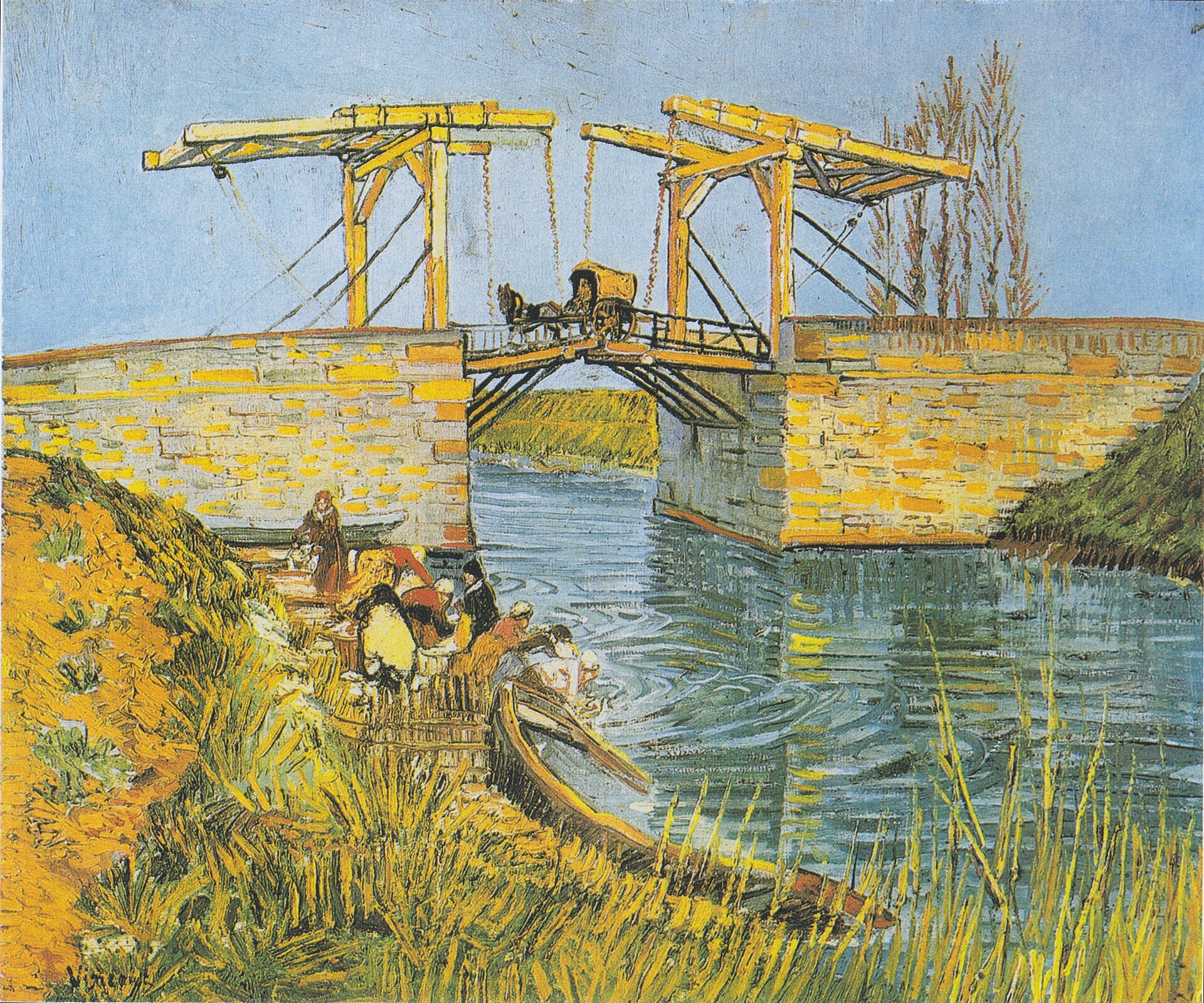
A wooden drawbridge over a canal, a horse and cart crossing, and women washing clothes on the bank: Van Gogh painted the Langlois Bridge in March 1888, weeks after arriving in Arles, and it reminded him of home.
- Artist
- Vincent van Gogh
- Date
- March 1888
- Painted in
- Arles, France
- Medium
- Oil on canvas
- Size
- 54 × 65 cm
- Museum
- Kröller-Müller Museum, Otterlo
- Catalogue
- F397 · JH1368
What the painting shows
The yellow drawbridge, with its beams and counterweights, spans a blue canal. A small cart is crossing it against a clear turquoise sky. In the foreground, on the left bank, a group of women in colourful clothes kneel at the water’s edge washing laundry, and their ripples spread across the canal. Grass and reeds grow along the banks.
The outlines are strong and the colours pure and bright, influenced by the Japanese prints he had collected in Paris.
A Dutch bridge in Provence
The bridge crossed the canal from Arles to Bouc, south of the town; it was known by the name of its keeper, Langlois. With its Dutch-style construction, it reminded Van Gogh of the drawbridges of his homeland. He painted and drew it several times in the spring of 1888, in different lights and from different angles.
The original bridge was destroyed in 1944. A similar bridge has been reassembled near Arles as the “Pont Van Gogh”.
The story behind the Langlois Bridge
One of the first subjects Van Gogh painted in Arles, in March 1888, was a drawbridge over the canal from Arles to Bouc, just south of the town. Locals called it the Pont de Langlois after the bridge keeper. With its wooden structure, raised by chains and pulleys, it reminded him of the drawbridges of his native Holland, and he painted it several times that spring, in oils, watercolour and drawings, from different angles and in different light.
The most famous version, in the Kröller-Müller Museum, shows a horse and cart crossing the bridge while washerwomen kneel at the water’s edge under a clear blue sky. The colours are bright and clean, with yellow, blue and orange set side by side in the manner of the Japanese prints he loved.
A Japanese-style bridge in Provence
Van Gogh had come south partly in search of what he called his Japan, a place of clear light and pure colour like the woodblock prints he collected. The Langlois Bridge, with its strong outlines, flat areas of colour and simple geometry, is one of his most Japanese paintings. He even cut the composition sharply at the edges, as Japanese printmakers did.
Things you might not know
- He painted it at least four times in oil. Versions are in Otterlo, Amsterdam, Cologne and a private collection, along with drawings and a watercolour.
- The original bridge is gone. It was replaced by a concrete bridge in the 1930s and blown up in 1944; a similar drawbridge was moved to a nearby site in 1959 and is known as the Pont Van Gogh.
- It is the centrepiece of a 2027 tour. The Kröller-Müller version leads the Grand Van Gogh Exhibition in Japan in 2027–28; see our exhibitions calendar.
Where to see it
This version, with women washing, belongs to the Kröller-Müller Museum in Otterlo. Other versions are in the Wallraf-Richartz-Museum in Cologne and the Van Gogh Museum.
Related paintings
 Café Terrace at Night1888 · Kröller-Müller Museum
 Fishing Boats on the Beach at Les Saintes-Maries-de-la-Mer1888 · Van Gogh Museum
 Flowering peach tree1888 · Kröller-Müller Museum
 Bridge in the rain, after Hiroshige1887 · Van Gogh Museum
Frequently asked questions
Where is Langlois Bridge at Arles by Van Gogh?
It is in the collection of the Kröller-Müller Museum, Otterlo.
When did Van Gogh paint Langlois Bridge at Arles?
In March 1888, in Arles, France.
How big is Langlois Bridge at Arles?
The painting measures 54 × 65 cm. It is oil on canvas, catalogued as F397 and JH1368.
See every painting from his Arles period in the catalogue, follow his travels on the interactive timeline, or download masterpieces as free wallpapers.
Image: Kröller-Müller Museum, Otterlo (public domain), via Wikimedia Commons. Facts checked against the holding museum’s catalogue and the standard Van Gogh catalogues (de la Faille and Hulsker).
Does the Langlois Bridge still exist?
The original was demolished, but a similar drawbridge was rebuilt near Arles in 1959 and is known today as the Pont Van Gogh.