Home › Paintings › Auvers-sur-Oise › Tree Roots
Auvers-sur-Oise · 1890
Tree Roots
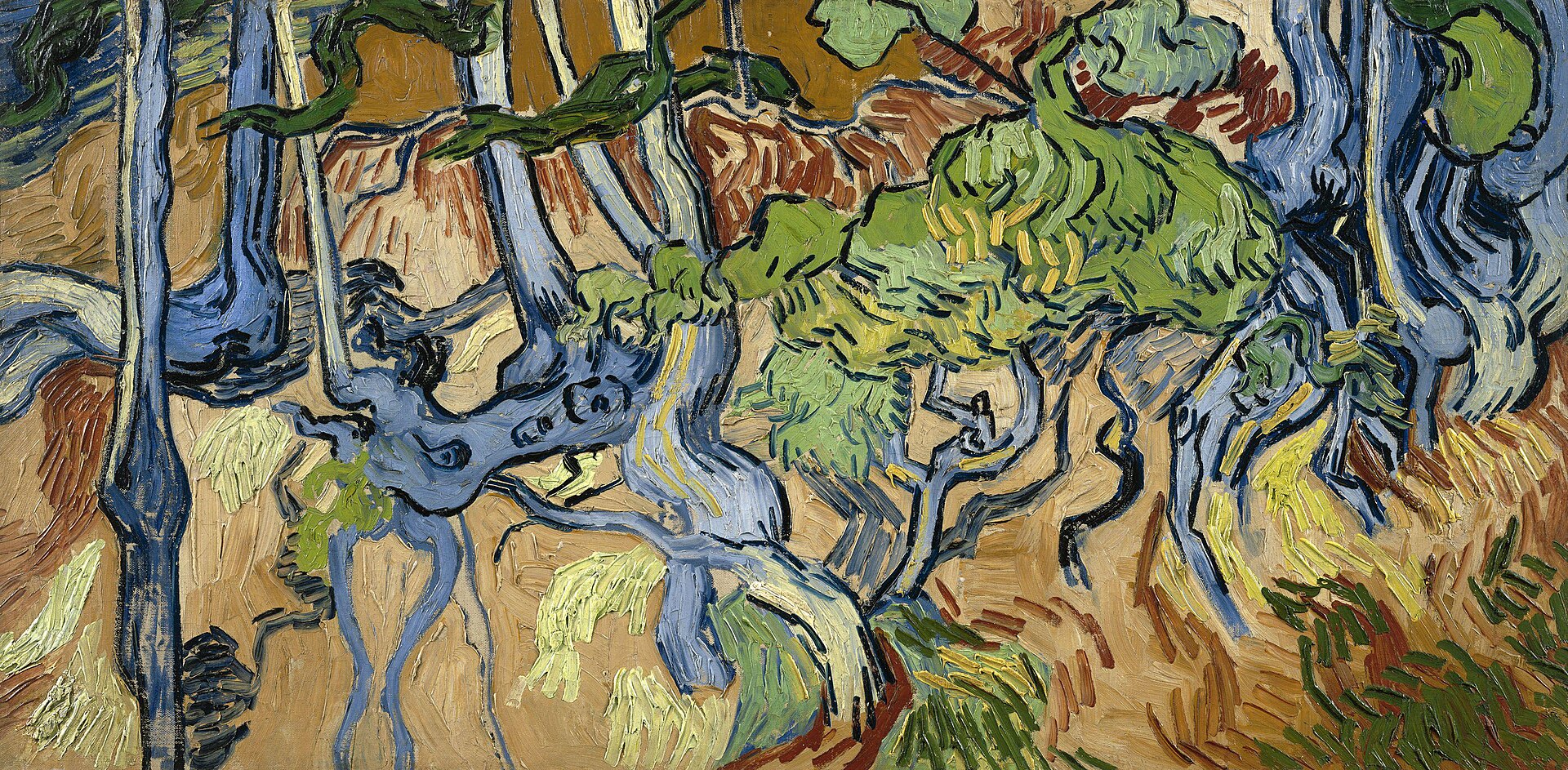
A tangle of roots and trunks on a bank, painted in bold blue, green and ochre and left unfinished: Tree Roots is now thought to be the very last painting Van Gogh worked on, on the day he was shot.
- Artist
- Vincent van Gogh
- Date
- July 1890
- Painted in
- Auvers-sur-Oise, France
- Medium
- Oil on canvas
- Size
- 50 × 100 cm
- Museum
- Van Gogh Museum, Amsterdam
- Catalogue
- F816 · JH2113
What the painting shows
The long canvas is filled with gnarled roots, trunks and stumps growing out of a steep slope. There is no horizon and almost no sky; the forms are flattened into an almost abstract pattern of blue, green, ochre and red shapes. Some areas are only roughly painted, and parts of the canvas are left bare, showing that the work was not finished.
It is one of the most radical pictures Van Gogh painted, looking ahead to twentieth-century abstraction.
Possibly his last painting
Tree Roots shows a tangle of roots and trunks on a bank of earth at the edge of a road in Auvers-sur-Oise, painted in bright blues, greens and ochres. For a long time it was overlooked, but researchers at the Van Gogh Museum have argued that it was very probably Van Gogh’s last painting, left unfinished on 27 July 1890, the day he shot himself. In 2020 the researcher Wouter van der Veen identified the exact spot on the Rue Daubigny in Auvers, where the same roots, now much grown, can still be seen.
Years earlier, in The Hague in 1882, Van Gogh had written to Theo that he wanted a drawing of tree roots to express something of the struggle for life. Many viewers see the same idea here: roots clinging to the earth, battered but alive.
A step towards abstraction
The painting is unusually abstract for its time. There is no horizon and no sky, only a close-up of roots, trunks and earth, cropped at every edge, in flat patches of colour with dark outlines. Parts of the canvas are unfinished, with bare areas between the strokes. Painters of the next generation, especially the Expressionists, would push this kind of close, almost abstract view of nature much further.
Things you might not know
- The spot was found in 2020. A postcard from around 1900 helped researchers locate the roots, a short walk from the Auberge Ravoux.
- It is unfinished. Some areas were left as bare canvas.
- It is in Amsterdam. It is part of the family collection in the Van Gogh Museum.
- Wheatfield with Crows was not the last. See Wheatfield with Crows.
Where to see it
Tree Roots belongs to the Van Gogh Museum in Amsterdam.
Related paintings
 Wheatfield with Crows1890 · Van Gogh Museum
 The Church at Auvers1890 · Musée d’Orsay
 Field with Wheat Stacks1890 · Beyeler Foundation
 Rain, Auvers1890 · Amgueddfa Cymru – Museum Wales
Frequently asked questions
Where is Tree Roots by Van Gogh?
It is in the collection of the Van Gogh Museum, Amsterdam.
When did Van Gogh paint Tree Roots?
In July 1890, in Auvers-sur-Oise, France.
How big is Tree Roots?
The painting measures 50 × 100 cm. It is oil on canvas, catalogued as F816 and JH2113.
Was Tree Roots Van Gogh’s last painting?
It is widely thought to be. The Van Gogh Museum considers it the most likely candidate, as it is unfinished and matches an account that he was painting a forest scene on the day he was shot, 27 July 1890.
See every painting from his Auvers-sur-Oise period in the catalogue, follow his travels on the interactive timeline, or download masterpieces as free wallpapers.
Image: Van Gogh Museum, Amsterdam (public domain), via Wikimedia Commons. Facts checked against the holding museum’s catalogue and the standard Van Gogh catalogues (de la Faille and Hulsker).
What was Van Gogh’s last painting?
Many researchers believe it was Tree Roots, left unfinished on 27 July 1890 in Auvers-sur-Oise, rather than Wheatfield with Crows as legend has it.