Home › Van Gogh Facts › Sunflowers series
Painting series
Van Gogh’s Sunflowers: Every Version
Van Gogh painted sunflowers in two groups: four studies of cut flowers lying on the ground in Paris in 1887, and seven still lifes of sunflowers in a vase in Arles in 1888–89. Here is every version, what makes each one different and where it hangs today.
The Paris sunflowers (1887)
Van Gogh’s first sunflower paintings were made in Paris in late summer 1887: close-up studies of two to four cut flower heads lying on a surface, seen from above and from behind, with their seeds and wilting petals in raking light. Four survive, in the Metropolitan Museum, the Kunstmuseum Bern, the Van Gogh Museum and the Kröller-Müller Museum. Paul Gauguin admired them and acquired two in an exchange of paintings, a gesture that fed his later wish for an Arles version.
The Arles sunflowers (August 1888)
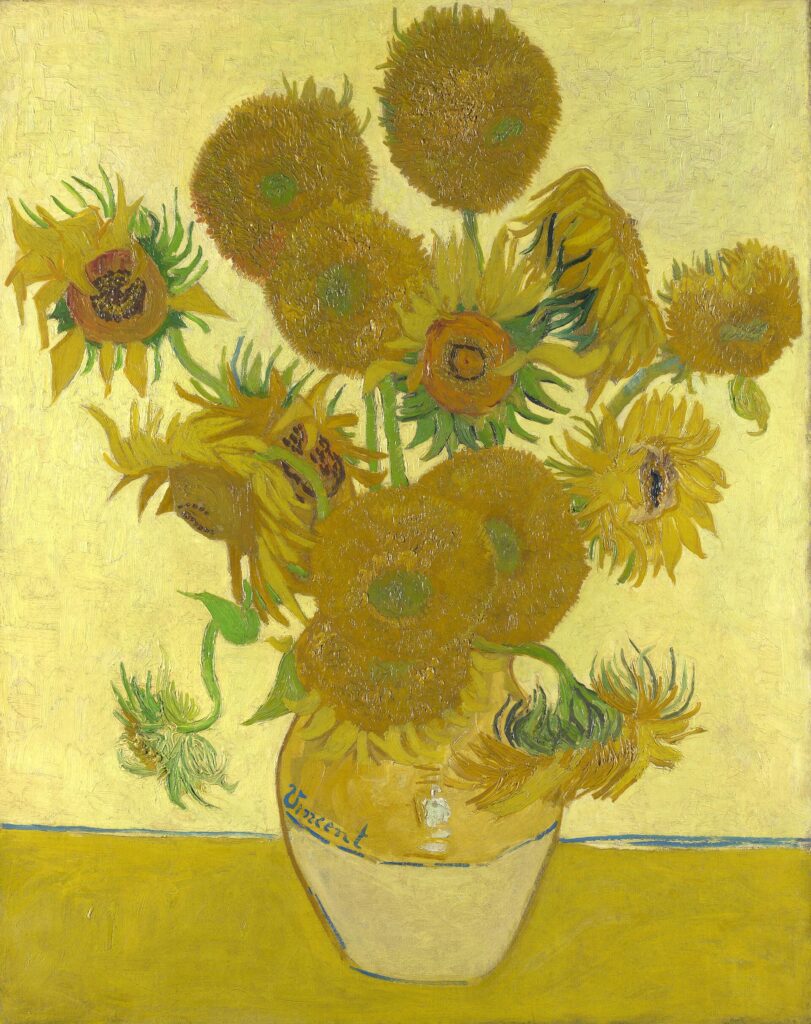
In August 1888, while waiting for Gauguin to join him in Arles, Van Gogh painted four still lifes of sunflowers in a vase to decorate his friend’s room in the Yellow House, working fast because the flowers wilted quickly. In order they show three, five, twelve and fifteen flowers. The first, Three Sunflowers, is in a private collection. The second, Five Sunflowers, was bought by a Japanese collector and destroyed by fire in Ashiya during an American air raid in August 1945. The twelve-flower version is in the Neue Pinakothek in Munich, and the fifteen-flower version, the one most people picture, is in the National Gallery in London.
The repetitions (January 1889)
After Gauguin left and Van Gogh recovered from his breakdown, he painted three repetitions in January 1889, partly because Gauguin had asked for one. Two copy the London picture: one is now in the Van Gogh Museum, the other in the Sompo Museum of Art in Tokyo. The third repeats the Munich composition against a turquoise background and is in the Philadelphia Art Museum. Van Gogh imagined two Sunflowers hung either side of his portrait of Madame Roulin, La Berceuse, as a triptych.
The Tokyo version made headlines twice. In March 1987 the Yasuda insurance company bought it at Christie’s London for £24.75 million ($39.9 million), then a world auction record for any painting. In the late 1990s some critics claimed it was a forgery; archival and technical research supported it, and it is now generally accepted. Read the full story in Van Gogh fakes and forgeries.
Every sunflower painting
 Bowl with Sunflowers, Roses and Other Flowers1886 · Kunsthalle Mannheim, Mannheim
 House with SunflowersPrivate collection
 Allotment with Sunflower1887 · Van Gogh Museum, Amsterdam
 Sunflowers Gone to Seed1887 · Van Gogh Museum, Amsterdam
 Sunflowers1887 · Metropolitan Museum of Art, New York
 Four Withered Sunflowers1887 · Kröller-Müller Museum, Otterlo
 Two Cut Sunflowers1887 · Kunstmuseum Bern, Bern
 Three Sunflowers in a VaseAugust 1888 · Private collection
 Still Life: Vase with Five Sunflowers1888 · Destroyed in 1945
 Sunflowers (Munich version)August 1888 · Bavarian State Painting Collections, Munich
 SunflowersAugust 1888 · National Gallery, London
 Still Life: Vase with Fifteen SunflowersJanuary 1889 · Sompo Museum of Art, Tokyo
 Sunflowers1889 · Van Gogh Museum, Amsterdam
 Sunflowers1889 · Philadelphia Museum of Art, Philadelphia
Where to see them
Four of the five surviving Arles vases are in public collections you can visit: London (National Gallery), Munich (Neue Pinakothek), Amsterdam (Van Gogh Museum), Philadelphia (Philadelphia Art Museum) and Tokyo (Sompo Museum of Art). They rarely travel, though London and Philadelphia exchanged loans in 2024–26. Check our exhibitions calendar and museum map.
Frequently asked questions
How many Sunflowers paintings did Van Gogh paint?
Eleven of sunflowers alone: four Paris studies of cut flowers (1887) and seven Arles still lifes of sunflowers in a vase (1888–89). Sunflowers also appear in a few other paintings.
Where are Van Gogh’s Sunflowers?
The Arles versions are in the National Gallery (London), Neue Pinakothek (Munich), Van Gogh Museum (Amsterdam), Philadelphia Art Museum and Sompo Museum of Art (Tokyo); one is privately owned and one was destroyed in 1945.
Why did Van Gogh paint sunflowers?
He painted the Arles series to decorate Paul Gauguin’s room in the Yellow House, and sunflowers came to stand for gratitude, friendship and the southern sun.
Which Sunflowers was destroyed?
Five Sunflowers (August 1888), owned by a Japanese collector, was destroyed by fire in Ashiya during an air raid on 6 August 1945.
Sources: Van Gogh Museum; National Gallery, London; Wikipedia, “Sunflowers (Van Gogh series)”; The Art Newspaper (1998, 2025, 2026); Van Gogh Museum Journal 2001; Van Gogh’s letters (vangoghletters.org).


