Home › Paintings › Saint-Rémy › The Starry Night
Saint-Rémy · 1889
The Starry Night
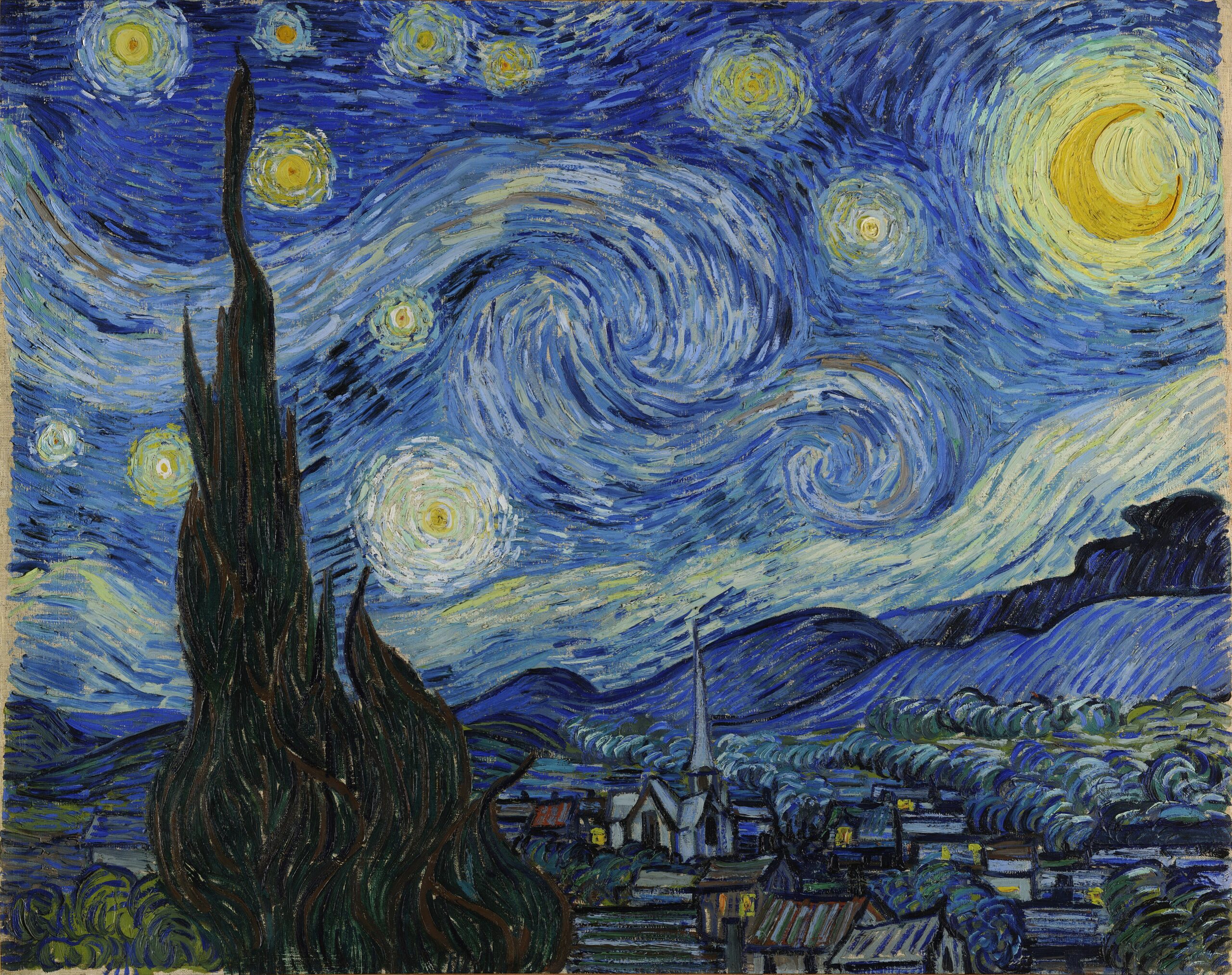
A swirling night sky full of blazing stars and a crescent moon above a sleeping village, with a flame-like cypress in the foreground: The Starry Night, painted at the Saint-Rémy asylum in June 1889, is Van Gogh’s most famous painting.
- Artist
- Vincent van Gogh
- Date
- June 1889
- Painted in
- Saint-Rémy-de-Provence, France
- Medium
- Oil on canvas
- Size
- 73.7 × 92.1 cm
- Museum
- Museum of Modern Art, New York
- Catalogue
- F612 · JH1731
What the painting shows
Most of the canvas is sky. Great spirals of wind or cloud roll across it, eleven stars burn with haloes of yellow and white, and an orange crescent moon glows in the upper right. Below, a small village with a church spire lies quietly among dark hills, its windows lit. On the left, a huge cypress tree rises like a dark flame from the bottom of the canvas into the sky, linking earth and heaven.
The brushwork is everywhere visible – long, curving strokes of blue, white and yellow that make the whole picture seem to move.
Painted from his window – and from memory
In May 1889 Van Gogh admitted himself to the asylum of Saint-Paul-de-Mausole near Saint-Rémy-de-Provence. From his bedroom window, which had bars, he could see a walled wheatfield and the Alpilles hills beyond, and he painted that view many times. He wrote to Theo that he had seen the countryside before sunrise, with nothing but the morning star, which looked very big.
The Starry Night, however, was painted in his studio during the day, and it is not a literal view. The village was invented, or remembered – its spire looks more Dutch than Provençal – and the cypress was moved into the foreground. Astronomers have noted that Venus, the “morning star”, was prominent in the sky at that time, and it may be the bright star near the cypress.
What did Van Gogh think of it?
Surprisingly, Van Gogh was not especially pleased with the painting. In a letter to Theo he mentioned it only briefly, as a night study, and he later called some of his stylised pictures of that time a failure, attempts at abstraction that had gone too far. Theo thought the forms had become too contorted. It was only after both brothers died that the painting became famous.
The story behind The Starry Night
Van Gogh had been at the asylum of Saint-Paul-de-Mausole for about six weeks when he painted The Starry Night in mid-June 1889. He was recovering well, sleeping and eating properly, and had been given a second room on the ground floor to use as a studio. From his bedroom on the floor above, a barred window looked east across a walled wheat field to the low hills of the Alpilles. He painted that view again and again, at every season and time of day.
Early in June he wrote to Theo that he had seen the countryside from his window long before sunrise, with nothing but the morning star, which looked very big. Within a few weeks he mentioned “a new study of a starry sky”. He could not paint outside at night from inside the asylum, so the picture was made in his studio by day, combining the real view, his memory of the night sky and a good deal of imagination. In September he rolled the dry canvas with other recent work and sent it to Theo in Paris.
Composition, colour and brushwork
The picture is built on a simple structure: a dark, flame-like cypress rising in the foreground on the left, a low village and church in the middle distance, a line of rolling hills, and a huge sky taking up more than two-thirds of the canvas. The cypress links earth and sky, and its curling shape is echoed by the great spiral in the centre of the sky.
Van Gogh painted it in his late style, with paint laid on in short, thick, directional strokes that follow the forms: horizontal in the hills, upright in the cypress, circling around the stars and the crescent moon. The palette is limited to deep ultramarine and cobalt blues, greens and blacks against pale yellows and whites, so the stars and moon seem to give off light. Unlike many of his paintings from that summer, it was not worked on the spot, and the brushwork is more controlled and rhythmic than it first appears.
Things you might not know about The Starry Night
- It was painted in daylight. Van Gogh worked on it in his ground-floor studio, not outdoors at night.
- The bars are missing. His bedroom window had iron bars, but he left them out.
- The village is partly invented. Saint-Rémy was not visible in that position from his window, and the slender church spire looks more like a church in the Netherlands than in Provence.
- The bright “star” is probably Venus. Astronomers have noted that Venus was prominent in the dawn sky in Provence in late May and June 1889, matching his description of the morning star.
- He thought it was a failure. Later that year he told Émile Bernard that he had let himself be carried away into making stars that were too big, and called it a new failure.
- It was not one of the paintings he exhibited. Theo found it hard to read, and it stayed with the family after both brothers died.
- The swirls fascinate scientists. A 2006 study found that the pattern of light in the sky follows the mathematics of turbulent flow, and later researchers have debated how far the comparison holds.
- A famous song is named after it. Don McLean’s 1971 song “Vincent” is known by its opening words, “Starry, starry night”.
- It rarely travels. MoMA lends it very occasionally; it has been one of the museum’s most visited works since it arrived in 1941.
- He painted another starry night the year before. Starry Night over the Rhône (1888) was painted outdoors in Arles, beside the river.
The cypress and what it means
Cypresses fascinated Van Gogh at Saint-Rémy; he wrote that they were as beautiful in line and proportion as an Egyptian obelisk and that no one had yet painted them as he saw them. In the Mediterranean world cypresses are planted in cemeteries and are associated with death and mourning, and many writers read the tree in The Starry Night as a link between life and death, earth and heaven. Van Gogh himself had written a year earlier that looking at the stars always made him dream, and wondered whether we take death to reach a star, as we take a train to reach a town. He did not explain the painting in symbolic terms, though, and it can be read simply as a powerful landscape. See more in Cypresses and our guide to Van Gogh’s night paintings.
From Theo’s apartment to MoMA
After Theo’s death in 1891 the painting passed to his widow, Jo van Gogh-Bonger. She sold it in 1900 to the French poet Julien Leclercq, and over the next decades it passed through private collections in France and the Netherlands. In 1941 the Museum of Modern Art in New York acquired it from the dealer Paul Rosenberg, paying with works from the bequest of its founder Lillie P. Bliss. It has hung there ever since and is now probably the most famous painting in the museum. It is not for sale, so it has no market price; for comparison, a less famous late landscape, Blossoming Chestnut Trees, sold for $190.4 million in 2026.
Seeing The Starry Night at MoMA
The Starry Night hangs in MoMA’s fifth-floor galleries of art from the 1880s to the 1940s, usually near Van Gogh’s Olive Trees with the Alpilles in the Background, painted the same month. It is smaller than most people expect, about 74 by 92 centimetres, and there is almost always a crowd. Arriving when the museum opens, or on a weekday evening, gives you the best chance of standing in front of it. Up close you can see how thickly the paint is laid on, the bare canvas showing through between strokes in places, and how the colours of the sky shift from deep blue to green and violet. Read our full guide to Van Gogh at MoMA for tickets and what else to see.
To see the theme elsewhere, the Kröller-Müller Museum in the Netherlands has Road with Cypress and Star, his last painting of a cypress under the night sky, made in May 1890, and the Musée d’Orsay in Paris has Starry Night over the Rhône.
Where to see it
The Starry Night has belonged to the Museum of Modern Art (MoMA) in New York since 1941, when it was acquired through the Lillie P. Bliss Bequest. It is the museum’s most visited painting. Its calmer predecessor, Starry Night Over the Rhône, is in the Musée d’Orsay in Paris.
Related paintings
 Starry Night Over the Rhône1888 · Musée d’Orsay
 Cypresses1889 · The Met, New York
 The Olive Trees1889 · Museum of Modern Art
 Café Terrace at Night1888 · Kröller-Müller Museum
Frequently asked questions
Where is The Starry Night by Van Gogh?
It is in the collection of the Museum of Modern Art, New York.
When did Van Gogh paint The Starry Night?
In June 1889, in Saint-Rémy-de-Provence, France.
How big is The Starry Night?
The painting measures 73.7 × 92.1 cm. It is oil on canvas, catalogued as F612 and JH1731.
Where was The Starry Night painted?
At the asylum of Saint-Paul-de-Mausole in Saint-Rémy-de-Provence, France, in June 1889. It is based on the view from his window, combined with memory and imagination.
Is the village in The Starry Night real?
Not exactly. Van Gogh could not see a village like this from his window; it was added from imagination or memory, and its tall church spire resembles those of the Netherlands.
How much is The Starry Night worth?
It has never been for sale since it entered MoMA in 1941 and is considered priceless. Comparable Van Gogh masterpieces have sold for well over $100 million at auction.
See every painting from his Saint-Rémy period in the Saint-Rémy collection, follow his travels on the interactive timeline, or download masterpieces as free wallpapers.
Image: Museum of Modern Art, New York (public domain), via Wikimedia Commons. Facts checked against the holding museum’s catalogue and the standard Van Gogh catalogues (de la Faille and Hulsker).
Why is The Starry Night so famous?
It combines Van Gogh’s most recognisable style, with swirling brushwork and intense blues and yellows, with a moving story: it was painted in an asylum a year before his death. Its acquisition by MoMA in 1941, countless reproductions and Don McLean’s song made it one of the best-known images in the world.
Did Van Gogh paint The Starry Night at night?
No. He painted it by day in his studio at the Saint-Rémy asylum, working from the view from his window, his memory of the night sky and his imagination.
What does the cypress in The Starry Night mean?
Cypresses are traditionally linked with death and cemeteries in southern Europe, so many see the tree as a bridge between life and death or earth and heaven. Van Gogh also simply loved their shape and colour.