Home › Van Gogh Facts › How Van Gogh Became Famous
His legacy
How Did Van Gogh Become Famous?
When Van Gogh died in 1890, only a handful of artists and critics knew his work. Within twenty years he was one of the most influential painters in Europe, and within a century the most famous. This is how it happened, and who made it happen.
Almost unknown in his lifetime
Van Gogh painted for only about ten years. He showed a few canvases at the Salon des Indépendants in Paris in 1888, 1889 and 1890, and six paintings with the avant-garde group Les XX in Brussels in January 1890, where The Red Vineyard was bought by Anna Boch. That is the only sale of a painting in his lifetime that is firmly documented; see did Van Gogh sell any paintings?
But fellow artists noticed him. Pissarro, Toulouse-Lautrec, Bernard, Gauguin and Signac knew his work, and in January 1890 the young critic Albert Aurier published the first article devoted to him, “Les Isolés: Vincent van Gogh”, in the Mercure de France, praising his intensity and colour. Van Gogh was embarrassed by the praise. Six months later he was dead.
Jo van Gogh-Bonger
When Theo died in January 1891, his widow Johanna inherited hundreds of Vincent’s paintings and drawings and almost all of his letters. Friends advised her to sell or forget them. Instead she went back to the Netherlands, ran a boarding house in Bussum, and devoted herself to making Vincent known. She lent paintings to exhibitions, sold works carefully to collectors and museums whose support would build his reputation, and spent years transcribing the letters. In 1914 she published them in Dutch, with a memoir of Vincent, and later began translating them into English. Without her, Van Gogh might have remained a footnote. Read her full story in Jo van Gogh-Bonger: the woman who made Van Gogh famous.
The exhibitions that changed everything
- Paris, 1901. A retrospective at the Bernheim-Jeune gallery stunned a group of young painters. Maurice de Vlaminck later said that on that day he loved Van Gogh more than his own father. With Henri Matisse and André Derain he went on to found Fauvism, with its violent, unnatural colour.
- Amsterdam, 1905. Jo organised a huge exhibition of several hundred works at the Stedelijk Museum, the largest Van Gogh show for decades.
- Germany, 1900s–1912. Dealers such as Paul Cassirer showed his work across Germany, where the Expressionists of Die Brücke and Der Blaue Reiter took him as a model. The Sonderbund exhibition in Cologne in 1912 gave him a room of honour with more than a hundred works.
- New York, 1913. The Armory Show introduced Van Gogh, with Cézanne and Gauguin, to American audiences.
The legend of the tortured genius
His fame grew fastest through his story. The letters revealed a passionate, articulate man who struggled with poverty, rejection and illness, cut off his ear and died young, yet kept working with total dedication. Writers turned this into the legend of the misunderstood genius. Irving Stone’s best-selling novel Lust for Life (1934) and the 1956 Hollywood film, with Kirk Douglas as Vincent, brought the story to millions. Don McLean’s 1971 song “Vincent” did the same for a new generation. Many historians think the legend exaggerates his isolation and madness, but it made him the best-known artist in the world.
Museums and the market
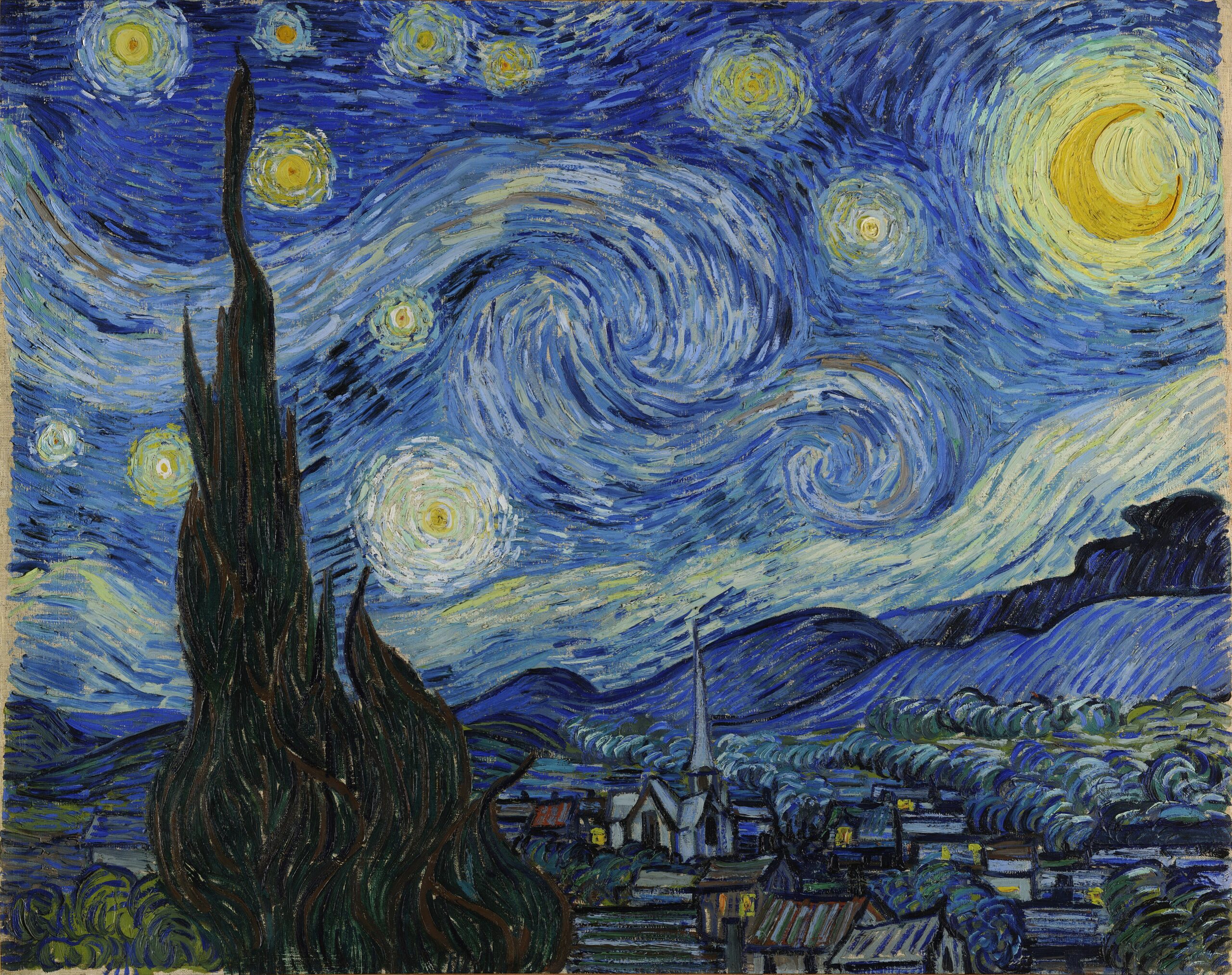
Museums bought early. The Kröller-Müller collection, built by Helene Kröller-Müller from 1908, became the second-largest Van Gogh collection in the world. The National Gallery in London bought Sunflowers from Jo in 1924, and the Museum of Modern Art acquired The Starry Night in 1941. In 1973 the Van Gogh Museum opened in Amsterdam to house the family collection. Prices rose with fame: in 1987 Irises sold for $53.9 million and in 1990 the Portrait of Dr Gachet for $82.5 million, then world records. In November 2026 Blossoming Chestnut Trees sold for $190.4 million. See our auction results.
Why his fame has lasted
Part of the answer is the work itself: bright, direct and easy to love, even for people who know nothing about art. Part is the letters, which let readers meet him in his own words; see real Van Gogh quotes. And part is the story, which speaks to anyone who has felt overlooked. Today his paintings fill museums, immersive shows draw millions of visitors, and the Van Gogh Museum is one of the most visited museums in Europe.
Frequently asked questions
Was Van Gogh famous when he was alive?
No. A few artists and critics admired him, and one critic wrote a full article about him in 1890, but he was almost unknown to the public and sold very little.
Who made Van Gogh famous?
Above all his sister-in-law, Jo van Gogh-Bonger, who exhibited his work, sold it carefully to collectors and museums, and published his letters in 1914.
When did Van Gogh become famous?
Between about 1901 and 1914, through big exhibitions in Paris, Amsterdam and Germany and the publication of his letters. His popular fame grew after the novel Lust for Life (1934) and its 1956 film.
Sources: Van Gogh Museum; vangoghletters.org; Hans Luijten, Alles voor Vincent (Jo van Gogh-Bonger biography); auction houses.