Home › Paintings › Arles › The Sower
Arles · 1888
The Sower
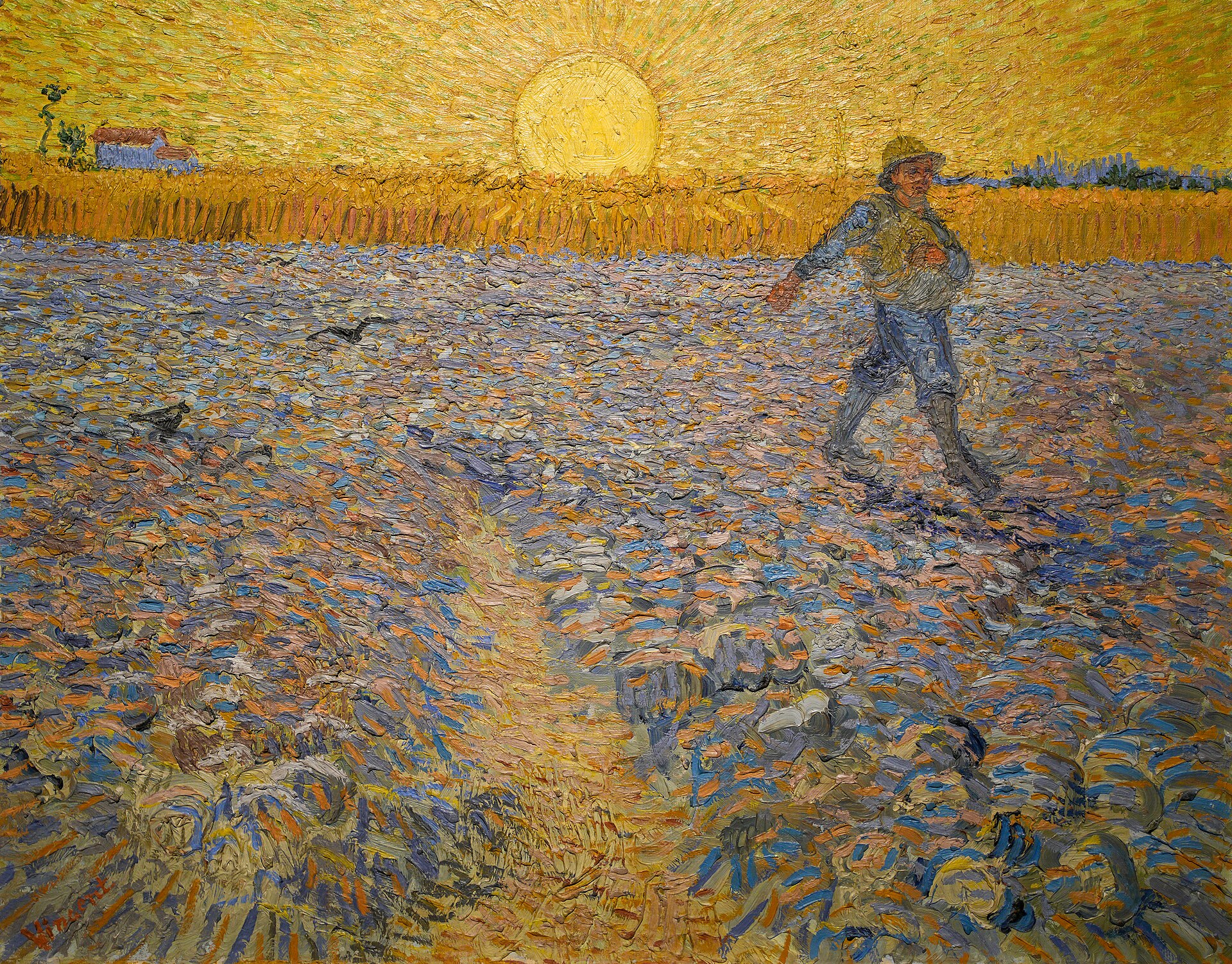
A huge yellow sun sets behind a field of ripe wheat as a peasant strides across violet earth, scattering seed: Van Gogh’s The Sower of June 1888 turns a subject from Millet into a blaze of complementary colour.
- Artist
- Vincent van Gogh
- Date
- June 1888
- Painted in
- Arles, France
- Medium
- Oil on canvas
- Size
- 64.2 × 80.3 cm
- Museum
- Kröller-Müller Museum, Otterlo
- Catalogue
- F422 · JH1470
What the painting shows
The sower, painted in blue, strides diagonally across a ploughed field, his right arm swinging as he casts the seed. The earth is made of thick dabs of violet, blue, orange and yellow, and beyond it a band of yellow wheat runs to the horizon, where a farmhouse and trees sit beneath a gigantic sun. The sky is a pale, greenish yellow.
Van Gogh was experimenting boldly. Instead of natural colours, he paired yellow with violet and orange with blue, the complementary contrasts he had learned about in Paris, to make the scene glow with heat.
Van Gogh and Millet’s Sower
The figure of the sower came from The Sower by Jean-François Millet, the French painter of peasant life whom Van Gogh admired above almost all others. He had copied Millet’s figure many times as a beginner in 1880–81, and the image remained with him all his life. For him the sower stood for the cycle of life and the hope of a harvest to come.
In Arles he tackled the subject in full colour for the first time. He was not completely satisfied with this canvas and returned to the theme in the autumn, in the more Japanese-style Sower with Setting Sun now in the Van Gogh Museum.
The story behind The Sower
The sower was Van Gogh’s favourite motif. As a young man he copied Jean-François Millet’s famous The Sower again and again, and he made drawings of sowers throughout his Dutch years. In Arles in June 1888, during the harvest, he finally painted his own version in colour: a peasant striding across a ploughed field, scattering seed, with a field of ripe wheat behind and a huge yellow sun on the horizon.
He was not satisfied with it. He wrote to Theo and to Émile Bernard that he was struggling with the colours, and he repainted parts after it had begun to dry. The violet field and the yellow sky are deliberately unnatural, chosen for their contrast rather than to copy what he saw.
A symbol of life
For Van Gogh the sower carried deep meaning. Coming from a family of preachers, he knew the Bible parable of the sower, and he saw sowing and reaping as images of the cycle of life and death. In his letters he linked the sower to the idea of eternity and wrote of his wish to paint a sower in colour as a picture of the infinite. He returned to the theme in Arles in the autumn with a more Japanese-style Sower with Setting Sun (Van Gogh Museum), with a tree cutting across the picture, and made many drawings, one of which became the most expensive Van Gogh drawing ever sold, at $11.2 million in 2025.
Things you might not know
- Millet was his inspiration. He copied Millet’s Sower many times in drawings and later in paint.
- He thought it was a failure. His letters are full of doubts about this canvas.
- The colours are deliberately unnatural. A violet field and a lemon-yellow sky are chosen for contrast.
- It is in the Kröller-Müller Museum. See our Kröller-Müller guide.
Where to see it
This version belongs to the Kröller-Müller Museum in Otterlo, the Netherlands, home to around ninety paintings by Van Gogh.
Related paintings
 Harvest at La Crau, with Montmajour in the Background1888 · Van Gogh Museum
 The siesta (after Millet)1890 · Musée d’Orsay
 Two Peasant Women Digging in Field with Snow1890 · Metropolitan Museum of Art
 Café Terrace at Night1888 · Kröller-Müller Museum
Frequently asked questions
Where is The Sower by Van Gogh?
It is in the collection of the Kröller-Müller Museum, Otterlo.
When did Van Gogh paint The Sower?
In June 1888, in Arles, France.
How big is The Sower?
The painting measures 64.2 × 80.3 cm. It is oil on canvas, catalogued as F422 and JH1470.
See every painting from his Arles period in the Arles collection, follow his travels on the interactive timeline, or download masterpieces as free wallpapers.
Image: Kröller-Müller Museum, Otterlo (public domain), via Wikimedia Commons. Facts checked against the holding museum’s catalogue and the standard Van Gogh catalogues (de la Faille and Hulsker).
Why did Van Gogh paint sowers?
He admired Millet’s Sower and saw the sower as a symbol of the cycle of life, linked to the biblical parable. He painted and drew the motif throughout his career.