Home › Paintings › Saint-Rémy › Olive Trees with the Alpilles in the Background
Saint-Rémy · 1889
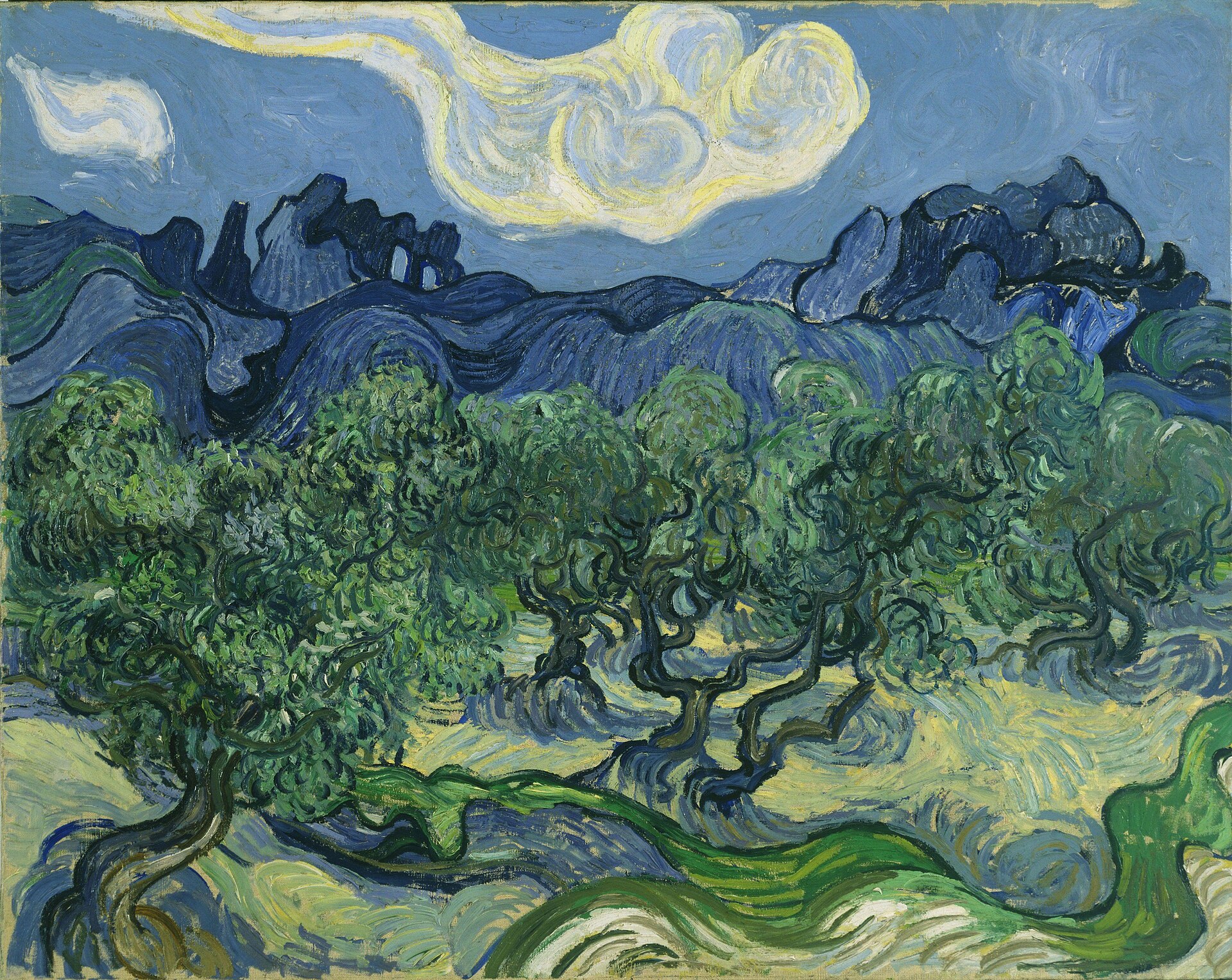
Olive Trees with the Alpilles in the Background
Painted in the same month as The Starry Night, this daytime view of olive trees beneath the blue Alpilles has the same rolling rhythm, and Van Gogh thought of the two as companion pieces.
- Artist
- Vincent van Gogh
- Date
- June 1889
- Painted in
- Saint-Rémy-de-Provence, France
- Medium
- Oil on canvas
- Size
- 72.6 × 91.4 cm
- Museum
- Museum of Modern Art, New York
- Catalogue
- F712 · JH1740
What the painting shows
A grove of olive trees sweeps across the foreground, their trunks and foliage drawn in curving strokes of green and blue. The ground is striped with ochre, red and violet, and beyond the grove rise the rugged blue hills of the Alpilles. A large, billowing white cloud floats in the sky above them.
Everything – earth, trees, hills and cloud – is caught up in the same undulating movement.
A pendant to The Starry Night
Van Gogh painted this canvas in June 1889, during his first weeks at the asylum in Saint-Rémy, shortly after The Starry Night. When he sent both pictures to Theo in September, he described the olive trees with the white cloud and the mountains as a pendant to the night sky – exaggerated in their forms in the same way.
The two now hang a short walk from each other in the same museum.
The olive groves of Saint-Rémy
The asylum of Saint-Paul-de-Mausole stood among olive groves at the foot of the Alpilles hills, and in 1889 Van Gogh painted them about fifteen times. He painted this canvas in June 1889, the same month as The Starry Night, and the two pictures share the same rolling rhythm: the twisting trunks, the waves of the hills and the swirling clouds all move together. Both now hang in the Museum of Modern Art in New York.
Olive trees were hard to paint, he admitted. Their silver-grey leaves change colour with the light and wind, and he wanted to capture that shimmer without copying it leaf by leaf. He used short, curved strokes laid side by side, which turn the whole field into a kind of moving pattern.
Why olive trees mattered to him
Olive groves carried religious meaning for Van Gogh. Gauguin and Émile Bernard had both painted Christ in the Garden of Olives, and Van Gogh disliked their invented biblical scenes. He wrote that he preferred to paint real olive trees under a real sky and let them carry the feeling on their own. His olive groves are his answer to them: no figures from the Bible, just the trees, the earth and the light.
Things you might not know
- It hangs near The Starry Night. MoMA owns both paintings from June 1889.
- He painted around fifteen olive groves. Other versions are in Otterlo, Amsterdam, Minneapolis, Edinburgh and elsewhere.
- He painted outdoors. Unlike The Starry Night, the olive groves were painted in front of the motif.
Painting in the wind
Van Gogh painted the olive groves outdoors, often in the mistral, the strong north wind of Provence. To keep the canvas steady he pegged his easel into the ground, and the wind is part of what we see: the trees seem to lean and twist, and the strokes in the sky curl like gusts. He painted thickly, laying paint straight from the tube in places, and worked fast to catch the shifting light on the silvery leaves.
Olive groves through the seasons
Van Gogh came back to the olive groves again and again between June and December 1889, painting them under blue summer skies, in the pink and orange light of evening, and with pale yellow autumn suns. In late 1889 he painted women picking olives, a subject he repeated several times, including a version now in the Metropolitan Museum of Art. He wrote that he wanted to paint the olive trees as others had painted the willows of Holland, as a subject that belonged to the land and its people. Taken together, the series is one of the great achievements of his year in the asylum.
How to see it at MoMA
The painting hangs in the same galleries as The Starry Night, which makes it easy to compare the two. Look at how the same curling stroke is used for hills, clouds and leaves in both. See our MoMA guide for tickets and timing.
Where to see it
The painting belongs to the Museum of Modern Art in New York, which received it in 1998 as part of the bequest of John Hay Whitney.
Related paintings
 The Starry Night1889 · Museum of Modern Art
 Olive Grove1889 · Kröller-Müller Museum
 Cypresses1889 · The Met, New York
 Landscape with Couple Walking and Crescent Moon1890 · São Paulo Museum of Art
Frequently asked questions
Where is Olive Trees with the Alpilles in the Background by Van Gogh?
It is in the collection of the Museum of Modern Art, New York.
When did Van Gogh paint Olive Trees with the Alpilles in the Background?
In June 1889, in Saint-Rémy-de-Provence, France.
How big is Olive Trees with the Alpilles in the Background?
The painting measures 72.6 × 91.4 cm. It is oil on canvas, catalogued as F712 and JH1740.
See every painting from his Saint-Rémy period in the Saint-Rémy collection, follow his travels on the interactive timeline, or download masterpieces as free wallpapers.
Image: Museum of Modern Art, New York (public domain), via Wikimedia Commons. Facts checked against the holding museum’s catalogue and the standard Van Gogh catalogues (de la Faille and Hulsker).
How many olive tree paintings did Van Gogh make?
About fifteen, almost all painted at Saint-Rémy in 1889.
Why did Van Gogh paint olive trees so often?
The asylum at Saint-Rémy was surrounded by olive groves. He painted them around fifteen times in 1889, in every season and light.