Home › Travel › Van Gogh in London
Travel guide · London
Van Gogh in London: Where He Lived and Where to See His Paintings
Before he ever picked up a brush, Vincent van Gogh spent almost three years in and around London as a young art dealer, teacher and would-be preacher. Here is where he lived, what you can still see, and where to find his paintings in the city today.
The young Van Gogh in London
Van Gogh came to London in May 1873, aged twenty, sent by the art dealers Goupil & Cie to work in their London branch. It was a promotion: he had done well in The Hague and the family expected him to make a career in the trade, like his uncles. The London gallery was at 17 Southampton Street, just off the Strand in Covent Garden, and later moved round the corner to Bedford Street.
He was not yet an artist. He sold prints and reproductions, visited the Royal Academy and the National Gallery, read Dickens and George Eliot, and began making small sketches. Later, after he had become a painter, he remembered standing on the Thames Embankment drawing on his way home. He lived in England, on and off, until Christmas 1876, and the experience shaped his taste for English illustrators and for pictures of working people. Read the full story in Van Gogh’s early life.
87 Hackford Road: the Van Gogh House
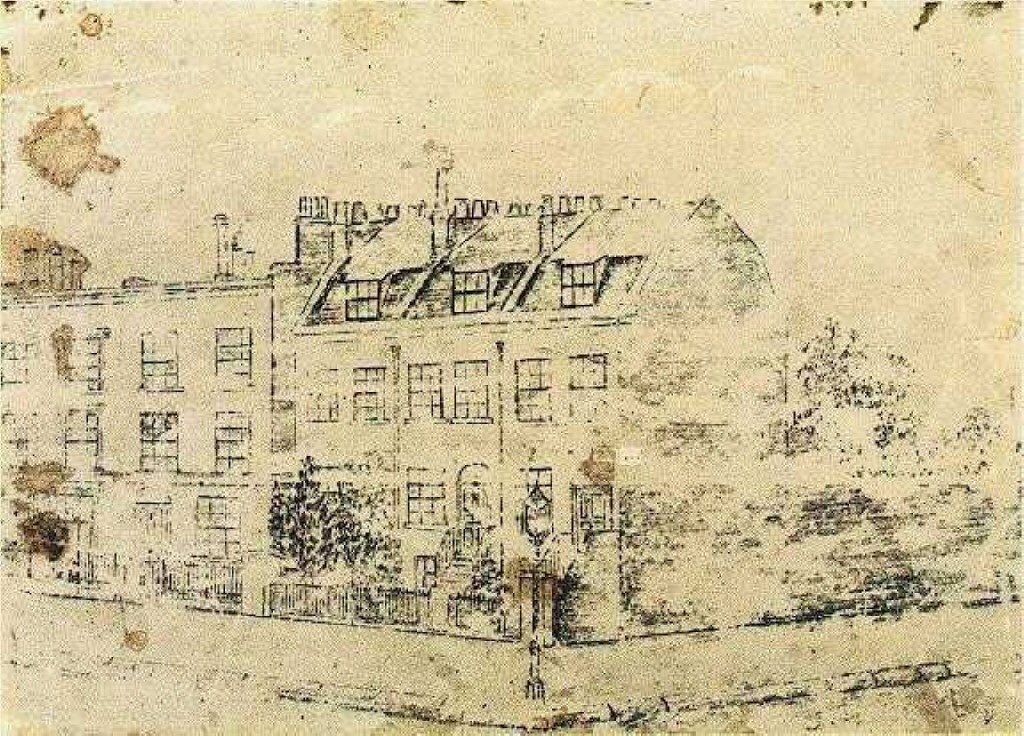
His first lodgings were too expensive, and in August 1873 he took a room at 87 Hackford Road in Stockwell, south London, in the house of Ursula Loyer and her daughter Eugénie. He walked about three miles to the gallery in Covent Garden each day, a walk of just under an hour. He fell for Eugénie, she turned him down, and in 1874 he moved on, to a house in Kennington he described as covered in ivy.
The Georgian terrace house, built in the 1820s and listed Grade II, carries a blue plaque put up by the Greater London Council in 1973. After years of decay it was restored with traditional materials, including lime plaster and horsehair, and opened in 2019 as Van Gogh House London, a home for artist residencies and exhibitions. From September to December it is usually open five days a week for its annual exhibition; for the rest of the year it runs pre-booked guided tours, including walking tours that retrace Van Gogh’s route from Covent Garden. The nearest Tube stations are Stockwell, Oval and Brixton. Check the house’s own website for current dates and prices before you go. Just round the corner is Van Gogh Walk, a pedestrianised street turned into a community garden.
Ramsgate and Isleworth
Goupil sacked him in early 1876 (by then he had been moved to Paris), and in April he came back to England to teach. His first post was as an unpaid assistant at William Stokes’s small boarding school at 6 Royal Road in Ramsgate, on the Kent coast. He lodged nearby at 11 Spencer Square, sharing the house with another teacher and some of the boys, and drew the view from his window. Both buildings have plaques, and the gardens in Spencer Square, now named the Van Gogh Garden, hold a bust of the artist. Thanet’s tourist office publishes a self-guided walk.
That summer Stokes moved his school to Isleworth, west London, and Van Gogh followed, before taking a better job with the Methodist minister Thomas Slade-Jones at Holme Court on Twickenham Road. He helped at services in Richmond and Petersham, and on 29 October 1876 he preached his first sermon at the Wesleyan Methodist church in Richmond. A plaque on Twickenham Road marks his stay. At Christmas 1876 he went home to the Netherlands and never returned to Britain.
Where to see Van Gogh’s paintings in London
London has one of the best groups of Van Goghs outside the Netherlands and France, and you can see most of it free of charge.
The National Gallery (Trafalgar Square, free) owns four: Sunflowers (August 1888), bought from the Van Gogh family in 1924; Van Gogh’s Chair (1888), bought the same year; A Wheatfield, with Cypresses (1889), acquired in 1923; and Long Grass with Butterflies (1890), which arrived in 1926. It also shows Farms near Auvers (1890), painted in the last weeks of his life and lent by Tate, which received it in the bequest of the collector Frank Stoop in 1933. The pictures usually hang together in Room 43, but check the gallery’s website, as Sunflowers in particular is sometimes lent abroad. See our National Gallery guide.
The Courtauld Gallery (Somerset House, Strand, paid entry) has two: the Self-Portrait with Bandaged Ear, painted in January 1889 a week or so after he left hospital in Arles, and Peach Trees in Blossom (April 1889), a lyrical spring landscape painted only weeks later. Both were bought by the industrialist Samuel Courtauld, who also paid for the National Gallery’s Sunflowers and Chair.
Tate owns further works on paper, including a watercolour of the Oise at Auvers and an early drawing of thatched roofs, but they are only shown occasionally.
A one-day Van Gogh walk in London
Start at the National Gallery when it opens and spend an hour in the Van Gogh room. Walk five minutes east along the Strand to Southampton Street, where Goupil’s gallery stood, then on to the Courtauld Gallery in Somerset House for the Bandaged Ear self-portrait. After lunch, cross Waterloo Bridge, the river he walked beside every day, and take the Northern line to Stockwell or Oval (or walk, as he did, about an hour) to 87 Hackford Road and Van Gogh Walk. If you have a second day, Ramsgate is about 75 minutes by high-speed train from St Pancras, and Isleworth and Richmond are a short train ride from Waterloo.
How London changed him
It is easy to treat the London years as a prelude, but Van Gogh never forgot them. He collected English wood engravings from magazines such as The Graphic for the rest of his life, admired English illustrators who drew the poor, and cited Dickens as a model for the kind of art that tells the truth about ordinary people. When he painted The Potato Eaters a decade later, that sympathy for working people was part of what he was reaching for. London was also where his religious crisis began, which led him to Ramsgate, Isleworth and, soon after, to the coal-mining Borinage in Belgium, the subject of our Belgium guide.
Frequently asked questions
Where did Van Gogh live in London?
His best-known address is 87 Hackford Road in Stockwell, where he lodged from August 1873 to 1874. It has a blue plaque and is now Van Gogh House London, open for tours and exhibitions. He later lived in Kennington, and in 1876 in Ramsgate and Isleworth.
Can you visit Van Gogh’s house in London?
Yes. Van Gogh House London at 87 Hackford Road runs pre-booked guided tours for much of the year and is usually open five days a week from September to December for its annual exhibition. Check its website for current dates.
Where can I see Van Gogh paintings in London?
The National Gallery has Sunflowers, Van Gogh’s Chair, A Wheatfield with Cypresses, Long Grass with Butterflies and Farms near Auvers (lent by Tate). The Courtauld Gallery has Self-Portrait with Bandaged Ear and Peach Trees in Blossom.
Did Van Gogh paint in London?
No. He was an art dealer, teacher and lay preacher in England in 1873–76 and only made small sketches. He decided to become an artist in 1880, in Belgium.
Is the National Gallery free?
Yes, entry to the National Gallery’s permanent collection, including its Van Goghs, is free. Some special exhibitions are ticketed.
Sources: Van Gogh House London; English Heritage blue plaque; Van Gogh Letters chronology; The National Gallery – Room 43; The Courtauld – Self-Portrait with Bandaged Ear; Visit Thanet – Van Gogh in Ramsgate.