Home › Facts › In His Own Words
Letters · His own words
What Van Gogh Wrote About His Own Paintings
Van Gogh is unusual among great painters: he explained what he was trying to do, often on the day he did it, in letters to his brother Theo, his sister Willemien and his friends. Here are nine famous paintings and what he said about them.
Why his letters matter
More than 900 letters by and to Van Gogh survive, around 820 of them written by him, most to Theo. They are one of the richest records any artist has left. He sketched new paintings in the margins, listed the colours he used, and explained his intentions in plain words. Because the letters are now precisely dated by the scholars of the Van Gogh Museum’s edition, we can often say which day a picture was begun.
The quotations below are short extracts in English translation. Each is followed by the letter number from the standard edition, Vincent van Gogh – The Letters (vangoghletters.org), where you can read the full text with the original sketches. For more about the correspondence itself, see our guide to the letters and our page of genuine Van Gogh quotes.
The Potato Eaters (April 1885)
Writing to Theo from Nuenen on 30 April 1885 (letter 497), he explained that he wanted viewers to feel that the peasants eating by lamplight had “tilled the earth themselves with these hands they are putting in the dish.” The point was honesty: the picture should speak of manual work and food honestly earned. That is why the hands are so large and knotted, and the colours so earthy. Read more about The Potato Eaters.
Sunflowers (August 1888)
In Arles on 21 or 22 August 1888 (letter 666) he told Theo he was painting “with the gusto of a Marseillais eating bouillabaisse”, which, he added, would not surprise him given that the subject was large sunflowers. He had three canvases on the go at once and planned a whole decoration of nothing but sunflowers for the studio he hoped to share with Gauguin. Read more about Sunflowers.
The Night Café (September 1888)
On 9 September 1888 (letter 677) he wrote that he had tried to express the idea that the café is “a place where you can ruin yourself, go mad, commit crimes.” He did it, he said, through clashing colours: blood-red and wine-red walls against greens. He had sat up three nights to paint it, and he insisted to Émile Bernard that it was not a brothel but a refuge for night prowlers. Read more about The Night Café.
Café Terrace at Night (September 1888)
To his sister Willemien (letter 678, 9–14 September 1888) he described the café on the place du Forum lit by a big gas lamp under a starry sky, and summed it up: “there’s a painting of night without black.” He also complained that a starry sky could not be done by putting white dots on blue-black. It is the first of his starry skies, painted outdoors at night. Read more about Café Terrace at Night.
The Bedroom (October 1888)
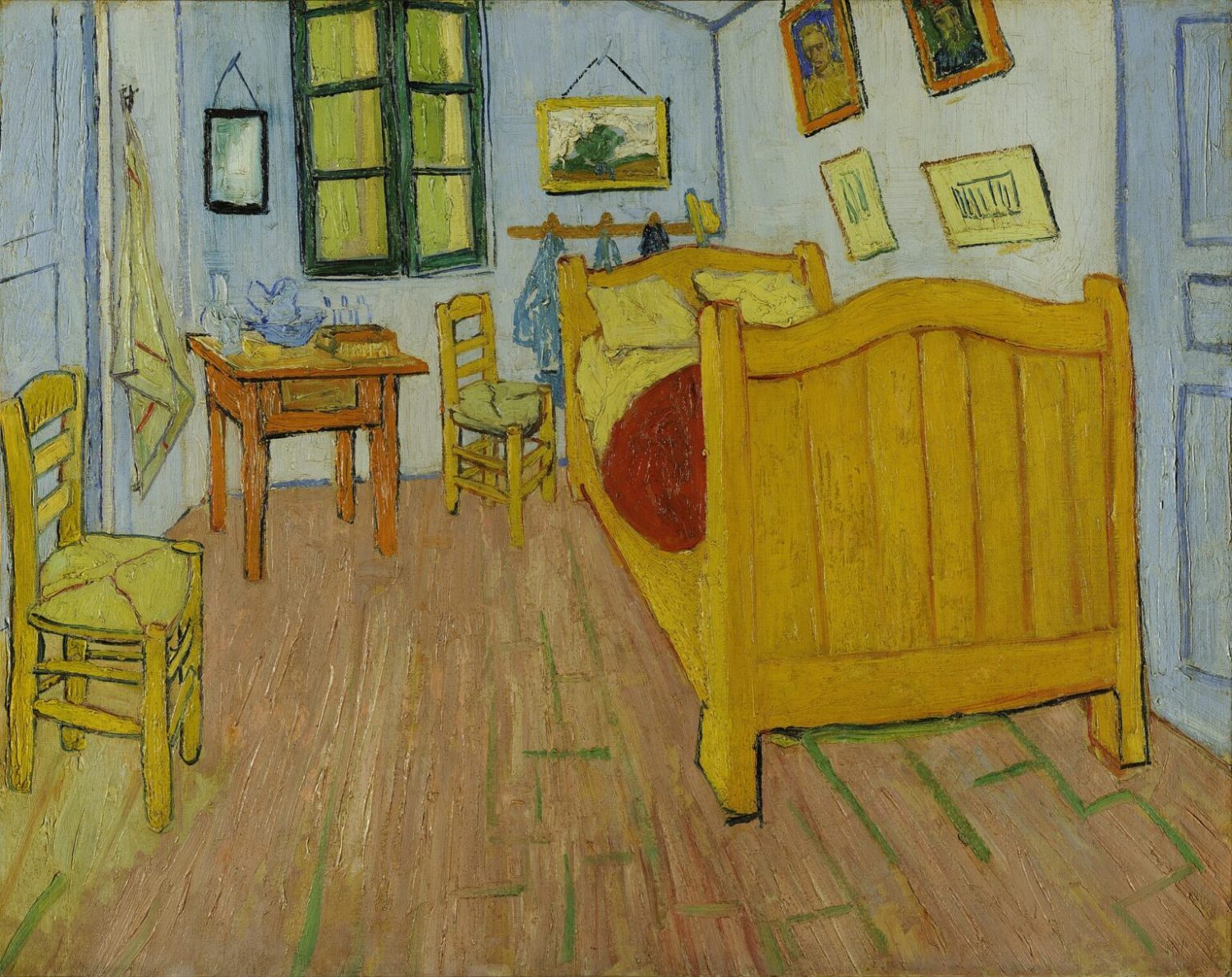
On 16 October 1888 (letter 705) he sent Theo a sketch of his room in the Yellow House, listed every colour (pale violet walls, red tiles, butter-yellow furniture, scarlet blanket) and wrote that “looking at the painting should rest the mind, or rather, the imagination.” The colour, he said, should suggest rest or sleep, with flat tints like a Japanese print. He was recovering from exhaustion; the picture was his revenge on enforced rest. Read more about The Bedroom.
The Starry Night (June 1889)
Van Gogh never described The Starry Night in detail, but in a letter from the Saint-Rémy asylum written in early June 1889 (letter 777) he set down the scene behind it: he had looked out of his window long before sunrise and seen “nothing but the morning star, which looked very big.” The editors of the letters identify the morning star as the planet Venus, which shines low on the left of the painting. Read more about The Starry Night.
Cypresses (June 1889)
Later that month (letter 783, 25 June 1889) he sketched a cypress painting for Theo and wrote that the trees in it were very big and massive. He was fascinated by cypresses, which he compared to Egyptian obelisks, and found that no one had yet painted them as he saw them. Read more about Cypresses.
Almond Blossom (February 1890)
When Theo’s son, named Vincent after him, was born, Van Gogh painted a gift. He told his mother on 19 February 1890 (letter 855) that he had started right away on a picture for the baby’s bedroom: “Large branches of white almond blossom against a blue sky.” Theo and Jo hung it above their piano. Read more about Almond Blossom.
Wheatfields under troubled skies (July 1890)
Three weeks before his death he wrote to Theo and Jo from Auvers (letter 898, about 10 July 1890) about his new double-square canvases: “immense stretches of wheatfields under turbulent skies.” He had tried to express sadness and extreme loneliness, but he added that the canvases would also show what he found healthy and strengthening about the countryside. The letter is usually linked to Wheatfield under Thunderclouds and Wheatfield with Crows, though he does not name them.
How to read the letters yourself
The complete letters, with translations, notes and the sketches, are free at vangoghletters.org, the edition made by the Van Gogh Museum and the Huygens Institute. A good way in is to choose a painting you love, find its date, and read the letters from that week: he almost always mentions what is on his easel. Bear in mind that he wrote in Dutch, French and sometimes English (most of the later letters to Theo are in French), so almost every English version is a translation, and the wording differs between editions.
Frequently asked questions
Did Van Gogh write about his paintings?
Yes. His letters, mostly to his brother Theo, describe hundreds of works as he made them, often with sketches, colour lists and explanations of what he wanted to express.
What did Van Gogh say about The Starry Night?
He described the view behind it in letter 777 of early June 1889: from his window before sunrise he saw only the morning star, which looked very big. He later called the painting a failure in a letter to Bernard, but he did not describe it in detail.
What did Van Gogh say about the Night Café?
In letter 677 of 9 September 1888 he wrote that he wanted to express the idea that the café is a place where you can ruin yourself, go mad or commit crimes, using clashing reds and greens.
Where can I read Van Gogh’s letters?
The full edition, with English translations, notes and sketches, is free online at vangoghletters.org. Most of the original letters are in the Van Gogh Museum, Amsterdam.
What were Van Gogh’s last letters about?
His last letters from Auvers in July 1890 discuss his wheatfield paintings, Daubigny’s garden and his worries about Theo’s family and finances.
Sources: Vincent van Gogh – The Letters (Van Gogh Museum & Huygens ING); Letter 497; Letter 666; Letter 677; Letter 705; Letter 898.