Home › Van Gogh Facts › The women in his life
His life
The Women in Van Gogh’s Life: Love, Rejection and the People He Painted
Van Gogh never married, and almost every time he fell in love it ended badly. But women were at the centre of his life and his art: a landlady’s daughter in London, a widowed cousin, a pregnant woman he took off the streets of The Hague, a café owner in Paris, and the sisters, mothers and friends whose portraits he painted.
Eugénie Loyer: the first rejection
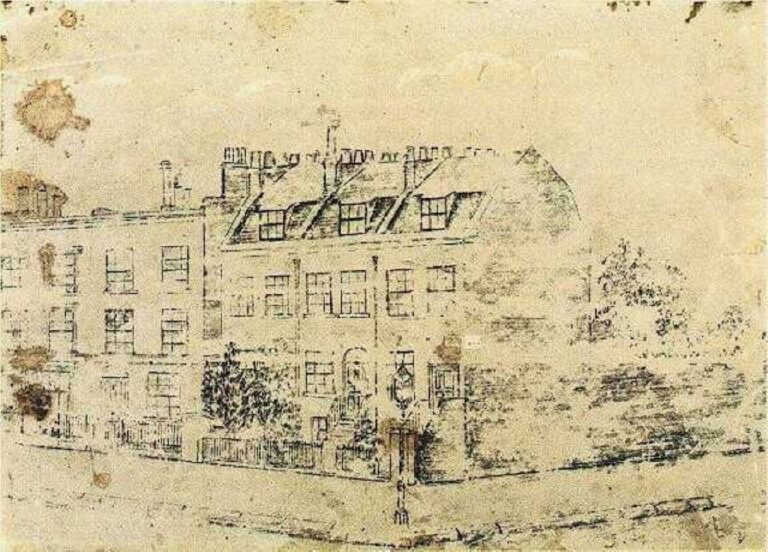
In August 1873, aged twenty, Van Gogh took a room in the house of Ursula Loyer and her daughter Eugénie at 87 Hackford Road in south London. He fell for Eugénie, but she was already secretly engaged, and when he declared himself in 1874 she turned him down. His family later saw this as the start of his withdrawal into religion. The house still stands; see our Van Gogh in London guide.
Kee Vos: “No, never, never”
In the summer of 1881 his widowed cousin Kee Vos-Stricker stayed with his parents in Etten with her young son. Vincent fell passionately in love. She refused him with the words he quoted again and again: “No, never, never”. He would not accept it. In November he went to her parents’ house in Amsterdam, and when told she would not see him, he held his hand in the flame of a lamp and asked to be allowed to see her for as long as he could keep it there. Her father blew out the lamp. The episode ended any hope, and led to the bitter row with his own father at Christmas 1881. Read more in Van Gogh’s family.
Sien Hoornik: a family in The Hague
In January 1882 Van Gogh met Clasina Maria Hoornik, known as Sien, a pregnant woman who had worked as a prostitute and already had a young daughter. He took her in, paid for her care and lived with her, her daughter and the baby boy, Willem, born in July 1882. She posed for many of his drawings, including Sorrow, which he thought his best figure drawing. He even talked of marrying her, to the horror of his family and his teacher Anton Mauve, who broke with him. Poverty, Sien’s health and pressure from Theo ended the arrangement, and in September 1883 Vincent left for Drenthe. He never forgot her children. Sien died in Rotterdam in 1904. See Van Gogh’s drawings.
Margot Begemann: Nuenen
In Nuenen in 1884 a neighbour, Margot Begemann, some twelve years older than Vincent, fell in love with him and he seems to have returned her feelings. Both families opposed a marriage. In September 1884 she swallowed poison during a walk with him; she survived, but the affair was over, and the village turned against him. A year later he left for Antwerp and never returned to the Netherlands.
Agostina Segatori: Paris
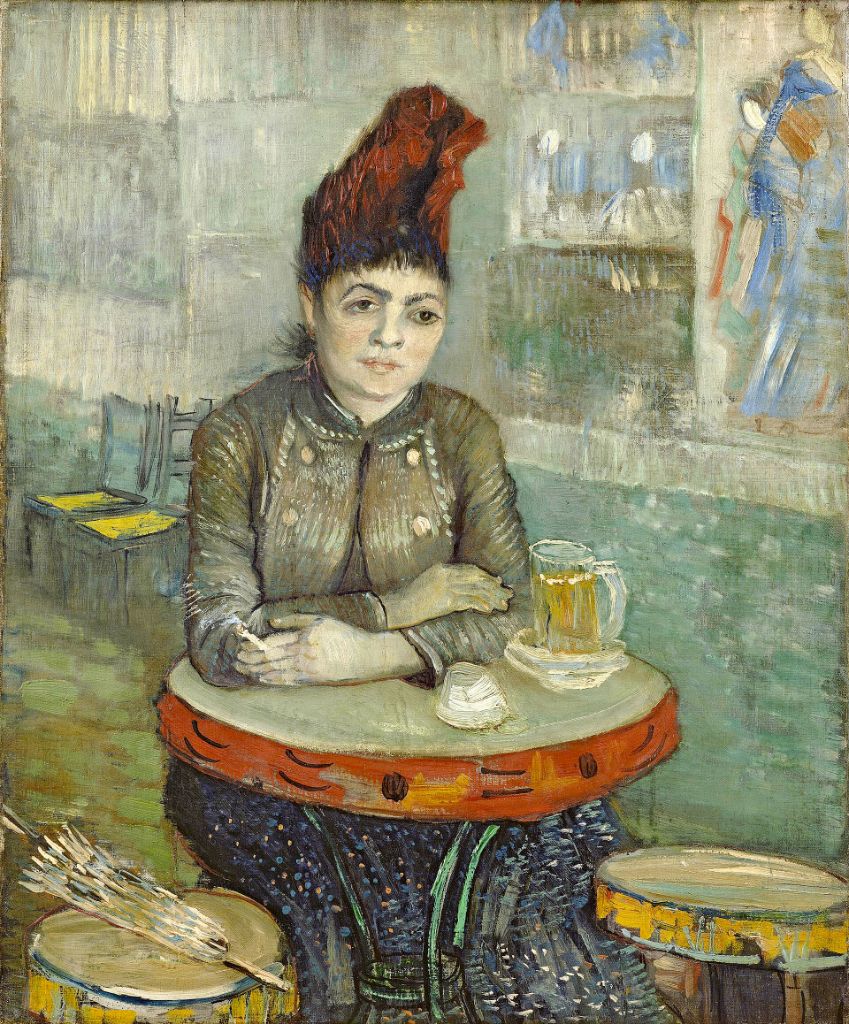
In Paris in 1887 Van Gogh had an affair with Agostina Segatori, an Italian former artists’ model who ran the Café du Tambourin on the boulevard de Clichy. He ate there in exchange for paintings, hung a show of Japanese prints on its walls and painted her portrait, seated at one of the café’s tambourine-shaped tables. The relationship ended in a quarrel later that year, and Vincent had to retrieve his canvases. In letters to his sister Wil he admitted, with some embarrassment, to a string of unsuitable love affairs in Paris.
The women he painted in Arles
In the south his most moving portraits are of women who were friends rather than lovers. Marie Ginoux, who ran the Café de la Gare with her husband and rented him rooms, posed for L’Arlésienne. Augustine Roulin, wife of the postman Joseph, became La Berceuse, the woman rocking a cradle, a picture he hoped would console sailors far from home. On the night of 23 December 1888 he took the piece of his ear to a young woman at a brothel, long known only as “Rachel”; research by Bernadette Murphy identified her as Gabrielle Berlatier, a farm girl who worked there as a maid. See what happened to his ear.
In Auvers he painted Dr Gachet’s daughter Marguerite at the piano and in the garden. Stories of a romance between them appeared decades later and have no reliable evidence behind them.
The women who stood by him
The most constant women in his life were family. His mother Anna encouraged his drawing and received his letters to the end. His youngest sister Wil was the one sibling he wrote to as an equal about art and life. And Theo’s wife Jo van Gogh-Bonger, whom he met only a few times, became the guardian of his work after both brothers died, and made him famous. Read her story in Jo van Gogh-Bonger.
Why he never married
Van Gogh wanted a wife and children and said so often. But he had almost no income of his own, depended on Theo, and chose women his family thought impossible. His intensity frightened people, and the illness that began in 1888 made a settled life even harder. In his last two years he poured his longing for family into his work instead: the Roulin portraits, the cradle-rocking Berceuse, and the Almond Blossom he painted for Theo’s newborn son.
Frequently asked questions
Was Van Gogh ever married?
No. He never married and had no children. The closest he came to family life was living with Sien Hoornik and her two children in The Hague in 1882–83.
Who was the love of Van Gogh’s life?
There was no single great love. His strongest attachments were to his cousin Kee Vos, who rejected him in 1881, and to Sien Hoornik, with whom he lived for over a year.
Who was Sien Hoornik?
Clasina Maria Hoornik, a woman from The Hague who lived with Van Gogh in 1882–83 and modelled for many of his drawings, including Sorrow.
Did Van Gogh have a girlfriend in Paris?
Yes. In 1887 he had an affair with Agostina Segatori, owner of the Café du Tambourin, and painted her portrait.
Sources: Van Gogh Museum – Vincent’s love life; Van Gogh Letters – biographical context; Bernadette Murphy, Van Gogh’s Ear (2016).