Home › Van Gogh Facts › His signature
Van Gogh Facts
Van Gogh’s Signature: Why He Signed “Vincent” (and Mostly Didn’t Sign at All)
Look for a signature on a Van Gogh and you will usually find nothing. When there is one, it says simply “Vincent”. A 2026 study by the Van Gogh Museum counted every signed painting for the first time, and the results explain a great deal about how he saw his own work.
Why “Vincent”?
In the nineteenth century painters normally signed with their surname or full name. Van Gogh was unusual in signing with his first name. In March 1888 he asked Theo to list him in an exhibition catalogue as he signed his canvases, “Vincent” and not “Van Gogh”, for the simple reason that people there could not pronounce the surname. The Dutch “gh” is a throaty sound that the English, French and Americans each mangle differently.
There was a personal reason too. In a letter of December 1883, after years of conflict with his family, he told Theo that in character he was quite different from the others and was not really a “Van Gogh” at all. Signing “Vincent” separated the artist from the family of ministers and art dealers.
How many paintings did he sign?
Very few. Researcher Julia Engelmayer compiled every known authentic signature for the Van Gogh Museum’s 2026 study Simply ‘Vincent’: An Overview of Van Gogh’s Signed Paintings. She found 133 signed paintings out of about 840 that survive, roughly 15%. By comparison his friend Paul Gauguin signed about 60% of his paintings. The study suggests that Van Gogh regarded much of his output as practice and signed only the pictures he thought finished and good enough to show, sell or give away.
Which works did he sign?
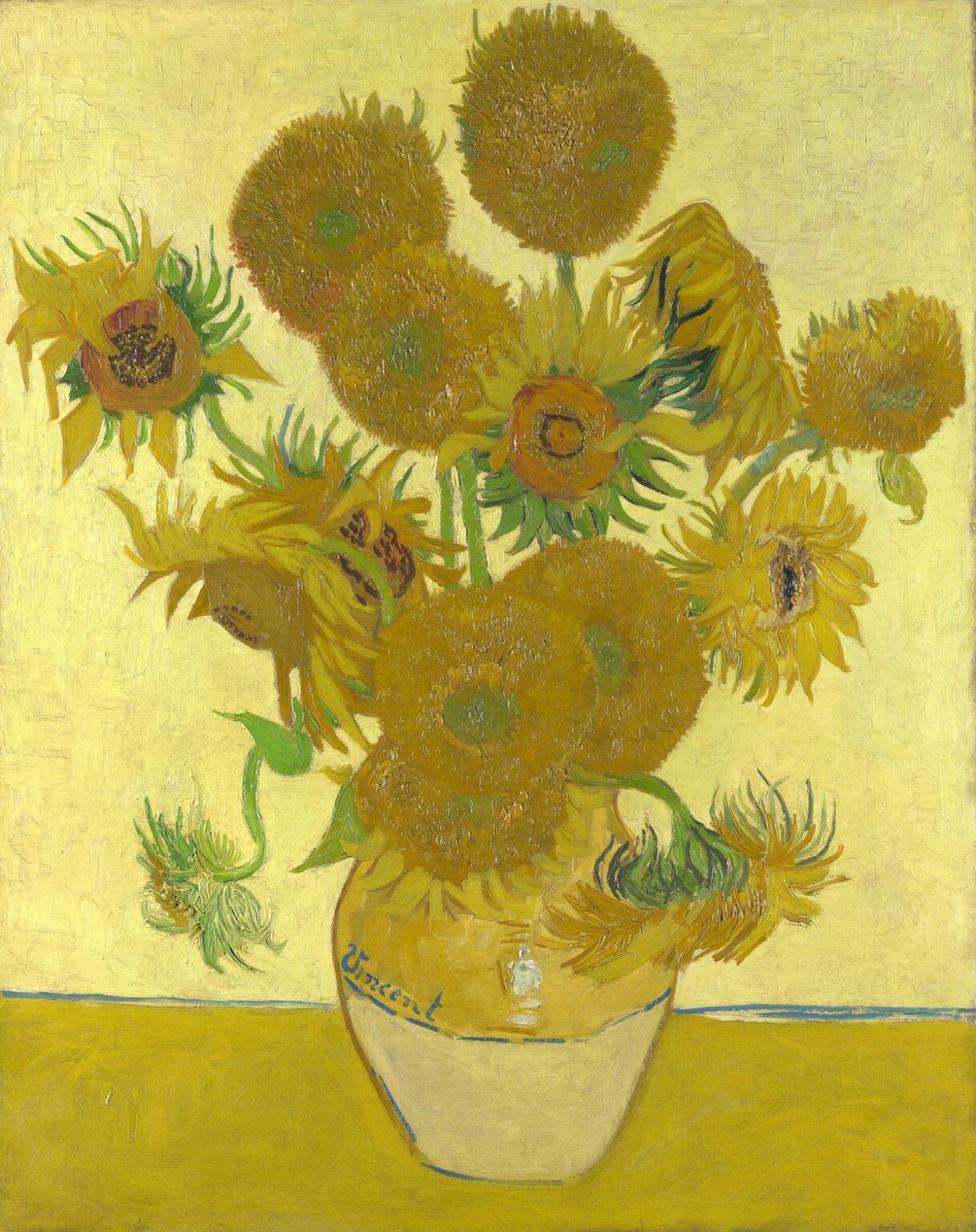
The pattern is revealing. In Paris, where he hoped to sell, he signed many of his flower still lifes. In the south he signed more landscapes, and several of his most ambitious Arles pictures, such as the London Sunflowers, where “Vincent” is painted on the vase itself as part of the design. He often signed works he gave to friends or swapped with other artists, but usually not his copies after Millet, Rembrandt and Delacroix.
In his last months he hardly signed anything. In Auvers he added “Vincent” only once, to the portrait he gave to his sitter, Adeline Ravoux. Many of the pictures now seen as his greatest, including The Starry Night and Wheatfield with Crows, carry no signature at all.
What the signatures look like
The signature is usually small and placed in a lower corner, written in fluent, slightly slanting letters with paint rather than drawn. Sometimes it becomes part of the picture: on the London Sunflowers the name sits on the pot like a maker’s label, and on the red boat in Fishing Boats on the Beach he painted the word “Amitié” (friendship) where a boat’s name would be. A few early Dutch works are signed “Vincent” with a date.
A signature does not make a Van Gogh
Because the signature is so simple, forgers have copied it for a century, and a “Vincent” on a canvas proves nothing. Equally, the absence of a signature means nothing, since most genuine works have none. Experts judge attribution on provenance, documents, materials and style; the signature is just one detail. Read more in Van Gogh fakes and forgeries and how much a Van Gogh is worth.
How to say his name
In Dutch the name sounds roughly like “fun KHOKH”, with a throaty sound at both ends. In Britain people usually say “van GOFF”, in the United States “van GO”, and in France “van GOG”. Since he chose to sign “Vincent”, perhaps the safest answer is the one he gave himself.
Frequently asked questions
Why did Van Gogh sign his paintings Vincent?
Because people outside the Netherlands could not pronounce “Van Gogh”, as he told Theo in March 1888, and because he felt different from the rest of his family.
Did Van Gogh sign all his paintings?
No. Only about 133 of roughly 840 known paintings, around 15%, carry his signature, according to a 2026 Van Gogh Museum study.
Is The Starry Night signed?
No. The Starry Night, like many of his late masterpieces, is unsigned.
Does a signature prove a painting is by Van Gogh?
No. The signature is easy to copy and most genuine works are unsigned. Attribution depends on provenance, documents, materials and style.
Sources: Van Gogh Museum – Simply ‘Vincent’; Van Gogh Museum press release, August 2026; The Art Newspaper – Why did Van Gogh sign his paintings as Vincent?.