Home › Van Gogh Facts › Van Gogh and religion
Van Gogh’s Art
Van Gogh and Religion: From Preacher to Painter of the Stars
Van Gogh was a minister’s son who wanted to be a preacher, threw himself into evangelism among Belgian miners, and then turned against the church. Yet religious feeling runs through his art to the end: in the open Bible of 1885, in the stars over Arles and Saint-Rémy, and in the biblical scenes he copied in the asylum.
A minister’s son
Vincent grew up in the parsonage at Zundert, son of the Reverend Theodorus van Gogh, a minister of the Dutch Reformed Church. In London in 1875–76, after his disappointment in love, he turned fervently to religion, read the Bible obsessively and preached his first sermon in Richmond. He studied for the ministry in Amsterdam, failed, and in 1878–79 worked as a lay preacher among the miners of the Borinage in Belgium, giving away his possessions in imitation of Christ. The church dismissed him for his excessive zeal. See Van Gogh before he painted.
The break with the church
Becoming an artist in 1880 coincided with a loss of faith in the church. After a furious quarrel with his father at Christmas 1881, Vincent refused to go to church and called the clergy’s religion cold and hypocritical. He still read the Bible, but now alongside modern novels by Zola, Dickens and Hugo, which he thought told the truth about ordinary lives. His real religion, he suggested, was love for people and for nature.
The Bible and the yellow novel
Soon after his father’s sudden death in March 1885, Van Gogh painted Still Life with Bible (Van Gogh Museum). His father’s large Bible lies open at Isaiah 53, the passage about the “man of sorrows”; beside it, much smaller, is a worn yellow copy of Émile Zola’s novel La joie de vivre. Next to the Bible stands an extinguished candle. Many see it as a quiet statement of the generational divide between the father’s faith and the son’s modern beliefs.
“A terrible need of religion”
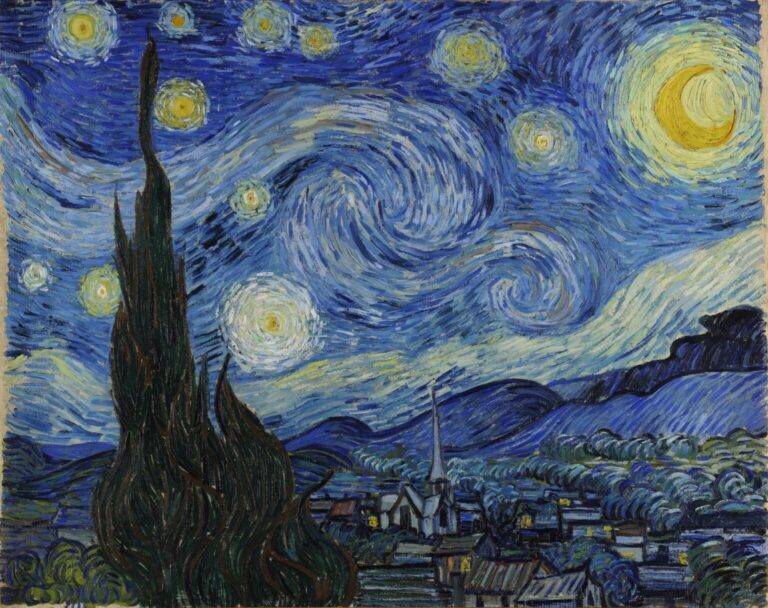
In Arles he avoided religious subjects. Twice in 1888 he tried to paint Christ in the Garden of Olives and scraped the canvas off, unhappy with the result. Instead he found the sacred in nature. In September 1888 he wrote to Theo that he had a terrible need of, he hesitated over the word, religion, and that he then went outside at night to paint the stars. The skies of Starry Night Over the Rhône and The Starry Night carry that longing. The sower under a huge sun, taken from the biblical parable and from Millet, became another of his symbols; see The Sower.
When Gauguin and Émile Bernard painted biblical scenes from imagination in 1889, Van Gogh criticised them, arguing that the feeling of Gethsemane could be found in a real olive grove. He painted the olive orchards around the asylum instead.
Biblical copies at Saint-Rémy
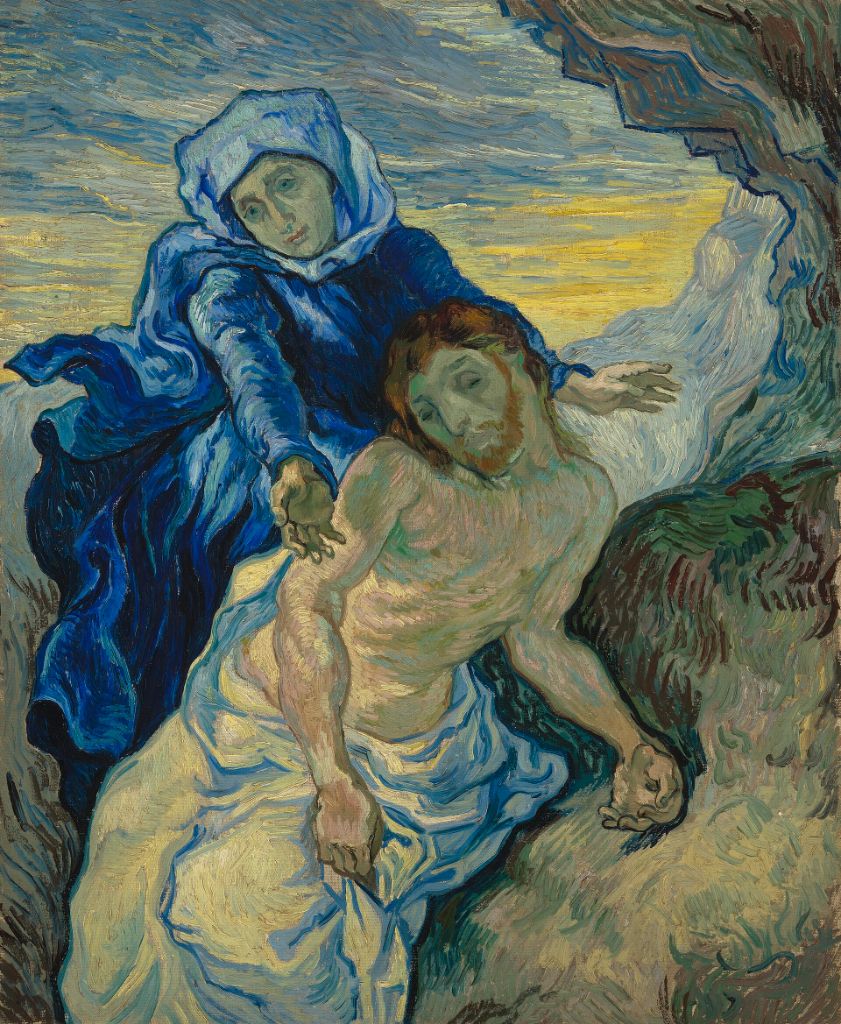
At the asylum, when illness kept him indoors, he made painted “translations” of prints by artists he revered, including three religious works: the Pietà after Delacroix (September 1889), shown above, in which Christ has red hair and a beard rather like his own; The Raising of Lazarus after Rembrandt (May 1890), from which he left out Christ and showed only the sun; and The Good Samaritan after Delacroix (May 1890). They are his only religious figure paintings.
Faith at the end
In Auvers he painted The Church at Auvers, its walls twisting against a deep blue sky, with a peasant woman walking away along the path. Because his death was believed to be suicide, the local priest would not give him a church funeral, and he was buried from the Auberge Ravoux. Read more in how Van Gogh died.
Frequently asked questions
Was Van Gogh religious?
As a young man he was intensely religious and worked as a lay preacher. Later he rejected the church but kept a strong spiritual sense, expressed through nature and the stars.
Did Van Gogh believe in God?
His letters suggest he never lost a belief in something divine, but he distrusted organised religion after about 1880 and found the sacred in nature, love and art.
Did Van Gogh paint religious pictures?
Very few. Apart from Still Life with Bible (1885), his only religious figure paintings are copies made in 1889–90 after Delacroix and Rembrandt.
What Bible passage is in Van Gogh’s Still Life with Bible?
Isaiah 53, the prophecy of the suffering servant, the “man of sorrows”.
Sources: Van Gogh Museum – Still Life with Bible; Van Gogh Museum – Pietà (after Delacroix); Van Gogh Letters.