Home › Van Gogh Facts › How to paint like Van Gogh
Van Gogh’s Art · Tutorial
How to Paint Like Van Gogh: A Step-by-Step Guide
You do not need to be a trained painter to learn from Van Gogh. His style rests on a few clear ideas: thick paint, strokes that follow the form, strong outlines and bold complementary colour. This guide shows you the materials he used, the modern paints closest to his, and a step-by-step exercise for a swirling sky.
What you need
Paint: oil paint is closest to Van Gogh’s, but heavy-body acrylic is cheaper, dries fast and holds a stroke well. Avoid fluid or student paints that flatten out. Brushes: stiff hog-hair flats and filberts in a few sizes; Van Gogh worked mostly with brushes, not palette knives. Support: a primed canvas or canvas board around 40 × 50 cm, the size of many of his Arles pictures. Other: a palette or old plate, rags, and for drawing a reed or bamboo pen and ink, as he used in Arles.
His colours and their modern equivalents
Van Gogh used a small palette of bright, mostly new industrial colours. Several were toxic or have proved unstable, so artists today use substitutes:
- Chrome yellow (lemon to orange) → cadmium or Hansa/azo yellows. See why he loved yellow.
- Ultramarine and cobalt blue → the same pigments are still made; Prussian blue for dark accents.
- Emerald green and viridian → viridian or phthalo green (emerald green contained arsenic).
- Vermilion and red lake → cadmium red and a permanent crimson (his red lakes have faded).
- Lead white or zinc white → titanium white, used generously.
Add ochre and a little black or umber for drawing lines. Our colour palettes give hex codes for 37 paintings if you work digitally.
Five rules of his style
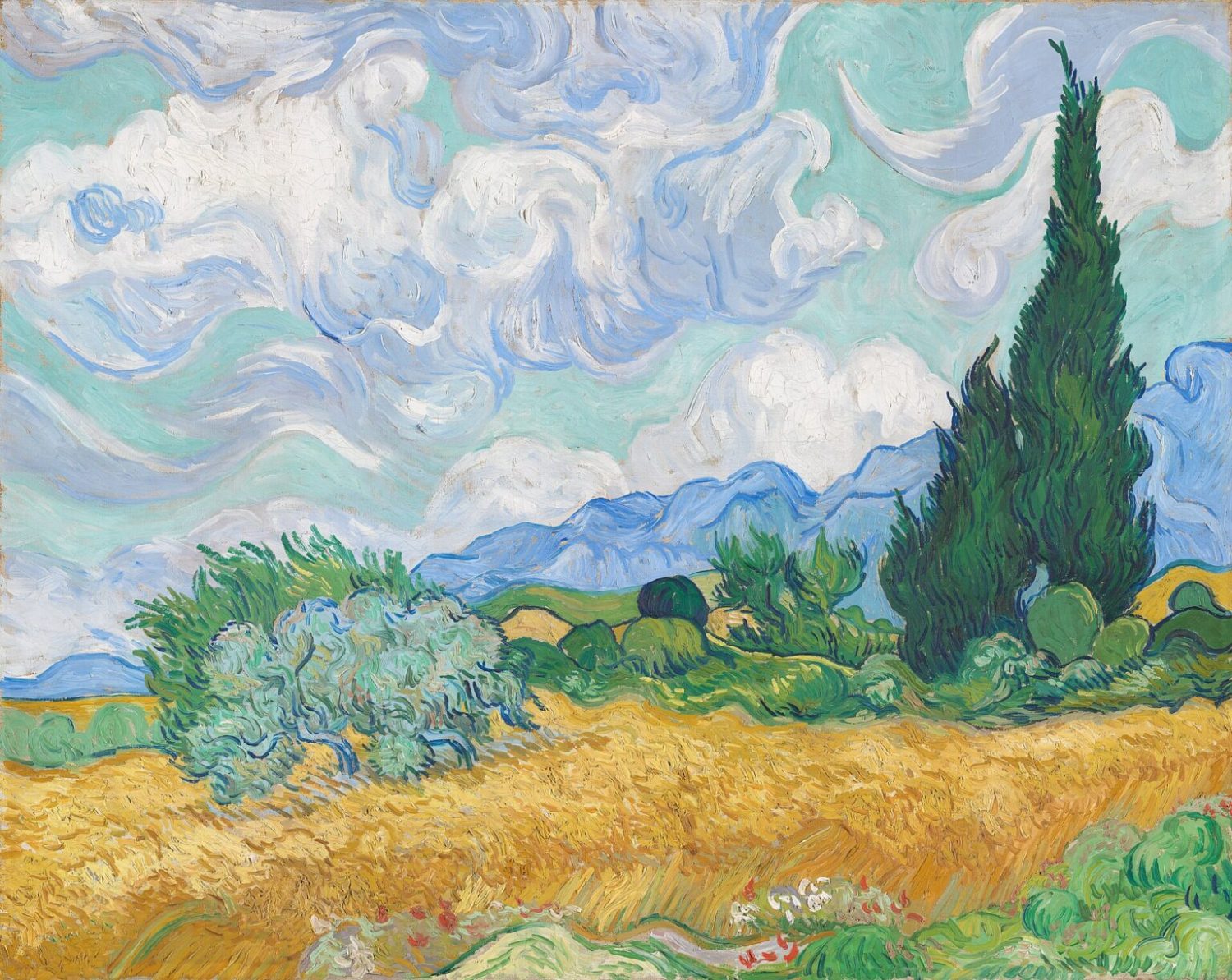
1. Paint thickly. Lay paint on in ridges (impasto) so each stroke stays visible. 2. Make strokes follow the form. Curve around a tree, ripple across wheat, spiral in the sky. 3. Do not blend. Place strokes side by side and let the eye mix them. 4. Use complementary pairs. Put yellow next to violet, blue next to orange, red next to green; they intensify each other. 5. Outline. Draw contours in dark blue or red-brown, as he learned from Japanese prints. Read more in Van Gogh’s technique.
Step by step: a swirling night sky
- Plan. Draw a simple landscape with a low horizon: hills, a few roofs, one tall dark shape such as a cypress. Leave two-thirds for sky.
- Block in. Cover the canvas quickly with a thin layer: deep ultramarine for the sky, dark blue-green for the land. Let it dry for acrylic, or work wet into wet in oil.
- Place the lights. Paint the moon and stars as circles of yellow and white, then ring each with short strokes of pale yellow and light blue.
- Make the sky move. With a loaded brush, add rows of short curved strokes in two or three blues and white, following one direction across the sky like wind. Add one or two larger spirals.
- Outline and accent. Paint the cypress in long upward flame-shaped strokes of dark green and black-blue, and outline the roofs and hills in dark blue.
- Stop. Van Gogh often finished a picture in one session. Do not go back and smooth it out.
Compare your result with The Starry Night and Starry Night Over the Rhône.
Draw like him too
Van Gogh drew constantly. To learn his reed-pen language, cut a bamboo or reed stick to a chisel point, dip it in ink and draw a field or garden using only dots, dashes, short hatching and curls, with different marks for each texture. See examples in Van Gogh’s drawings.
For teachers and children
For classroom versions of these exercises, with oil pastels instead of paint, see our lesson plans and worksheets and the colouring pages.
Frequently asked questions
What paint did Van Gogh use?
Oil paint in tubes, including chrome yellow, ultramarine, cobalt blue, emerald green, vermilion, red lake and lead or zinc white.
Can I paint like Van Gogh with acrylics?
Yes. Heavy-body acrylics hold thick, textured strokes well and dry quickly, making them a good cheaper alternative to oils.
Did Van Gogh use a palette knife?
Mostly no. Nearly all his thick paint was applied with stiff brushes, though occasionally he used a knife or squeezed paint straight from the tube.
How long did Van Gogh take to paint a picture?
Often a single day or session, especially outdoors. In Auvers he finished almost a painting a day.
Sources: Van Gogh Museum – Van Gogh’s painting materials; Metropolitan Museum – Wheat Field with Cypresses; Van Gogh Letters.