Home › Paintings › Paris › Portrait of Père Tanguy
Paris · 1887
Portrait of Père Tanguy
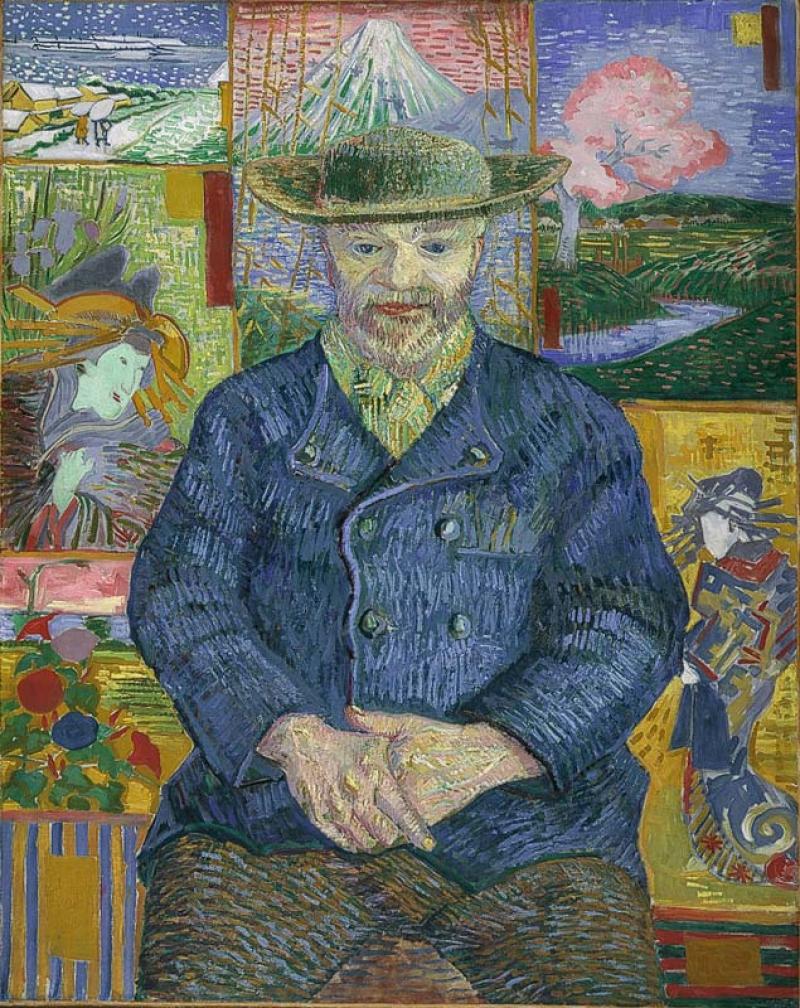
The Paris colour merchant Julien Tanguy sits calmly in front of a wall of Japanese prints: Van Gogh’s portrait of “Père” Tanguy combines his friendship for a generous man with his passion for Japan.
- Artist
- Vincent van Gogh
- Date
- Autumn 1887
- Painted in
- Paris, France
- Medium
- Oil on canvas
- Size
- 92 × 73 cm
- Museum
- Musée Rodin, Paris
- Catalogue
- F363 · JH1351
What the painting shows
Tanguy, a stocky man with a straw hat and a blue jacket, sits facing us with his hands folded. Behind him, filling the whole background, are colourful Japanese woodblock prints: Mount Fuji, geishas, cherry blossom and a landscape in the snow. The figure is painted in bright, broken colours, with strong outlines.
The pose is simple and frontal, almost like a religious icon, giving the shopkeeper a kind of dignity.
Who was Père Tanguy?
Julien Tanguy ran a small shop selling paints and canvas on the rue Clauzel in Montmartre. A former supporter of the Paris Commune, he was kind to struggling artists, often accepting paintings instead of payment and showing them in his shop window. Cézanne, Gauguin, Bernard and Van Gogh all bought colours from him, and his shop was one of the few places in Paris where you could see Van Gogh’s work in the 1890s.
Van Gogh painted him three times in 1887. This last, most finished version shows how completely he had absorbed the lessons of Japanese prints.
The story behind Père Tanguy
Julien Tanguy, known to everyone as Père (Father) Tanguy, ran a small paint and art-supply shop on the rue Clauzel in Montmartre. A former Communard, he was generous to struggling painters, accepting pictures instead of payment and displaying their work in his shop window. Cézanne’s paintings could be seen there when almost nowhere else showed them, and Van Gogh, Émile Bernard, Paul Signac and Gauguin were all regulars. Van Gogh painted him three times in 1887.
In the most famous version, now in the Musée Rodin in Paris, Tanguy sits facing us in a straw hat and a dark coat, hands folded, calm and solid as a Buddha, against a wall covered with Japanese prints: Mount Fuji, geishas, cherry blossom and actors. It is a portrait of a friend and also a manifesto for the art Van Gogh most admired.
The Japanese prints
The prints behind Tanguy came from Van Gogh’s own collection or were based on prints he owned. He and Theo bought hundreds from the dealer Siegfried Bing, and in 1887 Van Gogh organised an exhibition of them at the Café du Tambourin. The bright, flat colours and bold outlines of the prints are echoed in the portrait itself, which is painted in strong reds, greens and blues. A year later, in Arles, he would describe Provence as his Japan.
Things you might not know
- There are three portraits. An early, darker one (Ny Carlsberg Glyptotek, Copenhagen) and two with Japanese prints, one in the Musée Rodin in Paris and one in a private collection.
- Rodin owned it. The sculptor Auguste Rodin bought the painting, which is why it is in his museum.
- Tanguy sold Van Gogh’s work after his death. His shop was one of the few places in Paris where Van Gogh’s paintings could be seen in the 1890s.
- It is easy to see without crowds. The Musée Rodin is often missed by Van Gogh fans, so you can usually stand in front of it in peace.
Where to see it
The portrait belongs to the Musée Rodin in Paris. The sculptor Auguste Rodin bought it in the 1890s, and it hangs in his former home, the Hôtel Biron.
Related paintings
 Courtesan (after Eisen)1887 · Van Gogh Museum
 Flowering plum tree, after Hiroshige1887 · Van Gogh Museum
 Self-Portrait with Grey Felt Hat1887 · Van Gogh Museum
 Bridge in the rain, after Hiroshige1887 · Van Gogh Museum
Frequently asked questions
Where is Portrait of Père Tanguy by Van Gogh?
It is in the collection of the Musée Rodin, Paris.
When did Van Gogh paint Portrait of Père Tanguy?
In Autumn 1887, in Paris, France.
How big is Portrait of Père Tanguy?
The painting measures 92 × 73 cm. It is oil on canvas, catalogued as F363 and JH1351.
See every painting from his Paris period in the catalogue, follow his travels on the interactive timeline, or download masterpieces as free wallpapers.
Image: Musée Rodin, Paris (public domain), via Wikimedia Commons. Facts checked against the holding museum’s catalogue and the standard Van Gogh catalogues (de la Faille and Hulsker).
Who was Père Tanguy?
Julien Tanguy, a Paris colour merchant who supplied paints to Van Gogh, Cézanne, Gauguin and other avant-garde artists and often accepted paintings as payment.