Home › Van Gogh Facts › Van Gogh and Japan
Influences
Van Gogh and Japan
Van Gogh never went to Japan, yet Japanese woodblock prints changed his art more than any European painter did. Here is how he discovered them, what he collected, the pictures he copied, and why he called the south of France his Japan.
A craze in Paris
After Japan opened its ports to Western trade in the 1850s, Japanese goods flooded into Europe. By the 1870s and 1880s Paris was in the grip of japonisme: painters such as Monet, Degas, Whistler and Toulouse-Lautrec collected woodblock prints, fans and ceramics, and borrowed their flat colours, unusual viewpoints and asymmetrical compositions. Cheap prints, many by artists of the Edo period such as Hiroshige, Hokusai and Kunisada, could be bought for a few sous.
Antwerp and Paris
Van Gogh first bought Japanese prints in Antwerp in late 1885 and pinned them to the walls of his small room. When he moved to Paris in 1886 he discovered the huge stock of the dealer Siegfried Bing, and with Theo he bought hundreds of them; more than 600 prints from the brothers’ collection survive in the Van Gogh Museum today. In the spring of 1887 he organised a small exhibition of prints at the Café du Tambourin, the restaurant run by Agostina Segatori, which made a strong impression on his friends Émile Bernard and Louis Anquetin.
Three copies in oil
In 1887 he made three oil paintings closely based on Japanese prints, enlarging them with a grid and heightening the colours:
- Flowering Plum Orchard, after Hiroshige’s Plum Park in Kameido.
- Bridge in the Rain, after Hiroshige’s Sudden Shower over Shin-Ōhashi Bridge.
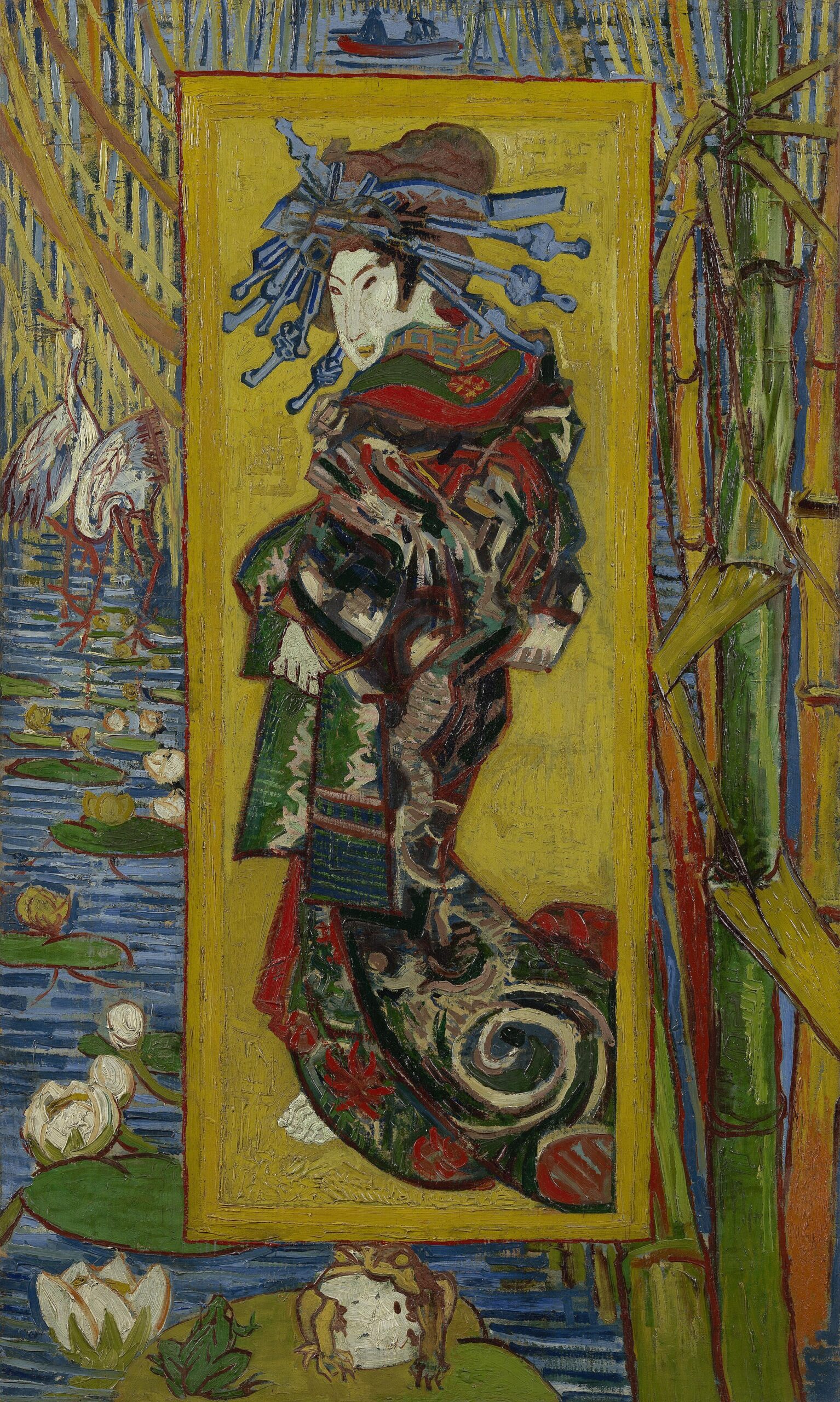
- Courtesan, after a figure by Keisai Eisen printed on the cover of Paris Illustré.
He framed each with borders of Japanese characters copied, not always correctly, from other prints. These were exercises: by copying he learned how the Japanese artists used outline, flat areas of colour and bold cropping.
Prints in the background
Japanese prints also appear inside his paintings. In the two 1887 portraits of the paint dealer Père Tanguy, the sitter is surrounded by a wall of prints, including a Mount Fuji, geishas and cherry blossom. In the Self-Portrait with Bandaged Ear of January 1889, a print of geishas in a landscape hangs on the wall behind him.
Arles: “the equivalent of Japan”
When Van Gogh left Paris for Arles in February 1888, he told Theo and his friends that he was looking for the equivalent of Japan in the south: clear light, pure colours and a simpler life close to nature. He arrived in snow and was delighted that the white landscape looked like a Japanese winter scene. That spring he painted orchards in blossom, and the Langlois Bridge, a drawbridge that echoes the bridges in Hiroshige’s prints.
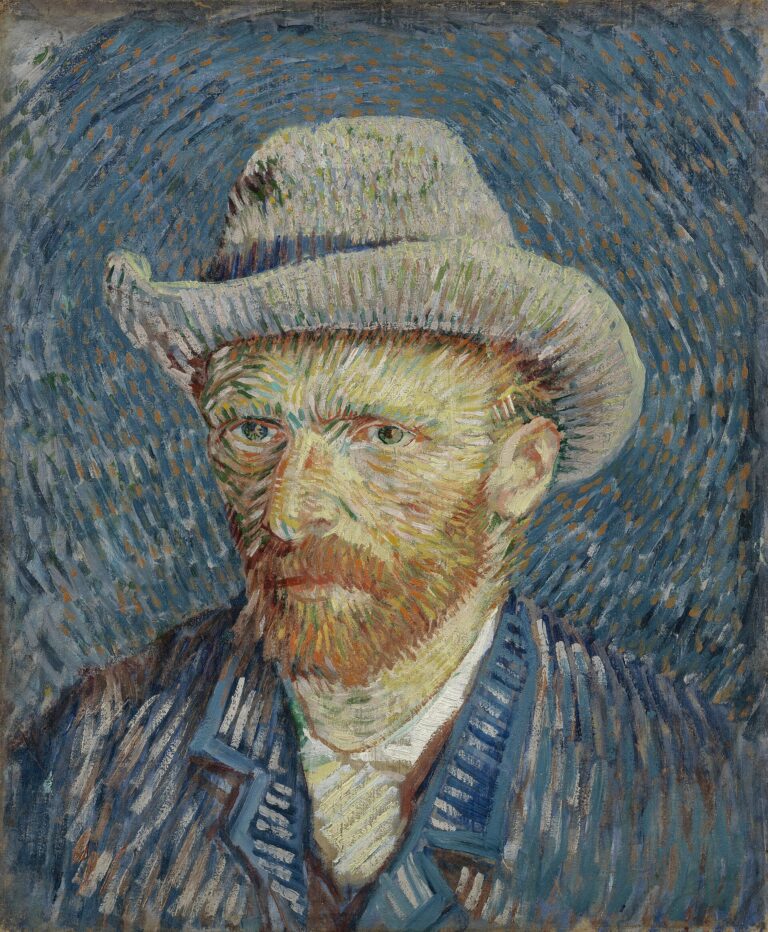
In July 1888 he wrote that all his work was to some extent based on Japanese art. He even imagined himself as a Japanese monk: in the self-portrait he dedicated to Gauguin in September 1888, he shaved his head and slanted his eyes, describing himself as a simple worshipper of the eternal Buddha.
What he took from Japanese art
- Bold outlines. Dark contours around flat areas of colour, seen in The Bedroom and the Arles portraits.
- Pure, flat colour. Large areas of unmixed yellow, blue and red instead of modelled shading.
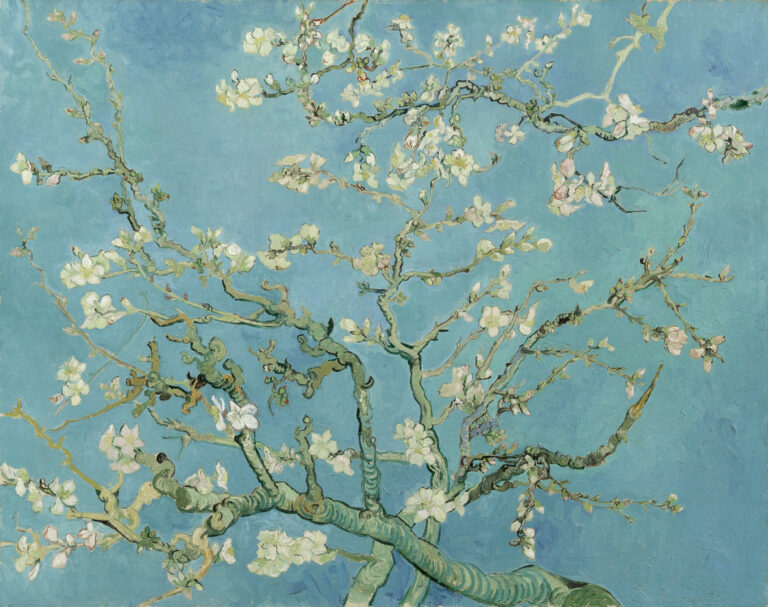
- Cropping and odd viewpoints. Tree trunks cut by the frame, high horizons and close-up branches, as in Almond Blossom.
- A new way of drawing. His reed-pen drawings of 1888 use dots, dashes and hatching in the manner of Japanese ink drawing; see our drawings guide.
- A way of life. He admired what he imagined as the Japanese artists’ simple life, close to nature and sharing work with one another, the model for his dream of a Studio of the South.
Seeing it today
The Van Gogh Museum in Amsterdam holds his print collection and all three of his Japanese copies, and shows a selection of prints in rotation because they are sensitive to light. Its 2018 exhibition Van Gogh & Japan brought the subject together in detail. Plan a visit with our Van Gogh Museum guide.
Frequently asked questions
Did Van Gogh ever go to Japan?
No. He knew Japan only through prints, books and objects he saw in Antwerp and Paris.
How many Japanese prints did Van Gogh own?
Vincent and Theo bought hundreds of prints; more than 600 from their collection survive in the Van Gogh Museum.
Which Japanese prints did Van Gogh copy?
Two by Hiroshige, Plum Park in Kameido and Sudden Shower over Shin-Ōhashi Bridge, and a courtesan figure by Keisai Eisen.
Why did Van Gogh go to Arles?
Partly to find the bright light and colour he associated with Japan, and partly to escape the strain of Paris.
Sources: Van Gogh Museum (Japanese print collection, Van Gogh & Japan, 2018); vangoghletters.org.