Painting series
Van Gogh’s Cypresses: The Paintings and Their Story
Sunflowers were Van Gogh’s motif in Arles; in Saint-Rémy it was the cypress. Within weeks of arriving at the asylum in 1889 he was painting the dark, flame-shaped trees again and again, and they became some of his most recognisable images.
“Like an Egyptian obelisk”
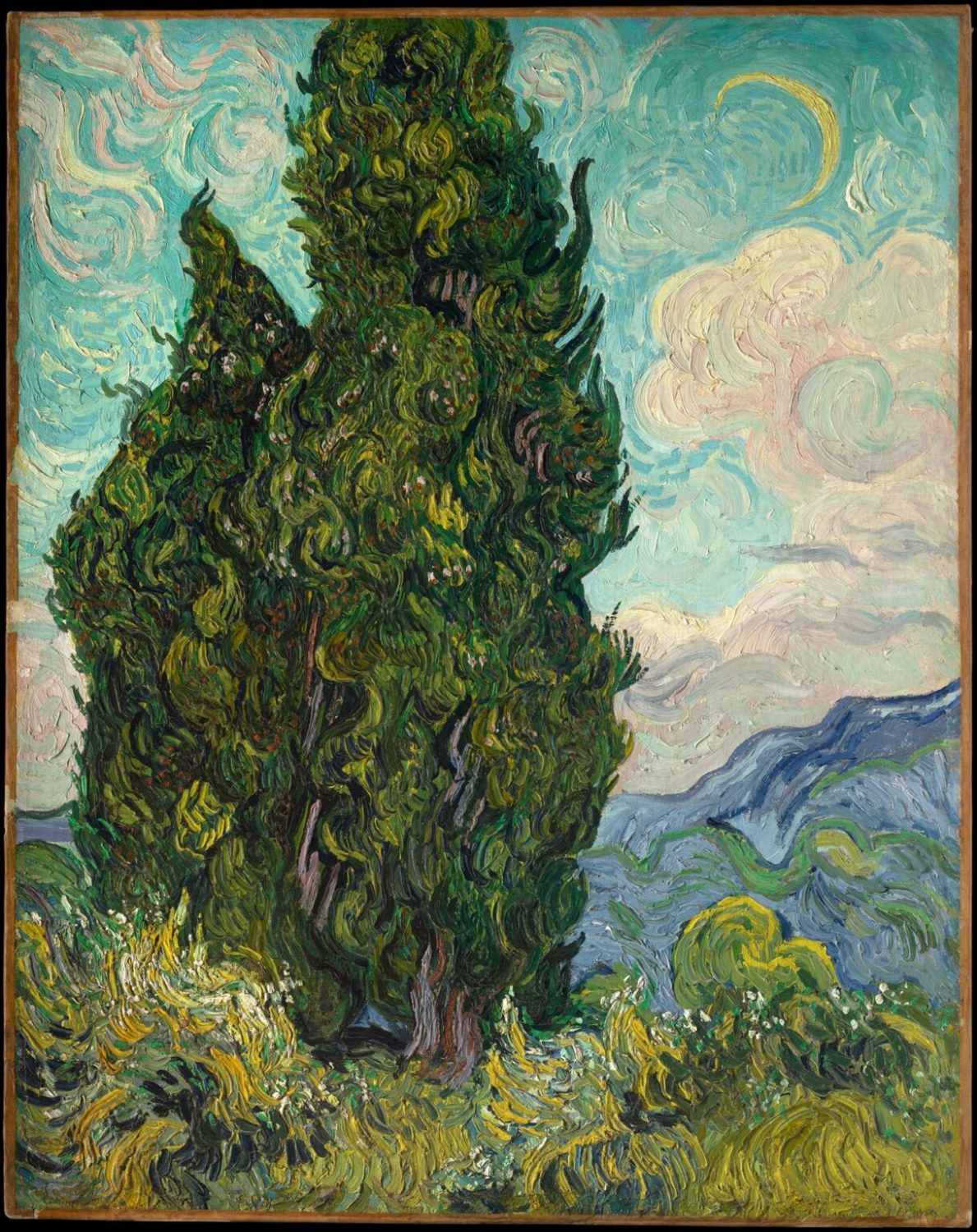
Cypresses are everywhere in Provence: farmers plant them in tall rows as windbreaks against the mistral, and they stand in cemeteries as symbols of mourning. Van Gogh had already included them at the edges of his Arles orchards in spring 1888, but it was only after he entered the asylum at Saint-Rémy in May 1889 that they took over his work. In late June he wrote to Theo that the cypresses were constantly on his mind, that he wanted to do something with them like the canvases of sunflowers, and that he was surprised nobody had yet painted them as he saw them. He found them as beautiful in line and proportion as an Egyptian obelisk, and their green of an exceptional quality: a dark patch in a sunny landscape, one of the most interesting and most difficult notes to get right.
The summer of 1889
In June 1889, once he was allowed outside the asylum walls with an attendant, he painted large vertical canvases dominated by the trees, among them the Cypresses now in the Metropolitan Museum, and the horizontal Wheat Field with Cypresses, painted outdoors among the ripening wheat. In the same month a cypress rose up on the left of The Starry Night, linking the earth to the swirling sky. The thick paint, laid on in curving strokes, makes the trees seem to move like flames.
In September, after an attack had kept him indoors, he made studio repetitions of Wheat Field with Cypresses: one is in the National Gallery in London, a smaller one for his mother and sister is in a private collection.
Road with Cypress and Star
His last great cypress picture was painted in May 1890, days before he left Saint-Rémy. Road with Cypress and Star shows a road under a night sky with a thin crescent moon and a bright star, a cypress shooting up the centre like a black flame, two walkers and a carriage. He described it as a last attempt at a night sky with stars, and sent a drawing of it to Gauguin. It is now in the Kröller-Müller Museum in Otterlo; see also our night paintings.
Why the cypresses matter
Because cypresses are planted in graveyards, many writers read them as symbols of death, especially in The Starry Night. Van Gogh himself talked about them mainly as a painting problem: how to render their dark mass and shape against the bright southern light. Either way they gave his Saint-Rémy landscapes their vertical energy. In 2023 the Metropolitan Museum devoted a whole exhibition, Van Gogh’s Cypresses, to the theme, bringing together paintings and drawings from around the world.
Every cypress painting
All the paintings in our catalogue in which a cypress is the main subject or plays a leading role, in date order. Click any picture for its full page.
 Orchard in Blossom, Bordered by Cypresses1888 · Kröller-Müller Museum, Otterlo
 Orchard with Cypresses1888 · Private collection
 Flowering orchard, surrounded by cypress1888 · Yale University Art Gallery, New Haven
 Cypresses with two figures1889 · Kröller-Müller Museum, Otterlo
 Green Wheat Field with Cypress1889 · National Gallery Prague
 Wheat Field with Cypresses1889 · Metropolitan Museum of Art, New York
 Cypresses1889 · Metropolitan Museum of Art, New York
 Wheatfield with Cypresses1889 · Private collection
 A Wheatfield, with Cypresses1889 · National Gallery, London
 Road with Cypress and Star1890 · Kröller-Müller Museum, Otterlo
 Cypresses and Two Women1890 · Van Gogh Museum, Amsterdam
Frequently asked questions
When did Van Gogh paint cypresses?
Mainly from June 1889 to May 1890, at the asylum in Saint-Rémy-de-Provence, though cypresses already appear at the edges of his Arles orchard paintings of spring 1888.
Where can I see Van Gogh’s Cypresses?
The Metropolitan Museum of Art in New York has Cypresses and Wheat Field with Cypresses; The Starry Night is at MoMA; Road with Cypress and Star is at the Kröller-Müller Museum; another Wheat Field with Cypresses is at the National Gallery, London.
What do cypresses mean in Van Gogh’s paintings?
In Provence cypresses are associated with cemeteries and mourning, so many see them as symbols of death and eternity. Van Gogh wrote about them mostly as a colour and form problem, comparing them to Egyptian obelisks.
Sources: Van Gogh Letters – letter 783 to Theo, 25 June 1889; Metropolitan Museum of Art – Van Gogh’s Cypresses (2023); Kröller-Müller Museum – Road with Cypress and Star.