Home › Paintings › Wheat fields
Painting series
Van Gogh’s Wheat Fields: From Nuenen to Wheatfield with Crows
No subject runs through Van Gogh’s work like wheat. He painted it as a young man in Holland, in Paris, in the Arles harvest, below his window at the asylum and in the last weeks of his life at Auvers. For him the wheat field was nature, work and the cycle of life and death in one image.
The sower and the reaper
Van Gogh grew up in the farming country of Brabant and revered Jean-François Millet, the French painter of peasant life. For both men the cycle of sowing, growing and reaping was a picture of human life itself. In Nuenen he painted sheaves of wheat and peasants at work; in Paris in summer 1887 he painted Wheat Field with a Lark on the edge of the city, his brightest picture yet. From then on, The Sower and the reaper became his two great symbols.
The Arles harvest, June 1888
In June 1888 Van Gogh walked out onto the plain of La Crau outside Arles as the wheat was being cut and, in about a week, painted around ten harvest pictures, often in a blazing sun and with the mistral shaking his easel. The masterpiece of the group is The Harvest in the Van Gogh Museum, a panoramic view of yellow fields, carts and haystacks under a turquoise sky, which he thought one of his best works. Others show sheaves, stacks and a reaper at work, in the Israel Museum, Toledo, Honolulu and private collections.
The field below his window
At the asylum in Saint-Rémy his bedroom window looked over a walled wheatfield to the Alpilles. He painted it around a dozen times through 1889 and 1890: green wheat, wheat under the rising sun, the harvest, the ploughed earth. Wheatfield with a Reaper shows a lone figure cutting the corn in a yellow haze. He told Theo he saw in the reaper an image of death, but a death without sadness, happening in broad daylight under a sun flooding everything with light. In June 1889 he also painted Wheat Field with Cypresses outdoors in the hills, and in the winter he copied Millet’s reapers and sheaf-binders from prints.
The Auvers double squares
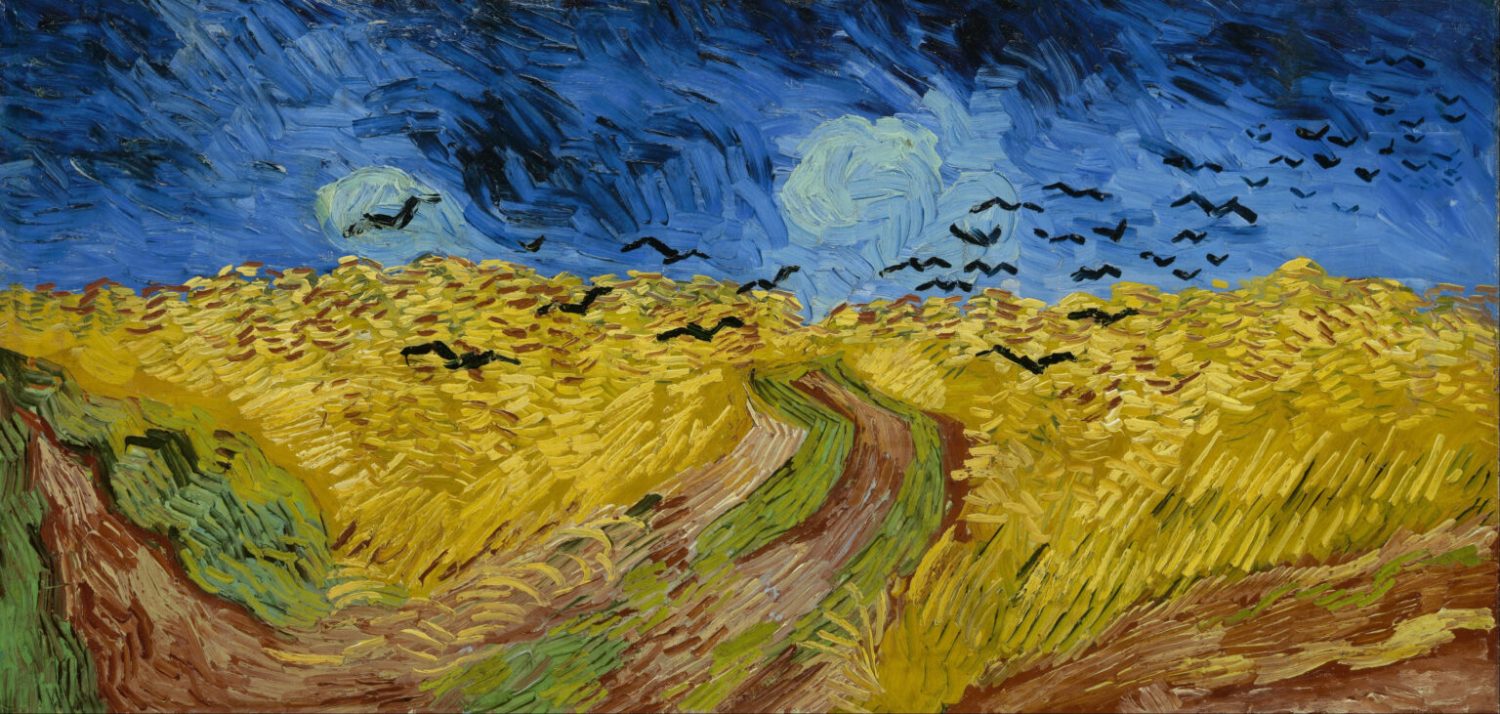
In Auvers-sur-Oise, in July 1890, he began painting the wheat fields on the plateau above the village on long canvases about 50 × 100 cm. They include Wheatfield under Thunderclouds (Van Gogh Museum), Wheat Fields after the Rain (Carnegie Museum of Art), Field with Wheat Stacks (Fondation Beyeler) and Wheatfield with Crows. He wrote to Theo and Jo that these vast fields under troubled skies expressed sadness and extreme loneliness, but also what he found healthy and strengthening about the countryside. Read about his last painting.
Every wheat field painting
All the wheat field, harvest and sheaf paintings in our catalogue, in date order. Click any picture for its full page.
 Sheaves of Wheat in a Field1885 · Kröller-Müller Museum, Otterlo
 Wheat Field with a Lark1887 · Van Gogh Museum, Amsterdam
 Edge of a wheat field with poppies1887 · Denver Art Museum
 Green Ears of Wheat1888 · Israel Museum, Jerusalem
 Harvest in Provence1888 · Israel Museum, Jerusalem
 Wheat Field with Sheaves1888 · Honolulu Museum of Art, Honolulu
 Wheatfield with sheaves and reaper1888 · Toledo Museum of Art, Toledo
 Wheat Fields with Stacks1888 · Private collection
 Arles: View from the Wheat Fields1888 · Musée Rodin, Paris
 Wheatfield1888 · Van Gogh Museum, Amsterdam
 Wheat Field1888 · Rijksmuseum, Amsterdam
 Farmhouse in a wheat field1888 · Van Gogh Museum, Amsterdam
 The Harvest1888 · Van Gogh Museum, Amsterdam
 Enclosed Wheat Field with Rising Sun1889 · Kröller-Müller Museum, Otterlo
 The Wheat Field behind St. Paul’s Hospital, St. Rémy1889 · Virginia Museum of Fine Arts, Richmond
 The Reaper (after Millet)1889 · Van Gogh Museum, Amsterdam
 Peasant Woman Binding Sheaves (after Millet)1889 · Van Gogh Museum, Amsterdam
 Wheat Field with Reaper and Sun1889 · Kröller-Müller Museum, Otterlo
 Green Wheat Field1889 · Kunsthaus Zürich, Zurich
 Green Wheat Field with Cypress1889 · National Gallery Prague
 Wheat Field with Cypresses1889 · Metropolitan Museum of Art, New York
 Landscape with wheat sheaves and rising moon1889 · Kröller-Müller Museum, Otterlo
 The Wheatfield behind Saint Paul’s Hospital with a Reaper1889 · Museum Folkwang, Essen
 Wheatfield with Cypresses1889 · Private collection
 The Reaper (after Millet)1889 · Private collection
 A Wheatfield, with Cypresses1889 · National Gallery, London
 Wheatfield with a Reaper1889 · Van Gogh Museum, Amsterdam
 Wheatfield under Thunderclouds1890 · Van Gogh Museum, Amsterdam
 Peasant Woman Against a Background of Wheat1890 · Private collection
 Ears of Wheat1890 · Van Gogh Museum, Amsterdam
 Wheat Field at Auvers with House1890 · The Phillips Collection, Washington, D.C.
 Green Wheat Fields, Auvers1890 · Private collection
 Sheaves of Wheat1890 · Dallas Museum of Art, Dallas
 Wheat Fields with Auvers in the Background1890 · Private collection
 Wheat Field with Cornflowers1890 · Beyeler Foundation, Riehen
 Wheat Fields after the Rain1890 · Carnegie Museum of Art, Pittsburgh
 Wheat Fields1890 · Private collection
 Field with Wheat Stacks1890 · Fondation Beyeler, Riehen
 Wheatfield with Crows1890 · Van Gogh Museum, Amsterdam
Frequently asked questions
How many wheat field paintings did Van Gogh make?
More than forty, painted between 1885 and July 1890, plus many drawings.
What is Van Gogh’s most famous wheat field painting?
Wheatfield with Crows (July 1890, Van Gogh Museum) and Wheat Field with Cypresses (1889, Metropolitan Museum and National Gallery, London) are the best known.
What did wheat fields mean to Van Gogh?
They stood for nature, work and the cycle of life and death. He saw the sower as an image of life and the reaper, in his own words, as an image of death in broad daylight, without sadness.
Sources: Van Gogh Museum; Van Gogh Letters.