Home › Van Gogh Facts › Starry Night facts
Van Gogh facts
The Starry Night: 15 Facts About Van Gogh’s Most Famous Painting
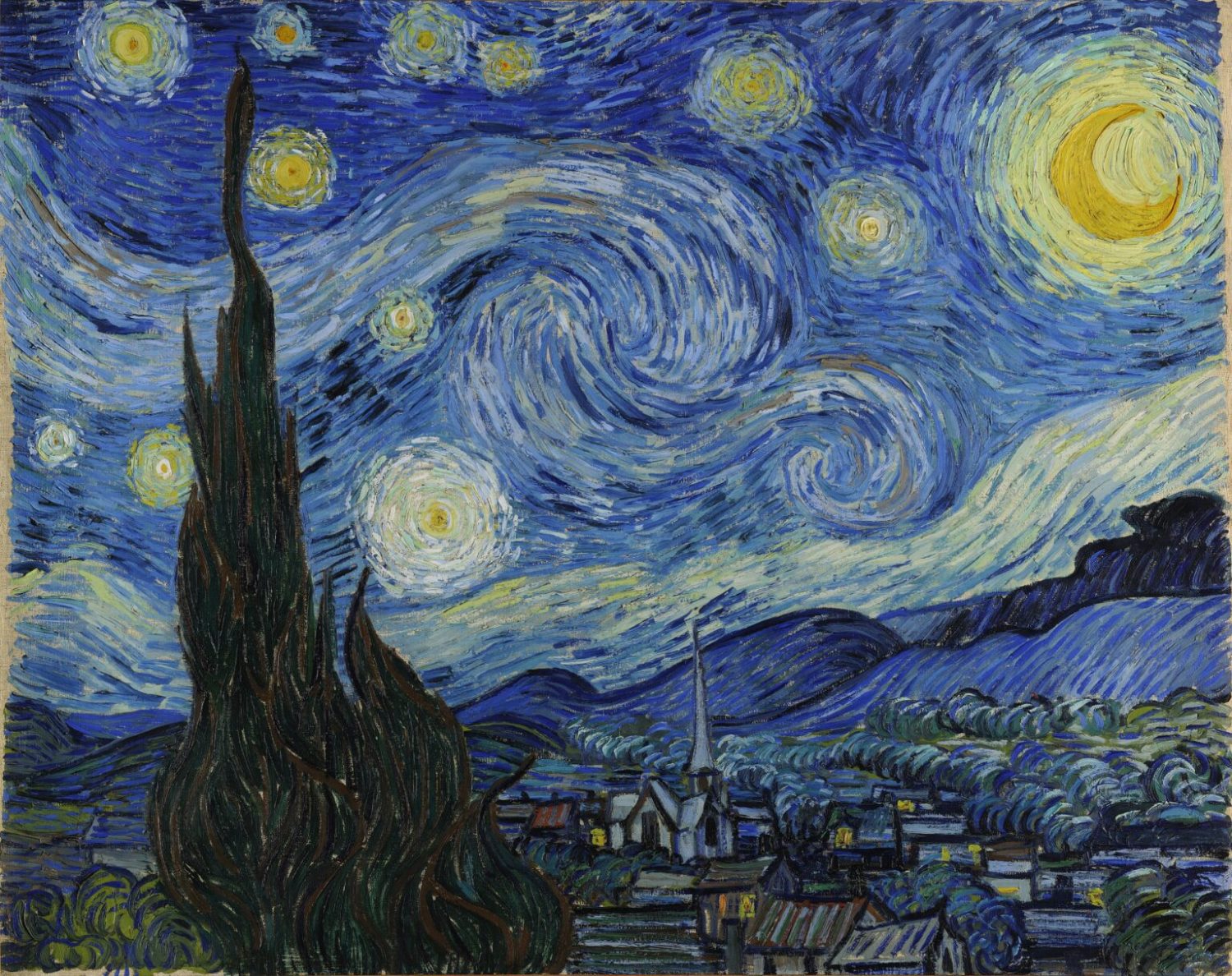
Painted from memory in an asylum, half-invented, dismissed by its own maker as a failure and now one of the most recognised images in the world: the story of The Starry Night is stranger than most people realise.
Where and when it was painted
- He painted it in a psychiatric asylum. Van Gogh admitted himself to the asylum of Saint-Paul-de-Mausole in Saint-Rémy-de-Provence on 8 May 1889, after his breakdowns in Arles. The Starry Night followed a few weeks later.
- The date is June 1889, or perhaps July. MoMA dates it to June 1889. A 2026 study in Scientific Reports matched the sky to the pre-dawn hours of 22 July 1889; the date is still debated (see the painting page).
- It is the view from his bedroom window, painted elsewhere. His bedroom on the upper floor faced east over a walled wheat field towards the Alpilles. He was not allowed to paint in his bedroom, so the canvas was made in the ground-floor room he used as a studio, from memory and drawings.
- The village is largely invented. The wall and field below his window do not appear, and the little town is imagined. Its pointed church spire looks more like a church in the Netherlands than one in Provence.
What is in the sky
- The brightest “star” is probably Venus. In early June 1889 he wrote to Theo that he had watched the countryside from his window long before sunrise, with nothing but the morning star, which looked very big.
- The moon is a crescent wrapped in a halo, painted with the same thick, circular strokes as the stars, so that every light in the sky seems to pulse.
- The swirls match the physics of turbulence. A 2024 study in Physics of Fluids measured the 14 main swirls and found that their sizes and brightness follow the scaling laws of real atmospheric turbulence described by Kolmogorov and Batchelor decades later.
- The cypress links earth and sky. The dark tree on the left, shaped like a flame, is the same tree that fills his other Saint-Rémy paintings; see Van Gogh’s cypresses.
What Van Gogh thought of it
- He considered it a failure. Later in 1889 he told Émile Bernard that he had let himself be carried away into painting stars that were too big, and called the result another failure. He preferred his studies done directly from nature.
- It was not his first starry sky. In September 1888 in Arles he had painted the stars above the Café Terrace at Night and the Starry Night over the Rhône, both painted outdoors at night. See all his night paintings.
- He hardly mentions it in his letters. In June 1889 he mentioned it to Theo only in passing, as a new study of a starry sky, and it was never the subject of the long descriptions he gave to works such as the Sunflowers or the Bedroom.
How it got to New York
- Jo van Gogh-Bonger sold it in 1900. After Theo’s death his widow Jo sold the painting to the French poet Julien Leclercq; it then passed through several collections in France and the Netherlands.
- MoMA acquired it in 1941 from the dealer Paul Rosenberg, paying for it by exchanging works from the Lillie P. Bliss bequest. It has never been sold at auction, and it is not for sale. Plan a visit with our MoMA guide.
- It is 73.7 × 92.1 cm, a standard size for a landscape canvas and smaller than most people expect when they see it in the gallery.
- It inspired a hit song. Don McLean’s 1971 song Vincent, which opens with the painting’s title, did much to make it the most famous Van Gogh in the world. See also Van Gogh on film.
Frequently asked questions
Where is The Starry Night?
In the Museum of Modern Art (MoMA) in New York, which acquired it in 1941. It is usually on view on the fifth floor.
When was The Starry Night painted?
In the summer of 1889 at the asylum in Saint-Rémy-de-Provence. MoMA dates it to June 1889; a 2026 astronomical study suggests the sky matches the early hours of 22 July 1889.
Is the village in The Starry Night real?
Only partly. The hills and the view east from his window are real, but the village was largely invented and its church spire looks Dutch rather than Provençal.
What is the bright star in The Starry Night?
Most likely Venus, the morning star, which Van Gogh described seeing from his window before sunrise in June 1889.
Did Van Gogh like The Starry Night?
Not much. He told Émile Bernard that he had been carried away into painting stars that were too big and called it a failure.
How much is The Starry Night worth?
It has no market value as such, because MoMA will not sell it. For comparison, the most expensive Van Gogh ever sold made $190.4 million in 2026; see our most expensive Van Goghs.
Sources: Museum of Modern Art – The Starry Night; Vincent van Gogh – The Letters (letter 777 to Theo); Ma et al., Hidden turbulence in van Gogh’s The Starry Night, Physics of Fluids 36 (2024); Astronomy – The Starry Night captures the physics of turbulence.